Why Are So Many Businesses Really, Really Bad At Culture? With Drew Jones
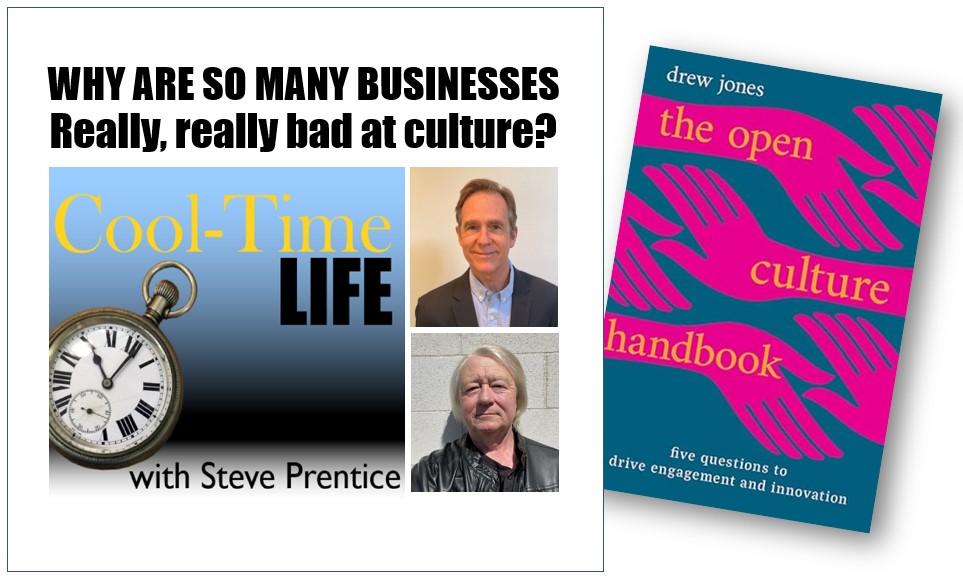
For decades, companies have been spending money on culture and training and have very little to show for it. Why? Because they have been going about it all wrong. They have been ignoring the concept that Drew Jones and others call “the collective brain” which is more organic, a lot easier, and tends to stick a whole lot more easily.
Listen to the podcast at our podcast host, Blubrry.com, or find it on your platform of choice, including iTunes, Spotify, Amazon, Audible, iHeart, and YouTube.
Transcript
Steve
Let’s face it. The reason why workplace comedies and dramas on TV and streaming are So, popular is because they deal with a concept that every viewer can relate to. That the culture in a workplace is more often than not a source of conflict and concern. In real life, some people spend years in school finding a profession or job that they like only to find that the price of that desired work is putting up with an unsupportive culture. And in many cases, it becomes no longer worth it. And that’s why as the expression goes, many people don’t So, much quit their jobs as quit their managers. Today, I’m talking to someone who has the answers as to why this is So, often the case and what we can do about it.
Hello, and welcome to CoolTimeLife, I’m Steve Prentice. Each of our CoolTimeLife podcasts focuses on a topic dealing with people productivity, technology, and work life, and each offers ideas and facts you need to know about to thrive in today’s busy world. An index of our podcast is available at cooltimelife.com.
I’m here today with Drew Jones, Dr. Drew Jones PhD, he is an anthropologist, a former business school professor, a practicing management consultant and founding partner of experience a workplace culture and strategy consultancy. He’s just released a new book entitled The Open Culture Handbook: Five Questions To Drive Engagement And Innovation. And he has some amazing insights into culture change, organic management and Activity-Based Working. Some really great ideas here wrapped up in an anthropological approach to work. So, Drew, welcome to the CoolTimeLife podcast.
Drew
Thank you So, much. Appreciate it – glad to be here.
Steve
I think a lot of people, a lot of the world actually, has noticed an increase in polarization and individualization of people in the workplace. And we’re both old enough to remember times when you know you had a work group, you had a work force, and there was much more of perhaps a sense of cohesiveness or just simply collective destiny. Whereas now we’ve got people who are highly individualized in their expectations and their behaviors. This is largely thought to be brought on by social media and customized channels that everyone chooses for themselves. So, as a start, Drew, what do you see with regards to the overall change in the workplace, and the attitudes and expectations of individual workers in this So, called post pandemic era?
Drew
Well, you’re getting right to the crux of why I wrote the book, to be honest with you, as an anthropologist has been frustrating for many, many years working with companies, teaching cases and quote unquote, culture change. And businesses are just really, really bad at culture. If you look at the data, we’ve had roughly 30% employee engagement for 60 plus years 70% of corporate change programs fail 80 to 90% of mergers and acquisitions fail, often because of poor culture fit. companies spent over $2,000 On average, per year per employee on culture programs. Yet data show that around 70% of participants in those programs don’t believe in the cultural goals of their leaders and 90% don’t behave in ways that align with those cultural aspirations.
So, we’re going about it all wrong. This is the premise of the book. And we’re basically managing people in businesses, against our cultural nature. And our cultural nature is more what you’re suggesting. And that is, culture is what anthropologist Joseph Heinrich in his book, The Secret Of Our Success, refers to as our collective brain. And So, at the core culture is the human capability of observing, learning, sharing, and empathizing with other people in the process of adapting and surviving. So, culture is what separates us from other higher primates. And it’s this collective capacity for innovation. And So, you’re exactly right. And it’s not just in the last 40 years or So, where we’ve gone off the rail when it comes to managing people, that really boils down to in a way the ideology of individualism that predominates in American culture generally, and the way culture changes attempted to be managed. Now, as the company will get a survey, they’ll determine what kind of culture type they have now, as if any organization can be within a typology of five culture types, or whatever. And they’ll set out on a goal of trying to move the needle from the culture they have now to the culture they want. But that just rarely works because the onus of change is put on employees to change their values, beliefs and behaviors to reach whatever goal the CEO has next, when they’ve probably been through three or four of these. That didn’t work previously. So, the cynicism runs really high.
And I see this everywhere I go. There’s another statistic that Paul Zak from Claremont University cites that in his research, only around 40% of employees are fully aware are of the company’s strategy. So, you’re dealing with this intractable situation where people are highly individualized to achieve just their own job security. And year over year, they’re not engaged in really stimulating work. And So, you end up with this mismatch between humans culture, I don’t say human nature, but our cultural nature that we’re cultural animals. And the way we’re managed. So, the challenge is, if you can’t quote unquote, change culture, the way it’s typically tried, what can you do? And that’s really the point of the book and the ideas.
The question I started with this project was, how can you evolve the culture in an organization without ever mentioning the word culture? That is, how do you create conditions where this collective brain process that we’re So, good at, can develop naturally. And it comes down to, you know, designing conditions, and working arrangements that allow people to work more collectively around the goals of innovation, and adaptation for the company? So, yes, I agree, we become more individualized since the pandemic, the upside of that is we’ve been become more connected to our families, right, is the great domestication. So, there has been this split between the work world and home life, which in many respects is healthy? Because, you know, we’ve been So, separated from that for So, long. But you’re right. And So, that really is the challenge, I think, is how do managers get out of the way and allow culture to evolve organically. And that really runs against the specific prescriptions or examples that I cite in the book really run against management orthodoxy. So, this is why it’s such a challenging message. So, I agree with what you’re saying. But I think that our individualized working approach has really been there. From the beginning, though, it’s probably getting more atomized over time.
Steve
We’re seeing the classic dynamic of today’s individuals who want to do things their own way versus managers need to control and oversee. And we’re also seeing an enormous challenge around trust, specifically, how managers cannot seem to trust employees to get their work done. But it does seem also, that certain senior leaders are picking up on the need to address this and Satya Nadella of Microsoft always comes out as one of the highest profile leaders to practice a major culture change, especially comparing him to his two predecessors at Microsoft. So, what do you observe about Nadella his approach?
Drew
I cite him in the book, and I cite him in many other articles that I’ve written that this can this can happen in a public company. A lot of the companies that focus in our private, they do things that shareholders might not really want, but Nadella has managed to do it. And it really does come down to trust and what I call unlocking employees inner innovator, because under the Steve Ballmer regime, it was a product driven, sales driven organization, where each product group was really pitted against each other. And it was a competitive, proprietary sort of fear-based environment, more than anything, what Nadella did was allow and encourage experimentation and innovation, with the promise that you wouldn’t be punished if you failed in some effort, innovation. It really for him was triggered by the book by Carol Dweck called Mindset, where she outlined the difference between a fixed mindset and a growth mindset. And he really has cascaded that through the organization.
And it’s once again become a place where creative software developers want to work, you know, for many years, the talent decamped to Silicon Valley away from Seattle, because Microsoft was sort of at odds with the open source cultural ethos of the software community in the Bay Area. But that’s changed now. And innovation is accepted.
And as I tied into the evolutionary science part of this, you know, humans were wired to solve problems. And collectively, we have enormous power, whether it’s the first hunting spear, the domestication of agriculture, or, you know, antibiotics or airplanes, these were not solo endeavors. This was the output of groups of people syncing up in this collective brain that Joseph Heinrich talks about. So, Nadella has released that So, this is where I say throughout the book is that innovation, or the opportunity to experiment and develop new things, is as much an HR issue, as it is a business growth issue, because this is what makes people thrive, is creating new value, trying new things and learning and growing, that one whole organization can do that. then you have this turnaround, from when Nadella inherited the company in 2015. To today, this is why I say into the second or third most valuable company in the world by market cap. So, really, it’s one of the clearest examples of a financial turnaround. That really began as a cultural turnaround. And it started with his growth mindset, in this acceptance of experimentation and innovation. And So, he really, he’s the poster child, for the model that I’m trying to advocate.
Steve
Often when people talk about leadership versus the workforce, and these kinds of efforts to create a more democratic workforce or whatever, they tend often to forget or ignore a third component, which is or are the shareholders and the board of directors and those personalities who may not actually want to align with this more democratic approach, or they want to do is maximize profit, minimize costs, and anyone who doesn’t align with this gets fired. So, Drew, this sort of triangular relationship here, isn’t there that a triptych almost? Do you observe that when people like Nadella establish themselves as role models for culture change, that there may be other leaders out there who may want to align with this and introduce it to their own companies? And they say, I want to do this here, but I’ve got a bunch of shareholders are investors who say no, just simply drive profits? How would you address that kind of Sword of Damocles that sits over leaders’ heads?
Drew
Again, that’s really one of the motivations behind the book is the 15 companies that I’ve talked about in the book, each one is first, second or third in their industry financially. So, it’s a fallacy, it’s a false choice that we’re asked to make between empowering people on the one hand, versus delivering results to shareholders. On the other hand, this is really the trap that we’re in. The fact is, is that companies that allow self organization allowed decentralized decision making encourage innovation. And I don’t want to say get out of the way, because obviously, in larger organizations, there’s complex management systems, but an approach to managing people that seems like chaos, and people running around doing everything they want, actually drives not only financial results, but accountability.
I’ll give you an example, at Morningstar Tomatoes, the largest processor of tomato products in the country, it’s completely self organizing company, they have no job titles. When you are hired, you find a project team that you want to work with. And when you start, and this is the kind of activating the collective brain dimension to this that is So, important. When you start on a project team, you write with what they call a colleague letter of understanding a clue. And it’s an outline of what value you think you can bring to that team for the coming year. And it’s supposed to be very detailed, but you actually write it to an individual person on the team. So, you can be held accountable. So, what they do is every two months, the recipient of a clue posts, the new hires progress against their own stated objectives and deliverables that they’ve promised for everybody to see.
So, it’s an intensely accountable environment, if you’re not delivering everybody knows it. But at the same time, they have latitude in decision making and how they self organize. So, it’s matching this transparency and trust and self organization with levels of accountability that you rarely see in a traditionally managed company, oftentimes, you know, you’ve got the annual performance review, which we know people can kind of game. But peer to peer accountability is every day, and you cannot hide. And So, this is part of what I’m trying to demonstrate is that there’s a certain way that organizations can innovate and create engaged employees, that leads to stronger financial performance. And it’s, I think, you know, I’ve taught in business school for many years. And I can tell you, from my colleagues, that that’s not what we teach over there business school, we teach predictability we teach, you got to hit your guidance numbers, and it’s shareholder this shareholder that but hopefully, people like Nadella can set an example that then case studies developed over the years and organic way of managing people becomes more a norm than it is now.
Steve
That’s a nice term, “a more organic way of managing people. “My thoughts as you were describing that were perhaps a newer generation of leaders who are just coming up now in their 20s or 30s, who may be better able to embrace this as opposed to those who are in their 50s or 60s who are raised professionally on command and control approaches. So, can we look at Activity-Based Working and why do you think this is such an effective solution, especially for companies who are facing let’s say, the challenge of hybrid work?
Drew
Well, this is one of the things that we do and it’s really something that gets me excited because Activity-Based Working, it’s not new. It began in the mid-90s, initiated by A Dutch consultancy called Veldhoen+Company, which is a fabulous company. What I say in the book is the most important company that you’ve never heard of is relevant.
Activity-Based Working is the idea, again, going back to the 90s, that people should have choice over when and where they work. But there’s a design element in it too. And it starts with this idea that not every employee in an organization necessarily needs a fixed desk or an office, including the CEO. So, the idea of Activity-Based Working is these environments. They’re the most compelling visually, and just initially, when you see one, environments, work environments, you’ll see they’re filled with multiple areas, zones for working, whether it’s a library, a den, a cafe, private offices, hot desks, small meeting rooms, medium meeting rooms, like whatever. So, the idea is that you pick an area, a zone, that matches the activity you’re working on at the time, if you have a client call, you need a quiet room, if you’ve got to block a time, when you want to just work in the open with some folks you can. So, the idea is in an activity based environment, nobody has a fixed office.
And this is where the transformation potential resides, including the CEO. Okay, now the backup, yes, because of the role, the importance of the role of the CEO, they have access to private spaces before anybody else. So, if you have a meeting, or conference, or whatever, they have access to that. But the idea is like a co working environment. In an activity-based office, everybody has a locker, and you plug into an area that matches what you’re working on at the time. One of those places could be at home. So, there’s several things here that are important. One is that senior leadership works in the same way, and is accessible, and CO works essentially with other people.
So, the great example I cite in the book is Macquarie Bank, the investment bank in Australia adopted this in 2009, transformed their whole campus and Activity-Based Working the CEO embraced it. And So, he had certain areas where he liked to work. And he’d come in and sit in the cafe area and just plug in. And all of a sudden he was accessible. He was around, people could sit down and talk with him. And the chief designer there, Anthony Henry talks about he said. What started out as a workplace project became an organizational transformation project because it had this democratizing effect. We had fewer meetings, younger staff could sit down next to senior people and ask them questions. So, we had this casual mentoring that went on. And it was this design, shaping patterns of interaction can have profound effects on culture and people’s working lives without even using the word culture.
And now the other side of it is because you don’t need an office or station per employee, you can reduce your real estate footprint significantly by 30, or 40%. Because on any given day, a certain number of people are at home. So, the idea that if you’re only going to work the office one or two days a week, you don’t need a private space, that’s just the waste of real estate.
And the other aspects of Activity-Based Working that are really quite compelling as they demonstrate employees are more engaged because they have more choice and autonomy, they’re more productive, because they can work sort of at times on activities that work for them, they stay longer. So, employee retention is up. Plus, you can reduce real estate spending by in some cases 30 or 40%. So, you know, if you backup to sort of the balance sheet, real estate, and people are generally the two of the largest cost items for big companies, and So, not only can you amp your engagement levels, you can also reduce your expenses. So, it’s what I think will be the logical next step. For hybrid working, though in our industry, people just obsessed over hybrid, and they’re not even fully aware that Activity-Based Working has been a viable alternative now for 35 years. And the challenge is back to your question about individualized is a VW is enormous in Asia, in Europe and Northern Europe, and Australia. But here, we face a tough uphill battle because not just CEOs with senior leaders and upper management. They just refuse to give up their private offices, because it’s a marker of status. It’s like their parking spot. But that will change. And I think that as the return to Office debate continues and people try to figure out what their quote unquote hybrid strategies are and stuff like that. That Activity-Based Working is the logical landing spot for this whole debate. It just hasn’t been fully accepted the way I think it eventually will, because particularly younger generations will demand it
Steve
It’s interesting and something of a challenge to slot these concepts into much of the existing American culture, which still idolizes the notion of the rugged individual. I’m thinking that discussions around organic management and other forms of collective activity might hold the same minimal appeal as getting a bicycle and cycling around town, like they do in Amsterdam. But you’ve been able to show us through examples like Microsoft and Morningstar, the tomato company here that this can work.
Drew
At the core of cultural evolution, in an ethnological sense, is trust. Paul Sack at Claremont talks about this beautifully in several HBR articles. And that is the human capacity to trust non-kin that people we’re not related to. That is what’s accounted for innovations, technologies, and evolution of human societies. We have propagated a version of human nature, call it Friedman ism, economic man or whatever, which assumes that we come out of the womb as these rugged individuals with no reliance on anybody else. That’s just a myth. That’s the American story. The sad thing is, is that that view of human nature really runs counter to what science knows about human nature. And So, trust is really the cornerstone of all of this is trusting employees, it’s trusting each other. We really don’t trust strangers, never trust a stranger, we have a certain ideological frame here that undermines the potential for the natural company that it’s a natural company really is one that trusts people. Ted Kirkpatrick who used to be at Morningstar says, Trust people to do it work to do things that they do every day at home. And companies that embrace that do better financially.
Costco is another example. Jim Senegal, when he was CEO, he spent 200 plus days a year on the floor interacting with line workers, employees would say, he’d remember details about one of their employees, family members who had been ill previously, and he’d asked about him, he trusted his people, he paid them well, he had empathy for them. So, that’s another example like a Satya Nadella, who creates this natural company environment that wins financially. So, that was the motivation behind the book to try to show the financial potential of this approach to managing people.
Steve
Through this, there’s So, much great stuff to unpack here. And I think IT managers and leaders would do well to make themselves aware of these newer and more community Focused Approaches to management that can actually be profitable. So, Drew Jones, where can people find you and get more information about your expertise?
Drew
Yes. So, the book is The Open Culture Handbook: Five Questions To Drive Engagement And Innovation. And you can find me at drew jones.co, my company’s Experient.work dot work and I’m on LinkedIn. I love to connect with anybody who’s curious about an anthropological approach to managing people.
Steve
I must say it has been a great pleasure talking with you today. So, thank you So, much for joining me today on the CoolTimeLife podcast.
Drew
Thank you So, much, Steve. I really really appreciate it.
Steve
Once again, Drew’s book is the open culture handbook are five questions to drive engagement and innovation and you can find drew at Drew Jones.co That is not.com but.co DREW Dr. E. W. Jones, J. O nes.co. His company is experience that’s ending with a T Experient dot work. And if you have a comment about this podcast, please feel free to drop me a line through the contact form at cool time. life.com a full listing of our past cool time lapse episodes is available there as well. I update the episodes regularly So, that the concepts do not get updated. So, check them out and download whatever feels good. If you feel you are getting value from this series, please leave a review and tell just one more person about us or mention us on social media. And if you want you can support us on Patreon contributions from our listeners allow me and my team to spend more time researching and preparing our podcast series. So, if that feels fair to you, please visit patreon.com/cooltimelife until next time, stay safe and thanks for listening
Thank you for visiting. Do you have comments or thoughts about this episode? Feel free to get in touch through our Contact page.
Tags/Keywords: management, leadership, culture, activity based work, Microsoft, Satya Nadella, Morningstar, Macquarie Bank, open office
 CoolTimeLife