Managing High Performance Distributed Teams
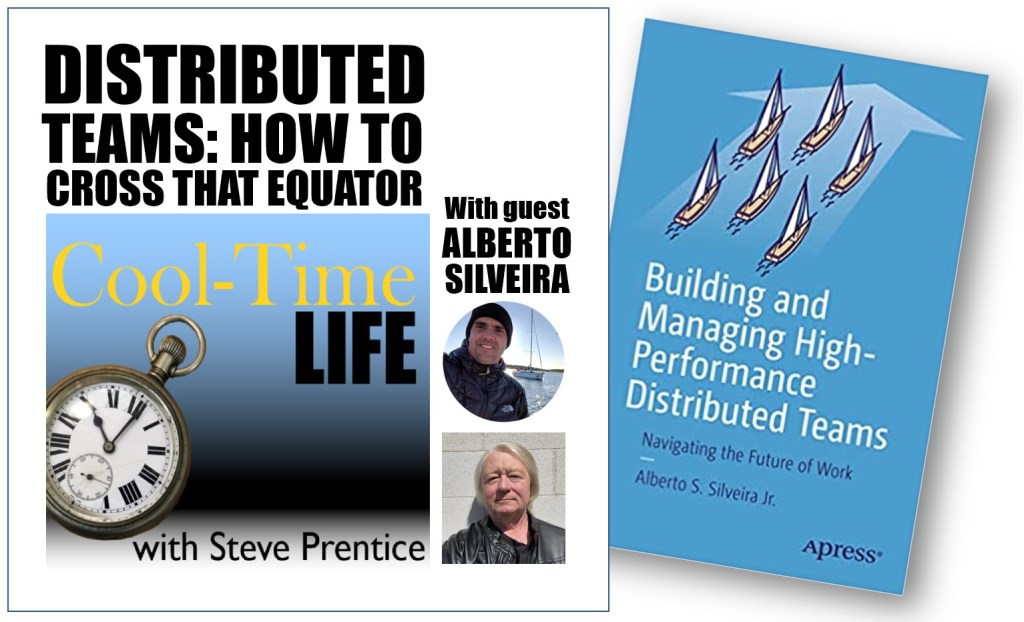
There’s a big difference between “remote work” teams and “distributed teams,” and this has as much to do with workplace innovation as with how the team members interact from their separate locations. Author Alberto Silveira chats with me about his book and his career to date, and he provides timely advice on how to build successful companies by employing people who work somewhere other than the office.
Listen to the podcast at our podcast host, Blubrry.com, or find it on your platform of choice, including iTunes, Spotify, Amazon, Audible, iHeart, and YouTube.
Visit Alberto’s site at CrossingTheEquator.com
Transcript
Steve
Alberto, welcome to the cool Time Life podcast.
Alberto
Hey, Steve. It’s a great pleasure to be here and to be talking with you. It’s always a pleasure. So super happy to be here. Well, fantastic.
Steve
Thank you. This is an exciting time to be in this business talking about how people work, how things are changing. Since we’ve come through two or more years of covid, and now we’re looking to this new normal, as it’s being called. And obviously I can think of no better expert to talk about this. Since you have lived this life, you have done this, and you have written the book about it. And that’s, of course, one of the things I want to talk about today is, is about your book. And I like for example, first of all that the the book has the official title of managing high performance distributed teams, but this is a personal voyage for you as well, and there’s a lot of nautical themes here, including the website crossing the equator.com, so just to start out, how would you describe what the book is about, for those who are just considering what the future of their workplace and their business might be in this New Normal,
Alberto
That’s a very good question, Steve, and many people come to ask me, like, what’s the future is going to look like? So well, the future is what we are leading now, and what the book carries is it’s way prior to the pandemic. So everything that I actually wrote in the book is based on my own experience for the past two decades, building teams, collaborating with teams, and in many different locations. And then, yes, the pandemic came. And then everyone is kind of like trying to figure out, oh my goodness, I don’t have, like, the central office anymore, and how do we collaborate? How we move things forward? And that was for me, to be very honest, Steve, I didn’t realize that the number of people, companies and teams that were not prepared for something like that, for me, like not allowing an employee to be working from a different location, it was some way a Surprise, but that’s why I decided to accelerate the production of the book during the pandemic, with the intent to help managers, executives, and honestly, anyone on the boat. As I make several analogies with sailing and boating, which is one of my passions, which we can talk later. But yeah, the book is about building high performance teams, and, yes, distributed teams, because I think that’s the that’s the present and that’s the future, and the only thing that covid did was to accelerate a process that was already happening.
Steve
And this is something that I love, is the fact that you have lived this. You know, some people will just write about this from, let’s say, an armchair perspective, but you have built businesses. You have done this, practicing what you preach in terms of this. But if we go down to first of all, just the basic terminology here, people can use the terms distributed teams and remote teams interchangeably to just refer to those who are not working in the office anymore. So what would you explain to somebody as the main difference between distributed and remote?
Alberto
That’s a very good question, and you’re right, people use the word remote and distribute it from from different perspectives, and many times without understanding the real meaning. And imagine the word prior pandemic. One or two employees would work away from the central office, and then people would actually talk in that meeting room. And then one person would point to the whiteboard or have a side conversation while you had like, that person work from home. That’s actually a typical example of, like, what a remote work actually is. So there is like the center offs, and then you have some of the people working away from that particular location. I’m not saying that remote is better than distributed or vice versa, but what I the way that I like to put it, is that is an evolution many companies had like the work remote for quite some time, and then with the pandemic, what it did was like everyone now is remote, and then when everyone is remote, that actually it’s when people start to collaborate, start to actually share all the information that everyone can see. And that’s when the definition that what distributed actually means. And I emphasize a lot that on the book, because there’s a big difference there. You don’t you don’t want like team members to feel outsiders or to feel left of important, important information, to make decisions, right? So I like to say that when everyone is remote, when we have that mindset, you’ll become distributed. So that’s a key definition, Steve.
Steve
I think I read in the book, you said, when everyone is remote, no one is remote, because everyone’s patching in from somewhere. And there’s a great sense of equality, which I think is marvelous. And we are sort of evolving away from, let’s say, 50 Years of people used to only meeting in meeting rooms and getting used to the fact that this can be done we can interact from any particular. Nuclear distance in anywhere in the world, which vastly expands a company’s hiring potential, right, and an employee’s potential for finding a new job. It doesn’t have to be in the commuting belt anymore. So since the book has come out, you know, we’re building this for years before the pandemic hit, pandemic supercharged everything, and your book came out exactly the right time to talk about this new approach. Have you been observing companies now embracing this? Or has your observation been that people are fighting this? Where are people going with the idea of companies using and hiring employees who are on a distributed system?
Alberto
Parts of this conversation, I think I leave that every day, either like, in Slack groups on the news, or like, like CTO groups that I usually attend, there’s always these questions, so what’s happening? Are you coming back into the office? Are you in the hybrid? Are you like? So I think we all seen some shape or form of it, but I think some companies and some leaders definitely learned pretty quickly that whatever was working before will not necessarily work today or even going forward. People realize the power of flexibility. In fact, I saw a picture in social media another day that was two pie graphs, and then one side was working from home, and then was just like a pie chart, just saying working. And then working from the office was like the coffee break, the social and and all the suspects from like the world, old world, as I like to refer and then I’m actually working replying to that particular imaging, which was very popular, because I think that’s not accurate. I think that this new distributed mode model I have, like, now time to take care a little bit of myself, to take care of, like, the work to actually be picking up, you know, my kid from from the bus station. So I have, like, a much better life quality than before, to the point where we are talking about what companies and what I’m seeing. I seen companies like Google opening offices in cities and in different formats that they were not thinking before. So they can actually having places where people can go. You have companies, you know, like coin days, I think, is lack that are fully distributed. Even the company that I work now lone starter, we are, like, fully distributed as well, meaning we hire the best talent, regardless where they are. But that doesn’t mean that we will not actually having opportunities to meet each other in person and strengthen our human connection and all of that. So I see companies going everywhere. Steve, the question is, which ones will be able to attract and retain the best talent? Because the eight to five, nine to six work mindset. I think that’s what will not come back. I think, like the companies and the leaders that are making the right decisions now, it’s what’s going to make the difference between success and failure as we look to the next couple of years for sure.
Steve
And I’ve seen this as well, with regards to the research I’ve been doing and some of the previous episodes I’ve been working on here on the podcast, just talking about the fact that people, when they work from home, as you said, that pie chart, it can be very easy for them to fall into this complete work. I mean, that there is a there is a motivation for a lot of people to do work, which is kind of flying in the face of what a lot of managers expect. They think that if employees are not being watched currently or watched constantly, they’re not going to want to work. You know, there’s a sort of, like an anti work mentality, is what they believe. So this has led to an issue of trust, with managers saying, Can I trust my people to work? So if you had, if you were sitting across the table from a manager who said, just that, how can I manage people that I can’t see, what guidance would you give that person in terms of how they could embrace this?
Alberto
I think it’s I’m kind of smiling now, because I actually was in the past in the same situation, my boss came, like, I went to the office, and he came to me and say, like, where’s your team? I don’t see anyone here. And I said, Wait a minute, are we did we miss any deliverables? Are we missing anything like, what are we missing here? No, where is everyone? And this was prior to the pandemic, right? So that was maybe three years prior the breakdown. And but in his head was, I need to see people sitting in a chair to believe that they’re actually working. That was actually a unit of performance measurement. Yes. Oh, someone got early in the office and left and left the office late. Oh, my goodness, that person is working above and beyond. No, no. Not necessarily, you know. So I think as any other relationship, trust has to be the foundation. If you don’t trust, there’s no way that that relationship of any kind will be successful. It’s just a matter of time before it fails. So there’s no reason for us to believe that an employer and employee relationship would work without trust. So if we assume that trust, there’s the trust, but there’s that insecurity of knowing if the person is working or not, I think I would say, like people would get surprised if you give the first step ahead and you have the right processes and tools and clarity, passion and ways of measuring like outcomes, the combination of all of that would make that manager or that person that asked that question to feel a little bit more comfortable. Many people we still insecure about this, and I would definitely suggest to find like, what are like, the processes and the Methodist and empowerment and culture that you have in place, because I like to say that you can never underestimate what a motivated team with process and guidelines in Place can actually achieve. It’s a transformation the traditional model of like seeing people to measure outcomes. It’s quite outdated.
Steve
Steve, yes, and it is. I mean, that’s exactly right. It’s coming from 100 years of doing things in one way, in a building, the only way people knew how to do it. And of course, even as you, I’m hearing you describe it here. It comes right back around to your website. You know the notion of crossing the equator, that idea of you are literally crossing over some sort of border from the Old World to the New World, or an old way of doing things to a new way of doing things, and with that indeed, having trust in your crew. I mean, you were saying before about the nautical analogies and your passion for sailing, how a crew needs to have individuals with skills but also the capacity to communicate and to collaborate with the rest of the crew, so that a captain or any sort of senior official can trust their people to do what’s required. So this is why I loved the combination of these things in the book, but yeah, there’s a lot of tools in the book. There’s a lot of workable things there. The rule of three, for example, as you look back on the creation of the book, you know is anything else that, anything that stands out to you as the as the one thing that you like to describe to people is saying, here’s something in my book that you can take and work with right away. I’m really proud of.
Alberto
yes, so I think every chapter brings some something very unique. So that’s a very hard question for me to answer. I think, like the notion that even you know, if you know me for a while, if you work with me, or if you, if you’ve been one of the companies that I was able to help contribute and make it successful is the one team, one heart model. It’s really hard to put a group of people together and share the same vision and make them to move towards to that direction. And I think that’s the challenge for any leader. It’s like, how can you have the best people to join your team, create the environment that they will be feeling comfortable, to give the best version of their selves and then achieve a goal? And you’re right. I use a lot of metaphors with like sailing and racing, because it’s the same concept. But when you are building digital products, everyone has a different opinion. Everyone has a different background, or, like a different culture, different perspective, the one team, one heart, it’s what connects each one of these different perspectives. So the iron triangle, the metrics and how you measure outcomes, the measurement of Team mood, which I talk about the concept of like a repetition, is key opening the net. It’s humans with different opinions and different perspectives. So if you can actually create this environment where people can connect this. I think it’s the heart of the book, and what I believe what forms like a strong team. I hope I answer your question, Steve.
Steve
Oh, absolutely. And you know, the interesting thing about this is, there have been books on management for decades, right? I mean, everyone wants to know how to be a great manager or how to manage things better. So there’s a lot of things people are looking at as to what worked in the past, but the constant here is about humans at the root of all the things that are good in our organization, and they can be the root of the bad things too. I mean, one bad apple, for example, can can really, let’s say, switch a manager off and saying, Well, if I have one employee who really abuses the trust that I gave to my employees, I can’t. Trust any of them. It’s very easy to see where people could could go astray and say, This isn’t going to work. But what is different right now is this is a new era. You know, really, I think we’re going to look back on 2020, as a real major equator. This is a place we leapt over from one to the other, and we’re now into a new era of working, hiring and onboarding. So the notion of interviewing,
Alberto
That’s one of my new passions. It’s about like, how to bring the right people to your team, right? I have a few talks lined up about this topic, and then it’s been a topic that I’ve been living and briefing and studying and researching and then figure out, like, what is the magic, or, if any? Because I want to know, how can we bring the best people, and equally important is, how do we retain the best people? And what I what I’ve been realizing, and actually come up out of this research, is that the workforce today, the qualified workforce, they can choose among so many offers where they’re going to work, what product they’re going to build and in what capacity are they going to contribute. So traditional mindset and traditional companies, they are losing their competitiveness because they cannot hire or retain the great talent back in the day, 20 years ago or 30 years ago, big companies, you know, oh, we have like, Great salaries, great benefits, and they would actually make people to dream About those jobs, whatever worked like at that time. Definitely it is struggling today. So what is the answer? And I think the answer is connecting more and more the passion about each individual, with their customers, with their products. So someone as an example, someone that is not passionate about finance, there’s there’s not enough money that you can pay for a person to work for finance, if that’s not the person special. And the market is pretty competitive. If you’ve been trying to hire engineers of any specialty, from cyber security to back end, front end automation, whatever, especially and on the product team, on design, it’s been quite challenged. So what I say, and what I will start saying my talks, which is going to be like the new series, is going to be around interviewing. The foundation is it’s created an environment where the person that is interviewing and the person that’s interviewed, they have more like a conversation than actually an interview. It has to be both ways. It has to be a fair environment. It’s not like the traditional environment where I ask and you answer and I create an environment that many times is intimidating, or many times, you know, prevents people with different cultures, languages, gender, apply for a job. So you need to create that environment that is welcoming, that people can actually answer questions, but also ask questions. And I think this is like the new change, and this is like, what needs to happen, and I’ve been successfully doing that for some time. And I like to say this word is, Steve, you have companies or like you as an hiring manager, you should be hiring people based on who they really are versus what they can show off in an interview. And if you can actually break that mindset of, like, I have a position, and then the person needs a job, that person, yeah, maybe needs a job. But there’s so many offers, so how can you attract and bring the people that really are passionate about your customer base is a passion about your product, a passion about what you’re doing, and yes, you have to compensate you well, have like, the full package. It needs to be attractive, but that’s what’s going to help you to be doing successful interviews. And most importantly, if all those box check, then you’re going to be able to retain more easily. And then your your retention mechanism will not only be throwing more money on the table because it’s proving and there’s many books that talk about that, and studies money, it’s a temporarily motivation instrument.
Steve
I just have one very brief question just to end this off, because you’ve given us so much already. But what could people do in terms of schooling, you know, for the next generation of kids coming through, preparing for their jobs in high school and college. Is there anything that we could do to make the education frame this mindset better, I mean, or are they already ahead without needing a college to tell them what to do?
Alberto
You know that I’ve been most of my career in education, so it’s probably like a topic for another podcast, the workforce and. The market and the demand. Think about, like, the past 2030, years, how much everything changed around us, especially in technology. You know, every time when I see things from like late 80s or, like, at some point in the 90s, I said, Oh, another day I showed like, a CD and a DVD. To my daughter, she’s seven. She asked, What is this and why is I said, No, there’s like, data and there’s media inside. And she asked, is, like, really? And she looks at the CD, but how and why you have this whole like? I said, Okay, so let’s, let’s go back. And I didn’t realize we were talking about the nine. It’s just feel like yesterday. See how I think we our generation. You know, if you’re like right now, between 30 and 50 and 60, you and beyond, you saw out this, right? I’m actually 40 now, and I’ve seen this transformation. I was part of this transformation. I did get, like a bachelor’s in computer science. I did a master and I went through traditional education. As I look forward, I think education must change. We must have, like a much more of what’s called, like personalized learning. I think if we all agree that every human being is different. That is the foundation to for personalized learning, where each individual will be measured and learn in different times and measured in different ways. I think the concept that everyone in a class needs to learn the same thing, it’s a dated concept, if you ask my personal opinion. And I think education is changing already, before we had to invest hours and a lot of time seeking for data, going to the library and find information. Today, the challenge is like filtering this information and actually finding information and transforming how that data in actionable outcomes. So as I said, Steve, it’d be like a long conversation, but I think my recommendation is, yes, the college, the way that you and I went, it needs to change. It has to change, and it’s been changing back in the day, yes, like having a five years degree and a master, that would be impressive today, especially if you’re talking about technology, you find like little genius, very capable professionals, much earlier, much younger, and very impressive talent. I believe it has to change, and will change and so much opportunity in this field. How this conversation about humanizing more and connecting people and collaboration will become more and more important as the new generation is way more connected digitally than personally. We have to discuss that further. Steve, but that’s like my not two cents, but probably 20 cents on the topic.
Steve
I love that absolutely. And yes, let’s do some more, because there’s so much to talk about here. I’d love to connect once again. If you have the time to share some more wisdom with us, that will be just marvelous. Where can people find you? Where do you want them to go to check out your book and check out everything else that you talk about and that you do? Yes, yes, yes.
Alberto
Well, I’m always open to connect, to talk, to discuss. That’s how I learned. And a lot of my book, a lot of my talks, as I mentioned earlier, is it’s just about like my practical experience. So what I write is based on what I do, and that’s connecting with the community. So I have my website, which is crossing the crater.com, I’m available in LinkedIn if you type my name, Alberto Silvera, as you’re going to see in the description, you’ll find me LinkedIn, you find me in Twitter, you find them in like and all these social media. And feel free, feel free to provide feedback, to give me ideas, to validate some ideas, and I would love that. Thank you very much.
Steve
Well, Alberto, this has been delightful, and I do really look forward to doing it again, because there’s so much to talk about in this quickly changing world. So thank you so much for joining us today on the cool time live podcast. Thank you.
If you have a comment about this podcast, you can drop me a line through the contact form at cooltimelife.com, where you can also find my social media links and a full listing of past episodes. I update all episodes regularly so that they remain a collection of viable and timely concepts. So, check them out and download whatever feels good. If you feel you are getting value from this series, please leave a review, and if you want, you can support us on Patreon. Contributions from our listeners allow me and my team to spend more time researching and preparing our podcast series. If that feels fair to you, please visit patreon.com/cooltimelife. Until next time, stay safe, and thanks for listening.
Thank you for visiting. Do you have comments or thoughts about this episode? Feel free to get in touch through our Contact page.
Tags/Keywords: remote work, distributed work, hybrid work, office, teams, leadership, iron triangle
 CoolTimeLife