Questioning the magazine’s undeniable problems of remote workers
Listen to the podcast at our podcast host, Blubrry.com, or find it on your platform of choice, including iTunes, Spotify, Amazon, Audible, iHeart, and YouTube.
Transcript
In June 2023, FORTUNE magazine published a piece entitled “Bosses are fed up with remote work for four main reasons. Some of them are undeniable.” Well, I’m going to deny them.
Hello and welcome to CoolTimeLife. I’m Steve Prentice. Each of our CoolTimeLife podcasts focuses on a topic dealing with people, productivity, technology, and life, and each offers ideas and facts you need to know about to thrive in today’s busy world. An index of our podcasts is available at steveprentice.com under the podcast link.
The FORTUNE piece is just one of hundreds that come out every week on the topic of hybrid work, and they tend to flip back and forth, pro or con on the subject, often within the same publication, sometimes even on the same day. A publication’s opinion on this topic reminds me of the old joke about consultants – of which I am one – when you ask a consultant, “what time is it?” they will reply, “what time to you want it to be?”
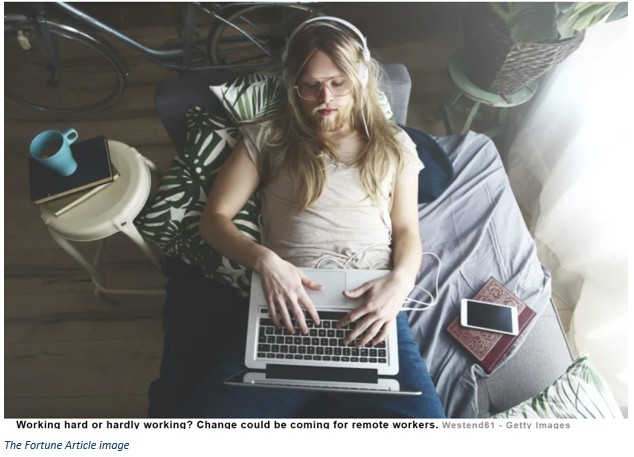
Sometimes, though, a story catches my eye because it goes a little overboard with the hyperbole. With the Fortune article, this started with the photo – the hero image that sits between the headline and the copy and which is intended to do catch your eye, as it did with me. I have included a link to the story in the show notes to this episode, but you can also search for the terms FORTUNE and “Bosses are fed up” and find it that way. The image is a classic stereotype: a stock photo of what looks like a slacker lazing away in bed, noodling on his computer. How can you tell he’s a slacker? Maybe it’s the long hair and the beard? Hmmm. Has anyone with long hair and a beard ever achieved anything?
This image is about as inaccurate as those of cybercrime hackers – you know, those faceless youths in hoodies typing evil code inside a curtain of overlaid green text. It’s not only inaccurate, it’s also quite insulting. Most hackers do not look like kids in hoodies, and most people working remotely don’t do it in bed. Please. It’s time to file these images under “Insulting cultural stereotypes.” I’m sorry, but most people – remote workers and hackers alike, look just like everyone else.
Besides, for the FORTUNE story, the stock photography model in that bed has really nice hair. He obviously has the discipline to care for it well. As much as he could be hiding in bed, avoiding work, as the image mutely suggests, it’s equally possible that he is guiding a unicorn company into the stratosphere from there. Or is that not allowed? Maybe someone should strip Richard Branson of his Necker Island hammock if that’s the case.
Anyone who has ever been to a Starbucks in the last two decades knows that they are often packed with busy, energetic, motivated self-starters who work from home and use coffee shops as their place to meet. People love to work when the conditions are right, even people with long hair and beards. It’s fascinating to watch people who believe in themselves and their companies as they get out there and drum up business as entrepreneurs, or as as they continue to do the work that they provide to their employer. They seem to have no problem getting work done, even though they are far away from a cubicle, and may be working in time slots other than – or maybe exceeding – nine-to-five.
The article suggests that managers believe that people who are at the office eight hours a day will put in a solid eight hours of work. Anyone who believes that should maybe not be in management. These in-office workers get called into over-long, often pointless meetings, they struggle with overloaded email inboxes and constant interruptions from those same managers. All they want is time to be left alone to get their work done, and they never get it. They lose more productivity through distractions and overload than the bar charts included in the FORTUNE article lets on. I have been working with these people for 30 years and those are the top three complaints. Meetings, email, and interruptions. Always. They may not have a bed to sneak back to, but there’s no question: in-office work will “get done” and correspondingly “not get done.” Much of this has to do with the fact that in-office workers can be at their desk and still be virtually asleep. It’s what we call presenteeism. You’re there at the office, but your mind is somewhere else. This happens to everyone and is a direct result of that same burden of overload: emails, meetings and interruptions, paired with the fact that eight hours is longer than a human energy curve, which rises and falls during this period as a result of blood sugar, diet, stress, fatigue, overload, and distraction. Most people feel this around 2:30 in the afternoon, and they struggle through this zone as if they were literally asleep at their desks. This is even worse for meetings held at 2:30.
The worst part of this FORTUNE article for me, though, is the use of the word “remote” and the way it seems to brand such employees as scofflaws who are out of sight of the boss and are therefore free to fulfill the supposed desire of every worker everywhere: to avoid work at all costs. The very assumption that employees once out of sight of their boss will slack off, actually points to a much deeper problem, one where a lack of trust collides with a desire to dominate, and consequently crushes the drive and pride that almost every professional person feels about their ability to do a great job and their desire to be seen doing that great job.
Remote is a bad word, certainly, which is, I think, why it is used so much in the article. The connotation of remote is negative, like being marooned on an island somewhere, or in the Arctic or desert; a place where connection cannot be made. It is a word that says managers cannot watch and interact with their teams, and that team members feel out of touch with the people back at the office. But are those the only two options? Certainly not.
There is a more positive term: distributed, which describes the same people, but in that single word, places the focus on the fact that they have a centre which they are distributed around. This is what these workers are – they are not remote, they are distributed, which means that despite being in different physical locations, they are able to rejoin. This approach allows people to work better, live better, and produce better, not by being shoehorned into an office, but to instead find jobs, roles and schedules that better fit their own lives and passions, and in turn, produce better output for their employers. This is something that woefully ignored by much of the media and corporate culture, since it actually shines a light on the fact this can actually work, and who wants to hear that?
There’s already a raft of applications out there designed to keep a team in a state of constant presence even when they are in their own homes or coffee shops. These applications, like Toucan Spaces and Virbela are designed to be “on” all the time, allowing for a virtual office space to have all team members visually present, where they can be chatted with (or interrupted), where they can have impromptu meetings, where they can enjoy well designed onboarding experiences, and where they can also work undisturbed, all the while “being” in a common place. This is not the Zoom or Teams video-meeting that everyone had to use during the pandemic. It’s an always-on presence, in which meetings only play a small part, as they should in real life.
The problem with articles like this, in my opinion, is that it supposes there are only two ways to exist: in the office or remote, and that all managers want their employees back and that all employees want to just go back to bed. Out of millions and millions of hard-working people, there will always be a few slackers, for sure, but I can guarantee they’re not all home-bound remote employees with nice hair and beards. Many find their way into management as well.
A century ago, when the automobile was made available to the common public, there was an outcry from certain groups that it should be banned on account of the fact that bank robbers could now escape faster than the horse-mounted police could chase them. In fact, every innovation, including the printing press, the bicycle, and the computer, has been greeted with a sound “NO” from those who wish to retain what they have, which is not productivity, but control.
The future of work will not be based on a return to twentieth-century practices that involve a commute to a building that was never designed with human needs in mind. For those whose work primarily involves a computer (as opposed to a fire truck or a farm), the future of work is not based on location at all , but on passion and trust. I would propose that rather than using this article’s “four main reasons” as proof of the failure of the remote model, we use it to ask why these reasons exist, and how “work” and “management” can both evolve to benefit both sides. Evolution is a constant. Resistance is both retrograde and ultimately futile.
To find out more, maybe ask some of those people at Starbucks – if they can fit you in, that is.
Thank you for visiting. Do you have comments or thoughts about this episode? Feel free to get in touch through our Contact page.
Keywords: Starbucks, Fortune, slacker, remote work, work from home, gig economy, slacker, hybrid work, return to office,
 CoolTimeLife