How a “leading phrase” motivates through fear and guilt
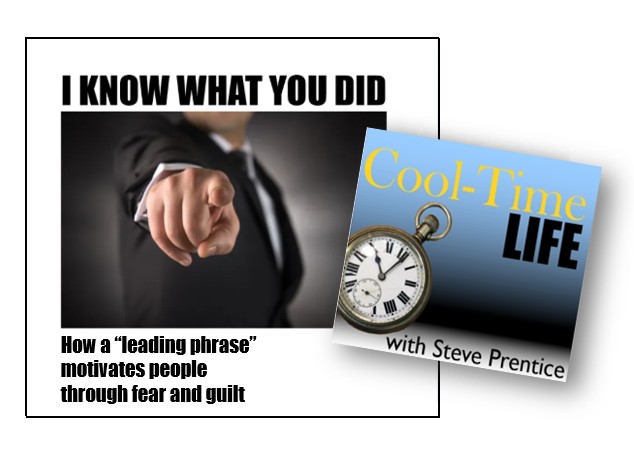
“I know what you did” is a type of leading phrase that cuts right through to your hidden guilt and fear. It gives the accuser enormous power over you, even if they know nothing about what you actually did. It has been used as a source of power throughout history and continues to be so, especially in politics and religion. In this podcast, I take a looks at its enormous influential power.
Listen to the podcast at our podcast host, Blubrry.com, or find it on your platform of choice, including iTunes, Spotify, Amazon, Audible, iHeart, and YouTube.
Transcript
I know what you did. You know what you did. So what are we going to do about it?
If someone said that to you in a menacing way, how would you feel? Where would your mind go? What terrible secret would your subconscious drag to the surface of your memory?
This phrase, “I know what you did,” is enormously powerful, even though most of the time it holds no actual substance at all. People in power, especially political and religious leadership use variations of it all the time.
“I know what you did” is just one example of a phrase that allows a listener to fill in the blanks with their own thoughts and feelings. It’s a leading statement. I can look at you and say, “I know what you did,” without knowing a thing about you. Maybe I’ve not even met you before. But if I say it with enough conviction, you will do the rest of the work for me. Your conscience will fly to something you did – something you are not proud of – and will assume that I somehow found out about it. You might even capitulate, allowing me to extend my dominance further, blackmailing you emotionally without ever learning what your terrible secret actually is.
Humans are terrible with emotion. As I have said in previous podcasts, we are ruled by emotion, not logic, which is why so much that people do is based on faith and not on knowledge. In fact knowledge itself becomes a threat to peoples’ faith, inspiring them to lash out in defence of what their emotion holds dear.
People who feel guilty about something carry a heavy emotional burden. So heavy, in fact that unless they are true sociopaths devoid of the capacity to feel, they are likely to give away their own game. Shakespeare summed it up best in Hamlet, when he writes, “So full of artless jealousy is guilt, It spills itself in fearing to be spilt.”
Guilt forces most people to act differently, to always be watching out for a slip of their own tongue or a glint of recognition from someone else that the jig is up. It’s an uncomfortable way to live. Police who investigate crimes in which more than one person is an accomplice often count on the guilt factor, that one of the accomplices will break, and will come forward to spill the beans.
So back to the initial phrase, “I know what you did.” This is a term of influence. Not a nice form of influence but influence just the same. Robert Cialdini, whose book on influence, The Art of Persuasion, is one of the classics of the business, does not mention guilt as one of the six faces of influence, which is weird, because of how powerful and how ubiquitous it is. I had another look at the six faces on his list:
- Liking? People like to do things for people they like. No, that’s way outside the guilt sphere.
- Reciprocity? Returning a favor or a good deed? Nope.
- Social Proof? Doing things that you see others doing – like fashion trends? No guilt there.
- Commitment and Consistency? Nope. That refers to trusting in people who stick with a style and give you comfort by not changing.
- Scarcity? Order now! Supplies are limited! Nope. That might speak to your sense of urgency and self preservation, but not guilt.
So what about the last one:
- Authority? Deferring to an expert or to someone in a position of authority. That’s probably as close as this list gets, although I would like to suggest that guilt go on there as number seven, since guilt can be generated from within oneself as much as from another.
Nevertheless, guilt and fear exist, and they influence us. Does guilt influence us from a survival and self-preservation standpoint? Do we seek to eliminate an enemy who knows our guilty secret in order to stay alive? Not really. It is likely a proof of a moral conscience – that point of interference between fact and emotion guided by a self developed sense of right and wrong – something that is not uniquely human – other higher-level creatures like elephants, dolphins and dogs appear to share this. But it drives many of our actions and certainly weighs heavy on our soul.
There are many, many examples of this leading phrase – this phrase that allows you to fill in the blanks with your own belief, fear and guilt. It is used a great deal in two areas where power over others is a stock in trade. One is politics and the other is religion (not surprisingly, the two topics that everyone is warned against bringing up at family get-togethers.)
In pre-literate centuries, the primary megaphone for knowledge and social awareness in Europe and the New World was the church, which never missed an opportunity to impose this same guilt-inducing tactic when considering the many sins a person was capable of. They literally wrote the book on it. Virtually every memorable passage in the bible, like turning water into wine, mutated from colloquial to miraculous as people interpreted from that what they wanted to hear.
Now we live in a post-literate age, where most people are able to read, but what they read merely supports their existing beliefs and fears. People who watch FOX news for example, go there because they know the news they hear on this network will match their existing state of mind. They don’t go there to learn facts, they go there to reinforce feelings. The same goes for most other forms of informational media – left leaning or right leaning – socialist, liberal, conservative or alt-right. We now go to the safe haven of a shared mindset rather than pursue independent knowledge through critical thinking.
By the time the more intellectual educated opponents have had their say and have eloquently presented a factual rebuttal, the ears and eyes and soul of the audience have been sewn up tight and have become property of the one who professes to already know what’s inside.
Thank you for visiting. Do you have comments or thoughts about this episode? Feel free to get in touch through our Contact page.
Tags/Keywords: influence, guilt, domination, politics, religion
 CoolTimeLife