…But put me down as a “no.”
Listen to the podcast at our podcast host, Blubrry.com, or find it on your platform of choice, including iTunes, Spotify, Amazon, Audible, iHeart, and YouTube.
Transcript
One of the most valuable parts of a person’s career comes through the opportunity of meeting others through events. Many events will teach you something about your business, but they will also give you an extremely valuable opportunity to meet other people and expand your network. But there has always been a challenge to this: when to schedule them. No matter what time you choose, it’s going to be difficult for most people to say yes. Any time within the traditional hours of the workday, or before, or after, is going to interfere in some way with their lives. This is not just frustrating for the organizer; it means that people will miss out on an event that is guaranteed to change their lives in one way or the other. So, what are we to do?
So how do you do it? I bet every week, maybe even every day you get invites to attend events, whether in person or online, and although you can’t go to all of them, it’s detrimental if you cannot go to any of them, because every meeting or event has the potential to do something good for you. So, what are the options?
My suggestion will always be for people to change the way they define the event. As I wrote in my book on change and fear (The Future of Workplace Fear – available wherever fine books are sold), we interpret every new event or happening that comes towards us through a filter of self-defense. Our instinct is hard-wired to ask, “what will this do to me?” rather than “what will this do for me?” As such, an event intrudes itself upon your status quo – your existing calendar time and on your stasis. It’s easier to avoid the event and stick with the priorities of the moment, which most likely include internal meetings and email.
I propose instead that you redefine the event as a “must attend.” Not every event invitation, of course, but a frequency that can actually fit itself into your schedule if you let it, even superseding the importance of returning emails. It’s important to see these events as “must attend” rather than negative intrusions because of one simple fact: something in that event will change your life somehow. Whether it’s learning about a new technique or process in your industry, or meeting someone you would have otherwise never met, something good will come from that event.
Let me share an example from my own professional life.
I have been in business as a small business owner – that’s all I have ever wanted to be – not a captain of industry, but a specialist – I have been this, and I have been consistently fully employed in this field for thirty years now. Two things come from this, which I feel are vital to anyone, whether a small entrepreneur, a professional in a larger organization, or someone in management with their eyes on that C-Suite position. First is that I have had to evolve my expertise with the times, and the best way to do this is to learn what others know and have access to their expertise through a direct professional relationship. And to reciprocate that action of course. There’s no better place to learn what is going on out there than to go out there – something that many people have forgotten to do or who feel too time constrained to do so.
The second is the power of those relationships themselves. As I said, I have remained very busy with my practice for three decades now, and I have never advertised. I have kept a record – a family tree, a documented lineage of the hundreds of clients that keep me busy over the years, and I can say to you honestly that 90 percent of these clients come from four people that I met at various breakfast networking sessions that I attended in the late 1990s. Their recommendations to a client of theirs led to further business and recommendations from those clients, and so on. The other 10 percent, by the way, comes from media exposure.
The point here is not to boast about my achievements, because there is nothing special in what I have done. It is all simply a matter of recognizing that the time required to go and meet people at an event is more important than taking care of emails or even billable work at that very moment. Taking care of emails or paid work takes care of the present, certainly, but an event helps take care of the future.
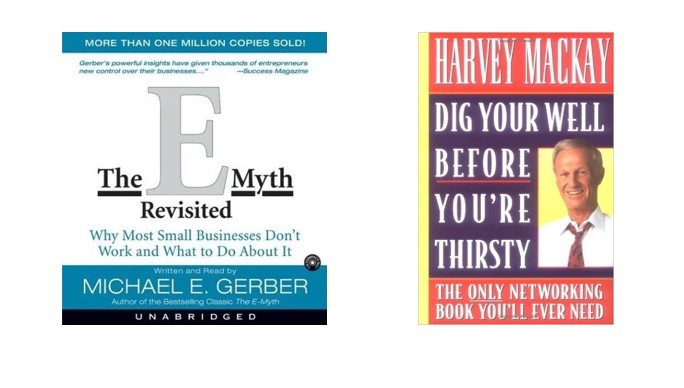
I have met so many managers and hardworking people who remain trapped in a hamster wheel of daily priorities: emails, meetings, self-directed work. Sure, these things are important for doing your job, but my suggestion is that it should never become 100 percent of your job. As Michael Gerber wrote in The E-Myth Revisited, and as Harvey Mackay wrote in Dig Your Well Before You’re Thirsty, spending some per day and week time working on your business or career rather than in it, gives you access to your future.
This is more of an art than a science, of course. No one can predict exactly who you will meet or how it will help, but in my opinion, you can be sure of one thing: it will add something to your life that you did not have before. And that’s what events are for.
In a way you can compare this to traditional advertising or promoting your company on social media. You can never be sure of who will see your message – even the people who try to sell you SEO solutions will admit to that, but the odds are good that something positive will come from it.
So, my primary suggestion would be to attend at least one event per month, whether in person or on-line. The emails can wait just a little bit.
When you schedule an event into your calendar, it becomes visible as blocked off time to those who have access to your calendar, and those who need to talk to you can simply work around that to book time with you at a different juncture.
The conceptual barrier to get over here is that an event is important enough to justify your time. For example, if you had a meeting with a client at 10:00 a.m., or a dental appointment, you would easily enter that into your calendar and expect people to work around it. But somehow, going to an event seems frivolous, not a good use of your time or other peoples’ time. But I’m going to disagree. Attending an event is never a frivolous waste of time. In a way, it’s an appointment with someone or something from your future. Ultimately the choice is yours, of course, but I have et so many people who wonder aloud why their career or business isn’t moving as quickly as they would have liked, and I will always gently suggest it’s because they have spent too much time in the present.
Do I get paid to attend?
But things have changed, there’s no doubt about that. The speed of life and the pressures that we feed are much more intense than they were in the pre-social media age, and there will always be some events that we just can’t get to. I have even heard of people now asking that they be paid for any internal corporate events that they must attend. Think of Friday evening get-togethers, or maybe even a weekend retreat, with workshops, team building exercises, maybe even some golf!
The truth is only a handful of people ever liked those things, and I know that firsthand, because I have spoken at many of them. Lots of people go solely out of pressure to attend and spend the weekend wishing they were back home. Let’s face it, if you work with people five days a week, do you really want to spend the weekend with them as well?
As I have written elsewhere, we have emerged, in the social media era as an audience-of-one. We are no longer a group, an employee base or a customer base. We are far more aware of our individuality, and we expect our shopping experiences, our entertainment experiences, and yes, our workplace career experiences to be individualized. Group entertainment events, especially overnight, are not for everyone and they are starting to make that clear by either declining or asking for compensation.
The Asynchronous event
There is no question that there is no substitute for being together in the same place at the same time, but the conditions for that are changing. Being together in a large room with people you either don’t know or don’t like is stressful. Meetings in stuffy boardrooms are never comfortable. The most comfortable photos that I have ever seen of people is when there are a few of them seated at a restaurant table, enjoying each other’s company for a short while. But even those are not always genuine. You can tell by the shape of their smiles and most directly, their eyes. A natural smile is a beautiful thing. A forced smile is a dead giveaway.
So, what about asynchronous events? I mentioned this first in a previous episode called Upgrading to a One-Week Meeting and I am revisiting it here. What would be wrong with having an event such as a conference – even a speech in which people can attend when it works for them, on an async platform like Slack? Even if there’s a speech involved, this can be attended by those who can attend, and then reviewed later by those who couldn’t – or did not want to – attend, There’s nothing new in that either, except for the improved opportunities to comment and interact through a chat channel, with the additional new benefit of an AI bot doing the work of analyzing the comments, summarizing the great takeaways and generally coordinating the flow. That’s the new element in the equation. Leaving comments is great, but having the messages curated and packaged by an AI bot would allow a flow and a cohesion that is missing from standard comment boxes.
The point is, people neither have the time, nor have the desire to share it in ways they used to. But time now has a new currency. In meetings and conferences alike, it is not necessary for everyone to be at a single point in time and space anymore. They still have the desire to meet, learn and interact, but that desire will remain strengthened when the activity itself fits their needs rather than forcing them to conform.
Thank you for visiting. Do you have comments or thoughts about this episode? Feel free to get in touch through our Contact page.
Keywords: meetings, networking, time management, overload
 CoolTimeLife