Self-Directed Learning as Your Career Insurance Policy
Is AI going to take my job? That’s one of the most common questions people ask about the future of work. But an empowering solution is close to hand. Self-directed learning is your career insurance policy in an era of AI, automation, and constant technological change. Rather than waiting for company-prescribed formal training sessions – which are often overwhelming and inefficient, develop your own consistent learning habits. In this episode, you’ll discover why microlearning (just a few minutes of learning each day) can dramatically improve your ability to retain knowledge, and adapt to change, stay valuable in your current role, and reduce the fear that comes with rapid technological change.
Listen to the podcast at our podcast host, Blubrry.com, or find it on your platform of choice, including iTunes, Spotify, Amazon, Audible, iHeart, and YouTube.
Transcript
As new technologies continue to move into our world, it is natural for all of us to worry about how this will impact or even threaten our jobs and our livelihood. It’s part of our instinct to worry. That’s what helps keep us alive and out of danger, but unfortunately it can also be a key source of justifiable stress. But here’s the thing: you have more control over your destiny than you have been led to believe. You have the power to face an unknown future with confidence, and in this episode I want to show a key source of that power. But to do so we first need to go shopping. Yes, that’s right. Retail therapy is always good.
Those of you who know me know that my primary passion is about people feeling comfortable and confident about their lives. Everything I talk about is intended to help you gain a genuine sense of realistic comfort. Many of us, however, once we land a job, and start receiving a regular paycheck, are kind of forced to trade any sense of independence that we once had for a complete reliance on our employer. How could we not? The first thing most people do once they land that salaried job is to take on obligations that demand we stay in that job. For most people that’s a roof over your head and reliable transport, and oh yes, food.
It feels great to have such items in hand, but this feeling also comes with a nagging awareness that to keep them, you must hold on to this job; and that’s where the fear sets in. I wrote a book about this many years ago called “Is This the Day I Get Fired,” and it expands on this idea in greater detail. But for the moment I just want to share with you one of the best ways you can neutralize that fear and actually feel better about being a working person with actual possessions and obligations.
Here it is: always keep learning.
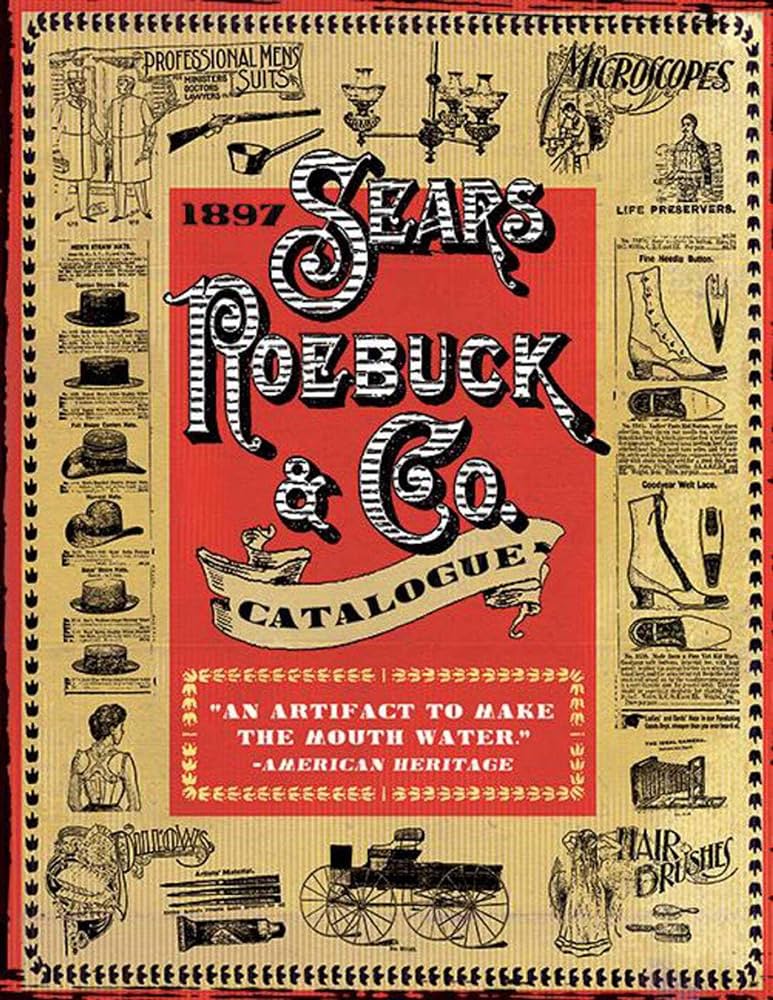
First of all, let’s think about Sears. You may be familiar with Sears as the department store of the 1970s and 80s. If you look back on its founding, however, you’ll see that Richard Sears founded the company back in the late 1800s by having an epiphany, noticing a new technology that appeared that had not been there before, called The Telegraph. The Telegraph allowed messages to be sent at Super speeds, of course, by way of wires. This delivered an idea to Richard Sears. He recognized there were many farmers and others in the Midwest of the US who didn’t have the time or opportunity to go to the cities on the east coast to buy the things they needed. So he sent them a catalog, and he invited customers to order their goods by way of telegraph, which then would be fulfilled and shipped by train back to them. Over 100 years later, Amazon did the same thing in this situation. However, the catalog was replaced by a web page. The telegraph was replaced by the internet. And of course, rather than shipping by train, everyone receives their packages now by a fleet of vans and trucks. Same thing, two people who noticed a new technology, a new opportunity, but didn’t go to school to learn this, they figured it out as they went along. The second thing, however, to notice about Sears is it didn’t last. They were the biggest retailer in America and probably in the world during their peak period, but their model didn’t last and they didn’t change. So in this case, we see two people who saw an opportunity with a new technology and a new way of doing things that didn’t exist before. But this also brings us around to another retail giant, and that is Walmart. Walmart has also grown to become an enormous retailer over the last few decades, and one of the things it perfected was just in time delivery, they were able to receive the goods that they were going to sell, just in time to move them basically from the loading dock almost immediately onto the sales floor, thus reducing the need for large inventories at the back of the store, losing value by the day. So these are two concepts. They’re both about goods and both about retail. But think about what would happen if you replaced the words goods with the words information and knowledge. Let me say the sentences again, the telegraph and in this century, the internet deliver unprecedented access to information and knowledge, the Walmart model of information and knowledge dispensed with the old notion of storing old goods in the back and simply using new goods as they arrive just in time. So even though these retail stories focus on retail operations, goods and products, we can put this clearly into the context of your career today, regardless where you work and what you do.
Let’s start with the biggest elephant in the room right now. AI. It’s all around us as we all know, especially Generative AI, like Copilot and ChatGPT. The question I get the most from people is, “Will AI take my job?” Notice what is not being asked here. Very few people ask me, “how can I learn AI in order to protect my job?” They don’t ask me how to learn, they ask for an answer to their fear and ostensible how to defeat AI from replacing them. If you are worried about AI taking your job, here are the two things you need to do:
1. Learn how AI might be incorporated into your current job
2. Learn how to do those things so that you can get AI to work for you.
Remember, AI cannot work by itself, unsupervised. It needs skilled people to set up the parameters of work – to write intelligent, accurate prompts – and it needs skilled people to assess the outcome to ensure it is correct and appropriate. It also needs people to know how AI can be best used within your organization. You can be that person. You just need to know how to work the tool called AI, and ideally learn more about it than your boss.
Life has always been about learning
Learning is power. You can understand more about the world by learning about history, economics and other major topics. Unfortunately, people are not actually encouraged to do this. As kids we had to go to school. But the standardized education system made it very difficult for people to actually learn. I’m sure you remember classes or subjects that you had an affinity for and did OK, or even did well in the class, and there were likely others that really weren’t your strength and which became a bad experience for you. Standardized education, by its very nature is not the best way for individual students to learn.
It became a disincentive. Boring classes, stressful exams, and a lot of cheating. True, personalized education cannot be supported in the normal school system, and that sad fact not only established a lifelong lack of interest in seemingly complex topics like history and economics, but it also turned students off certain topics because a.) their experience in learning them was unsatisfactory, and b.) the education system to them – and “them” includes you and me – suggested that most topics were irrelevant to the type of job you were likely to get. That’s so wrong. Every area of study contributes a great deal to a person’s mind, not only in its direct information, but also in strengthening the mind to remain inquisitive and aware in other topics as well.
Sadly this culture of disincentivizing education translates to the education system in many workplaces. So before I get fully into how you can revolutionize your self-directed learning plan, let’s look at corporate training sessions and why they too can be counter-productive.
The curse of the PD training session
If you work for a company of a certain size, it is likely you have been sent to “training sessions” or PD (professional development) sessions. These are often multi-hour or full-day events, held either in person in a classroom, or on video chat like Zoom or Microsoft Teams. If the sessions you have attended were more than 1 hour long, they were – and still are – too long and consequently of little use to you or to the company that is paying you to be there. That’s the curse of PD sessions.
The reason for this, first and foremost, is information overload. People are just not able to remember or use most of the concepts they have just experienced. I call it “facts through a firehose.” Think about any set of instructions you have received with a product you have purchased, or the user manual that comes with a car. DO you read it from cover to cover before starting to use it? No. You’re going to go to the section that covers something you need to know about right now, such as “how and where to replace the windshield washer fluid.” There’s no point in learning every single aspect of a car’s operation on day one. You will never remember it. That, by the way is why most products sold come with “Quick Start” guides – in order to get people to focus on just what they need at the moment. Just in time.
Many corporate teaching centers try to apply the full-day-class-teach-as-much-as-you-can method because that’s how it’s always been done. Prior to the internet and social media, there was only one way to teach a group of people some new knowledge, and that was to crowd them into a single room where they could all hear the teacher at the same time.
But also, there is a more pressing motivation for corporate classroom sessions, and that is the economics of professional development. It appears to be less expensive to run one class for 30 people than it is to teach 30 people individually. Once that teaching is done, it’s up to the student to make something of it and if they fail, it becomes their fault. I have always found this to be patently unfair. For not only is a six-hour class way too much information for humans to absorb, different people have different ways of learning. They have different attention spans and different personalities. Not everyone is extrovert enough to want to ask the questions they need to ask. Nor can everyone grasp a teacher’s particular way of teaching. Furthermore, not everyone wants the training at all. They were sent there by the powers that be.
Thus, the student body is condemned to exist on that classic bell curve, the one that has a few people who “get it” occupying the cherished front end of the curve, and everyone else finding some place further back. Education based on this type of economics tends to echo that old expression about buying new windows for your home: the cheapest windows are the most expensive. Basically, because they won’t last.
Father Guido Had it Right

Way back in the early days of Saturday Night Live, in the era of John Belushi and Dan Aykroyd, there was a character called Father Guido Sarducci. He was a chain-smoking, street-savvy Cardinal working directly for the Vatican who made appearances usually on the show’s mock newscast, Weekend Update. One of his best spots was called the Five-Minute University. This was one of the businesses he was setting up to help make money for the church.
The courses he would offer would only be five minutes long. His premise was, at any regular college or university you could take a whole semester of introductory Spanish, and a year later all you’re going to remember is the first thing you heard: ¿Como estas? Moy buen.
So that’s all he will teach you. ¿Como estas? Moy buen. His course cost five dollars and lasted five minutes and he would give you a certificate for basic Spanish.
He also offered a five-minute course in Economics. The entirety of the education was, “you buy something and then you sell it for more.” Five minutes, five bucks, a certificate in Economics.
This bit was way back in the seventies, but he was definitely on to something.
Herman Ebbinhaus knew it too – a century ago
Herman Ebbinghaus knew this a century and a half ago – in 1885 – when he demonstrated his “forgetting curve,” a chart that shows how ineffective human short-term memory is in retaining new information. This is by the way the exact time when Sears was founded, just so you know.
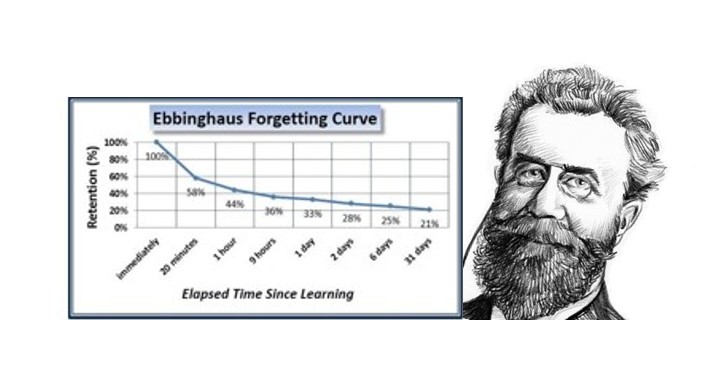
The Ebbinghaus curve chart follows a downward trajectory that represents diminishing retention over time. He put forward that although a person may recall 100% of what is said immediately after hearing it, they will only recall 58% of it 20 minutes later, 44% of it 1 hour later, 33% of it one day later, and 21% of it one month later, unless practice and repetition supports retention. In other words, new knowledge doesn’t stick the first time, and that doesn’t deliver great ROI for the student or in the case of corporate training, for the company. Learning takes awareness, practice, time, and relevance, but most training courses only deliver the first of these.
The Fear of Making Mistakes
There is also the fear people have of making mistakes and being seen to be less than competent in their job. This naturally ties back to the ultimate fear of losing that job. This might sound overly dramatic, but it’s one of the reasons why people don’t change their passwords frequently, or who don’t use multi-factor authentication or other security techniques. They say it’s a hassle, but beneath that generally is the fact that they don’t quite get how to do it, and the teaching of this skill, if there was any, was inadequate. Not only did I write a book on this topic, it is the concept that actually made me start my company 35 years ago.
For most of us, the idea of “making a mistake” comes with a sense of humiliation or fear, largely drawn from experiences in school, when that red “X” on an exam paper made us feel we were less than ideal students. I will always maintain that it’s not the student who is wrong, it’s the way the student was taught that deserved the X.
In high school, courses such as economics, history and science were boring to most students because the system made it so, despite the best efforts of a handful of talented teachers. If you never did well in economics, it doesn’t mean your mind is incapable of understanding economics, it’s that the system could only teach it in one way, which meant only connecting with that small population at the front of this particular bell curve.
Corporate professional development classes perpetuate this problem. Students are brought to a room or a video chat session to learn something new and are next expected to go back and become instant experts in this new technique. But people need time and repetition to practice new skills, and they need to build their knowledge up through experience, and, yes, making mistakes along the way.
A Return to Iterative MicroLearning
So let’s get to the key message of this episode. One of the best ways to ensure your career success is to keep learning. Learn mew things, and equally importantly, learn the things that your organization will need, so that you can be central in the next phase. OR learn the things that are in demand right now in case you want to move on to another job elsewhere, or in case that decision is made for you.
In all of these cases, employers want people who can do something to move the organization forward. It’s never about them “giving you a job” out of compassion or a sense of social responsibility. We have seen way too many times that companies hire people and then remove them once they see a need to cut costs. Nobody can ever guarantee you a job for life regardless whether AI is the issue or something else. It’s up to you to prove your value and make them want you.
One of the best ways to do this is to keep learning, Since AI is the hot topic right now, learn everything you can about what it is, how it works, and how it is most likely to affect your company. Instead of asking “will AI take my job,” why not ask, “will AI affect this company?” The answer is “yes,” and you can gather the skills and knowledge to add, “yes and I know what we can do about it.”
Just keep learning.
You don’t have to wait for the next PD session to come around. Learn on your own time. Listen to podcasts while you commute. Small amounts at a time are actually much better than condensed courses. Think about a full-day PD course. Not counting lunch and two breaks, you are facing four and a half hours of learning time – that is 270 minutes. The negative impact of information overload, paired with the stress you feel in terms of the work and emails you are not able to do, combined with the Ebbingahus forgetting principle means that 240 of those minutes are largely wasted.
If, by contrast, you spend 10 minutes a day for 27 days – basically a month, most of what your learn will be retained, thanks to manageable amounts of learning, paired with repetition and practice. Your future is really up to you.
Ten minutes a day. Take some of that time you currently spend scrolling through Instagram or TikTok or Facebook and use it instead to add something to your personal knowledge base. If there’s a question that you don’t know the answer to, look it up, watch a video on YouTube. If you want to learn more about business in order to move up the ranks, or simply keep the job you have, don’t fret about not having the time or money to get an MBA. Listen to podcasts about business history. You will learn more about business in general by listening to bios of great entrepreneurs, innovators and failures, as well as stories about businesses even if they are not in the same industry as you.
I like to subscribe to two key ideas. You are responsible for making your own luck, and you are responsible for your own education. The two intersect really well. We have been told it’s more important to get that degree, but remember most concepts taught in schools are at least five years old. If you come to the table with an idea or a solution that fits today’s or tomorrow’s marketplace, you immediately become more valuable.
Just keep learning.
If you want a couple of suggestions of entertaining business podcasts, let me recommend The History of Business and Business Wars, both of which deliver a fantastic iterative education in a not-boring style. But this doesn’t have to be about business education. Learn anything about anything and it will add to your value and your career security.
Become the person who has the answers, and opportunity will beat a path to your door. Not just answers about AI of course, that is a big one, but about anything that affects a business, from hybrid work, to the impact of tariffs, to changing customer demands. It could be information directly related to your job, such as “how will agentic AI change the work we do here?” or it could be something more related to the future in general or your next career. Or just knowledge in general. It’s like money – always handy to have some on you.
And that’s exactly what you need: ideas and knowledge of your own.
Just keep learning. And do it in small parts over time.
The term “iterative learning” is basically redundant since all true learning is iterative. Everything we learn in life comes from experience and repetition. Even an infant learning to walk must do so through experience and mistakes, because that’s what learning is. Each successive action patches over the holes in our knowledge, piece by piece until we become fluent in that action.
The ideal approach to learning, then, is to do it in small amounts at a time. Learn one thing, get good at it through immersion and experience and then come back and build on it. This is something every person can do themselves, without waiting for the next corporate PD session to come around.
That’s my key point. If you want to learn more about anything, for example, how AI might affect your job, then go out there and learn it yourself in small amounts. Invest in yourself. The resources are directly in front of you. Is there something that scares you? Job prospects, world events? Go out there and find out what you need to know. Own it, so that the fear doesn’t own you.
Learning about stuff can be enjoyable too. Find the right YouTube video, the right podcast, ask the right questions to your favorite LLM like Copilot or ChatGPT. They will not only find great material, they are also very supportive and positive to your cause. If you don’t know where to start, then start with something you are already interested in and see where it leads. It is no longer necessary to go to a physical classroom or to conform to someone else’s definition of what teaching should be. The best part is, this practice is yours to craft and refine as you want, as if your future. You have the capacity to create your own future and your own luck, and I know you can do it.
Think once again about the story of Sears and Walmart that I used at the beginning of this episode. Richard Sears, and a century later, Amazon founder Jeff Bezos saw the potential of new knowledge to create a new service that in both cases was extremely successful. This comes from a commitment to continuous learning and the benefits that an agile mind – the result of continuous learning – can enjoy in any context, from building a new business, to keeping your current job.
The Walmart example talks about the idea that inventory that languishes on shelves gets dated very quickly. The same thing goes for knowledge. New knowledge is required to keep pace with a workplace environment that is advancing faster than any other time in history.
The choice, of course, is yours. And so, too, is the power over your career. It is yours also.
Just keep learning.
And come back for the next episode where I will talk about the “number one thing to do.” But one thing at a time.
So, start today, and just keep learning.
Thank you for visiting. Do you have comments or thoughts about this episode? Feel free to get in touch through our Contact page.
Keywords: self-directed learning, career development, future of work, AI and jobs, will AI take my job, continuous learning, lifelong learning, career security, upskilling, career resilience, AI in the workplace, future skills
 CoolTimeLife