A conversation with Barbie Brewer
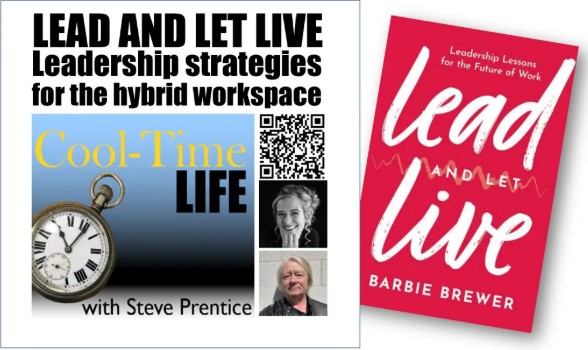
Listen to the podcast at our podcast host, Blubrry.com, or find it on your platform of choice, including iTunes, Spotify, Amazon, Audible, iHeart, and YouTube.
Transcript
Steve
The ideological battle between the hybrid work movement and the return to the office movement continues. There’s a social media world full of opinions and there’s also a great deal at stake. So it’s refreshing to hear from someone who has actually been through this not just once, but twice with two high profile companies in the tech sector. This is someone who has now translated her experiences into a book. And as you will hear, she has a perspective that goes well beyond the normal talking track, and will definitely provide some substantial food for thought on this most significant of issues. Hello, and welcome to Cool Time Life. I’m Steve Prentice. Each of our cool Time Life podcasts focuses on a topic dealing with people productivity, technology and life, and each offers ideas and facts you need to know about to thrive in today’s busy world. An index of our podcast is available at cool time life.com My guest for this episode is Barbie Brewer. She says that although remote work might have initially been a reaction to the COVID 19 pandemic forward thinking companies now recognize its potential to transform the workplace by helping employees achieve a better work life balance and by breaking down boundaries. Further, all businesses benefit from diversity and the remote workplace by eliminating geography and hiring decisions can open an entire world of talent to hiring managers. Barbie worked as the chief culture officer at GitLab and was next vice president of talent for Netflix, when the streaming service expanded from 20 million subscribers to over 150 million. She has a new book out on leadership in this era entitled live and lead lead. She has also asked me to clarify that her first name is actually Barbie and has been so long before this year’s smash hit movie. So Barbie, welcome to the CoolTimeLife podcast.
Barbie
Thank you. It’s great to be here.
Steve
So there’s so much to talk about here in terms of your past as well as your present and future and talking about remote work and hybrid work. You’ve achieved so much already in such high profile organizations, are you doing this as your own self driven organization or as part of another company that you’re working with?
Barbie
Well, I have been passionate about remote work for a very long time. Now really, since Netflix, I left Netflix due to a health crisis that I had. And I ended up you know, being on chemo for a year and but still wanted to practice my craft and work. But when I was at Netflix, I had a very long commute. And I was always in an airplane kind of going to another country as well, which was fun, but not conducive to my new kind of world order that I was in. So when git lab reached out to me and had an opportunity for hiring their first head of HR, in an all remote environment that was exciting to me one because I could still do my job and take care of my health and my family. And two because I would be learning some great new things I had never done all remote before I had done distributed teams, certainly whilst at Cisco or other companies that were highly distributed. But this is my first time having the opportunity to actually work for a company that had no buildings, right and what that means and how that’s different. And that was long before the pandemic, right. So that was long before anyone else got thrown into it. And what I saw was the value that that brought not just to the company, we could expand and grow and and not have to be constrained by the number of offices or conference rooms we had, which was great. We didn’t have to spend a lot of money paying rent and facility fees, which was great. But we also got to tap into amazing talent across the world. And I fundamentally believe that brilliance and excellence are equally distributed across this planet. That opportunity is not and more SaaS companies and software companies. Getting into remote work is huge for lifting up the economies everywhere, not just the economies in the Silicon Valley in New York and Boston or Austin or wherever these hubs are of talent. And so what I found is that some of the best people I had were people I never would have considered in the past. I had an amazing recruiter in Russia, I had another amazing recruiter in Nigeria. Why very probably best HR director I’ve ever worked with before it was not a director at the time it is now because she deserves it was a military spouse. And so she was never able to really build a career because every time her husband got transferred to new base, she had to quit her job and move well with Git lab. She didn’t have to keep quitting her job and moving anymore. She was able to build a successful career and she was amazing. So I really saw the value that it brings to society and I could go on and on. But I also see that you know, when you see research that 93% of CEOs are preparing for a recession for example, when you see those numbers and you think how do they increase the runway for their company? You can absolutely increase runway by reduce reducing costs. Why are you paying rent and and I don’t believe in taking advantage of lower income societies. But I do believe in paying according to market, and the cost of living is a factor. So you can also save money on talent too, even though you might be paying top a market where they are, you might be able to save some money overall for your company. But more importantly, you’ll have more diversity, you’ll be contributing to improving the economies where people are actually from not just where they’re going to. I used to be very involved in university recruiting and university relations. And we would go out to all these colleges and universities and we would find the very best engineering talent and then we would move them to California. And what does that do to those economies when they lose their role models? They lose some of their best and brightest examples in their schools. They take your take your parent to work day, I live in the Silicon Valley. Take your take your parent to school day, in a Silicon Valley, you get a plethora of professions and companies and things. What do you get in Spencer, Iowa? Right and, and maybe you did have that brilliant engineer coming out of Spencer, Iowa, why not let her stay there, right and contribute to the society. I see it just myself when I was commuting between Pleasanton and Los Gatos, here in the Bay Area. I had my hairdresser in Los Gatos. I had my doctor in Los Gatos, my dentists in Los Gatos. I did all those services where Netflix was, instead of where I lived, because it was easier to leave work and do that. I went to the restaurants in downtown Los Gatos, not the restaurants in downtown Pleasanton. Now that I work remotely, I can give business to my community. And I could spend more time in my community, and I can increase the tax revenues for my community, as well as be able to coach my daughter’s soccer team, or do you think that I couldn’t do before, because it would take me two hours to get home? Well, now it doesn’t. Now I’m already home. And it takes me two minutes to get to soccer field. So I can give more to work, but also give more to my family. And it’s huge.
Steve
Two really great things that I’m hearing from you here, first of all, is obviously because of your life situation, this almost forced you to do this, which is not something that is, you know, anybody would want to have to face health issues. But the fact is it it represents that immediate and completely vibrant solution to people whose lifestyles aren’t conducive to the standard nine to five, Monday to Friday commute. And secondly, the fact that you were an executive in two very high profile organizations at least means that you’re speaking from a very high perspective of credibility and experience that when you’re looking at a remote or hybrid workforce, you’re looking at it from the corporate side, not just as an ideal. So it’s very exciting to hear and see how this is successful. And as you said, and this is the tide that raises all boats. So people who can work in Iowa or Nigeria or anywhere else, are able to both contribute to their own personal livelihood, but also to their local economy. These are excellent ideas. But obviously, there has been pushback, and we see it every single day in the mainstream media, how inconceivable this is, and the major pushback from managers is that we’re going to lose spontaneity, creativity, team building, younger employees are not going to have the opportunity to onboard correctly, all this gloom and doom about how they’re not going to be able to enjoy that idealized corporate life. So what do you say to that kind of argument?
Barbie
Well, you know, there’s a lot of people who miss horses and whips now too. And, and that was a hard transition as well. So I do think that those factors are real. And there is definitely a perception that remote work stifles collaboration, and ideation. I would say you’re doing it wrong. The one thing that COVID gave us was a whole new industry of tool sets and things that you can use to collaborate and, and be effective online. When I think about the good old days of being in the office, you know, is it Billy Joel, the good old days weren’t all that good, right? And, and when you think that it’s spontaneity, when you’re in a hallway and make a hallway decision, that’s not spontaneity, that’s exclusion from the people who didn’t happen to be in that hallway with you at that same time. So there’s definitely things that we need to do to improve remote work. The pandemic environment of remote work was the worst possible environment for more remote work that you could have. And for that, for people whose that was their only experience. I don’t blame them for not thinking it’s great for leaders who are used to walking into a building and seeing all their people and the ego that gives them an and how that improves their sense of self worth or seeing their company name on top of that big building. That’s real. That’s that’s real ego feeding stuff. But there can be a different way to feel good about yourself too. Right? And so what is changing things. The management skills it takes to be good at remote work aren’t different from the management skills it takes to be good in an office. But they’re more important. And being a good manager becomes more important. And when you don’t do things, right, the impact is going to be bigger. So when you talk about distributed teams and remote work, you don’t have to be in 60 different countries and all that different timezone. Right. If you are you need to build the async muscles. Syd from GitLab is a great guy to follow on LinkedIn to get great tips on this. I loved working for him and everything he taught me about this. And but you don’t have to be that distributed. Right, you could say we want to be in to timezone only, and we’re going to open it up there, that helps not have to build the async muscle. But communication and collaboration, I get so frustrated on Zoom calls at the company, I work for safe security, love safe security, we’re remote anti hybrid, we have some offices people can go into. But what I do is on a town hall meeting, we do a town hall meeting every Thursday. And we get people on those calls. And the number of people who have their cameras turned off. How many people would go to a meeting in an office building and put a bag over their head. So you didn’t have to see their face? Because they didn’t think they looked good that day. Right? And you won’t do that. So why are why do we think it’s acceptable on Zoom? You know, there’s going to be exceptions, of course, anytime you might be driving during the meeting and things but if you are in front of your computer, and you can be on beyond let people get to know you so much of communication is nonverbal, that doesn’t all have to go away. With remote work, it can still be there. The other thing that doesn’t have to go away is social activity. Now some of that social activity, maybe with your community instead of your company. But that doesn’t bring less company loyalty. Having a working for a company that allows you to be involved in your community can be a draw, it can be something that helps with retention, not hurting it. However, when you had the pandemic, we couldn’t even do social together. Right. One thing we did great at GitLab was we got together every nine months. And it wasn’t to get work done. Because if you wait to get work done until you get in the same room, you have lots of weeks we’re not we’re not getting work done. So it was about getting to know each other. It’s about relationship building, not not not productivity, per se. But that relationship building helped us be more productive the other 12 months of the year, this is only one week, so really is almost once a week. And it was great to be able to do that. And to get together. We also had a travel budget. So if you went to a town for a vacation, and you happen to meet with two or three people from GitLab, that also worked in that town, then we’d give you 100 bucks for each other get lab where you met with to help pay for your plane ticket your hotel. So an increase in encouraged employees to get to know each other when they were traveling around the world as well. And so there’s ways that you can still have social or at work to, then there’s activities you do at work. When you go to a conference room for a meeting in a building. And not everyone’s shown up yet you talk to each other. You tell some jokes. Why don’t we do that online? Why don’t we all stay quiet with our cameras turned off on our mics turned off until the runner of the meeting joins? Why aren’t we talking to each other. I’ve gotten to a point now whether it’s meetings, even if it’s a large meeting that more people need to join, I play music in the background. And we laugh and we rock out you see people nodding their heads and getting down to it right? Like it’s it’s good, and it’s fun. So you still have to take time to make the small talk, you just have to be more deliberate about it, it’s not going to be in front of a water cooler. So if you have one on one with your employees every week, and it’s 30 minutes, make sure five minutes of that at the start or the finish is just about your family and your home and your kids or your life or your friends or your activities. The great thing about remote work is you see people’s lives, you’re in their homes. So you’re gonna hear their dog bark, you’re gonna see their cat walk across their screen, you’re gonna see a little kid interrupt a meeting, you’re gonna, you’re gonna actually we’ve talked for years about bringing your whole self to work, but we’ve never met it right. And now we’re bringing our whole work into our homes. And that’s an opportunity to really get to know people. So my kids have a rule, they interrupt a meeting that I’m in and I’m in it on a video conference call and they’ve stepped foot in my office, they have to come to a camera and wave and say hello, Summit. Some of these CEOs that want everything to be very professional and buttoned up, need to understand that they can loosen up a little bit to embrace this world of work that’s changed and it’s new, but it’s new. And we and one thing as leaders that we have to be great at doing is unlearning. We’ve learned a lot in our careers to get us where we are we need to start unlearning.
Steve
That’s a very good observation because I think there’s a lot of insecurity on the part of managers and leaders who are seeing seeing what they have created in themselves being removed if you have no input For us physically around you, you can’t walk the halls and impose that presence upon them. But I love that idea. And it’s very rare to hear that. So do you still prefer in terms of building relationships with your distributed teams? Do you have a preferred technology that you like to use? I mean, is zoom good enough? Or do you have you found anything else of interest?
Barbie
You know, I actually really like Zoom. I like that it integrates with apps like Hootsuite did it, we just did a Kahoot game with the whole company this morning, where we played music and you had to guess the song. And it was, you know, it was interactive, and good and fun. And they’re constantly coming out with new features. But there’s a lot of great technology out there. I think you’ve got to find that which works for your company. I’m not a big Microsoft user. But you know, I know people who like Microsoft Teams, I know people who like Google meet, but I would say Zoom is my preferred company meeting set for customers, we like to use gone with it too. And you know, there’s, there’s lots of different things out there.
Steve
Yeah, a lot of this hasn’t been made aware of to people. I mean, I have learned, for example, the interest in closed captioning, which, you know, you immediately assume is just for people who are hard of hearing, but there’s a lot of people who just like to read what’s being said. So the recognition that this is a technology that is well beyond just simply turning a camera on and off. The the current approach to leadership and management needs to be unlearned. And the recognition that this actually does engage people. And I always find it intriguing that for decades, companies had team building exercises, you know, you know, weekends out and so forth, to try and build that sense of community. And now you’ve got this, this technology available to do this right away.
Barbie
But maybe it’s just a fear factor, with no location bias, right. Without the you sit next to me. So I interact with you more, yeah, right. This is now there. Now, you can be just as close to me as the person who lives in the same town if if we if we use this technology correctly.
Steve
Okay, so let’s take this one step further. When I have, I’ve been doing a lot of teaching and speaking or using zoom and related technologies like that. And then there’s the next step up, which is sort of the virtual reality ones, whether you have an avatar is something but much more interactive. And do you have you, I mean, I’ve used to kind of use of rubella, which is one that I really love. And I just just, I think this is something that people will get into much more as they experience it. But giving people the chance to learn these, the obligation is on the part of management to say, well, let’s give people a chance to learn the technology more than just simply turn it on, and hope, you know, hope that your cat doesn’t embarrass you. So once again, it seems that the management has sort of let go of the opportunity to teach to give people that chance to learn these these physical skills. I’ve experienced, as I said, when I’m teaching, most people want to communicate with me through the chat window. And this to me is quite surprising. And I always say at the beginning of every class that I teach, I say Please interrupt, you know, if you’ve got something to say, just interrupt right now, because that’s the conversation that we’re looking for as a team together. But still, I’m seeing most people will prefer to just send me a message quietly in the chat window for fear of disturbance. So there’s an obvious need for a cultural shift, again, with the responsibility being, I think, our management to give people the permission to do this. So you’ve seen great success in doing this, you’re seeing the great economic benefits of people who are living in areas outside of a commuting belt and not having to live in Silicon Valley. Do you see this as is there any particular generation that I want to get ageist on what I see here, but people assume that the younger employees are always going to be the ones who embrace this more quickly? Do you agree with that? Are you seeing older employees being more fearful of technology? Or are you seeing anything different as a pleasant surprise?
Barbie
Yeah, interestingly enough, I have seen the you know, I’m in my 40s. And I’ve actually seen some of the more experienced mature folks actually embrace this more. They’re the folks who actually have a life outside of work now, right. And, and, and being able to have that flexibility, mobility brings up is very meaningful in their lives. As you as you get older, some of the young folks, I’ve seen a mix of I want to go into an office and I want to see people, this is the folks that kind of went into the workforce during the pandemic and never got to go into the office. And now that they’re opening back up, they think it’s great, but I also see a huge phenomena. It’s really great the first week, and then the second week, they call up and they say hey, is it okay? If I do two days from home? And then the next month? It’s okay, if I do four days from home the next month is like can I just come in one day a month? So you’re here to you’re gonna see it goes cyclical, and it’s gonna depend right everyone’s different to some people very much like to be in an office activity. There’s always going to still be those jobs. There’s you know, Elon Musk is someone who drives me crazy. I love his cars but when he makes comes out and says his statement that it’s unfair, that some people can work remotely and some people can’t that’s not unfair. Um, rock stars have to work weekends, they still chose to be rock stars, right? That’s part of the job. And not everyone can drive a Tesla car either. But it doesn’t mean he doesn’t make up. So the idea that you can’t give opportunity to some, it improves the lives of the people who can’t work remotely to all those all those car, people working on the assembly lines for Tesla that are stuck in traffic behind all the software engineers have a much shorter drive to work at the software engineers aren’t on the road with them. And the teachers have a shorter drive the nurses, the doctors, the police officers, the fire department, I got stuck on 680, which is a freeway here the other day, it was a weekend, but traffic was dead stop because of an accident. And the poor fire trucks couldn’t get through because no one was willing to move over for them. You know, it’s if you look at the trees during the pandemic, and how green they got and how much more alive the Earth looked when there weren’t as many cars on the road. And now you see it starting to desegregate again, now that you’re getting all the traffic, again, it’s an impact on society, it’s an impact on humans health, and getting more cars off the road helps the cars that have to stay on the road. It’s not a bad thing. It’s good for everyone.
Steve
I think it is. And I think it’s nudging that way, you know, in the sense that people are again, they’re afraid of change, obviously, in the status quo. And it doesn’t mean that everybody has to stay away forever. I mean, coming back to the office, and socially interacting on occasion is a nice thing and highly recommended. But there’s there seems to be this subtle shift, people are recognizing that it can be done. And of course, we’re not just simply talking about anywhere. We’re also talking about any when you have to get the work done. It’s not a matter of asking, Are my employees working so much is the work getting done? So you know, our time together here is whizzing by incredibly, just have two questions, obviously, I want to ask about your book. So you can you can tell us about the book and everything else that you’re doing that you want to promote. But before we do that, I just want to talk about trust. Because one of the key issues that managers have when it comes to letting go of the brick and mortar Kingdom or royalty that they enjoy is can I trust my employees to work? I find this surprising statements. But this is something that they a lot of them don’t know that they can trust their employees to get the work done. What message would you have for both managers and for employees themselves about this enormous divide?
Barbie
You know, it’s an interesting question to me I trust because I don’t want to work in a building with people I don’t trust either. I have to walk to the parking garage at night. I don’t want people I can’t trust in that parking garage with me. When it comes to trusting getting the work done. How is that really different than when people were in the building? Did you assume they were getting work done because you saw them sitting at their computer. Because that’s that seems Yeah, that’s that’s a very Miss Mason leading indicator. These all someone sitting in a desk that you thought they were working. So I think it really is about managing the results and the output more than you’re managing the where you see them sitting at this moment. Now with that being said, there are situations in which you absolutely need some core overlap working hours, right, because you do need to collaborate live together, you do have to get things done, I understand those scenarios and situations. And you should just know what they are and make sure you manage around that. But to assume that you see someone so you know they’re working might be true on an assembly line, because they’re there and you see them putting things together, it is not true for anyone sitting in front of my computer. So you have to learn how to manage performance differently. And really the way you should have been managing it all along.
Steve
When I started my company in the early 90s, I was doing a lot of software training and time management. So really, basically on the floor productivity stuff. And one of the most common questions I ever I always got from people wherever I went, was how do you switch your screen back? Like if I’m doing something and the boss walks by how can I quickly switch my screen back so my boss thinks I’m doing my work. So you know, for all those bosses who are waxing nostalgic about the fact that people only do work when they’re in the office, if they are truly that ignorant of the numerous ways you can get away from work, even meetings, just simply attending meetings, with no intention of doing anything. It’s vacationing from your work, the number of ways you can you can get off doing work in the workplace is you know, incredible and any any manager who is not aware of that has to learn this. So I agree with you I think that a trust is is the thing that’s going to hold relationships together in the corporate world as it would be in the human world as well.
Barbie
Yeah, and employees need to be clear right you need to clearly put on whatever systems you use if you slack say your if you’re away say you’re away. Otherwise people are gonna not trust you right they slack your you don’t reply for three hours what happened to Barbie? Right? Say you’re away if you’re away, don’t hide it. Be be very communicative. You need to over communicate in remote environments. So make sure you do that. Make sure you set expectations clearly make your availability clear so that people don’t think you’re trying to bamboozle them.
Steve
Absolutely. So I mean, it goes both ways. It’s establishing relations. Chip. Well, what I’ve really enjoyed about listening to you is the wonderful way you can see things from the other side. And you know, even simply about, you know, I want to trust people where I’m working, it just sort of flips the argument around from Can I trust my employees. So you’re obviously an amazing person to learn from. And I want people to know where you are, what you do, and how they can learn more about you. So let’s just talk about your book lead and lead live and what you want people to know about it or anything else your speaking or your consulting work. What else can we learn from you?
Barbie
Yeah, so lead in that live is really written to help inspire everyone to be the very best really leader they can be. And I don’t believe that comes with title, I think we’re all leader in some way. And, and, and understand that we serve at the pleasure of our employees, right. And we’re only as good as what they turn out for the company and what we can accomplish with them, not in spite of them, or not. ahead of them, we walk with them. And so the book is really meant to inspire great leadership and to inspire people that are future leaders to want to be better than the current months. Right. So it’s a little bit of trying to inspire current leaders to be their best selves, but also inspire future leaders to be, you know, better than those who came before them be better than me. Right.
Steve
Fantastic. Yep. That’s servant leadership. That is wonderful. So we have the book, assuming it’s available everywhere, like Amazon and everything else.
Barbie
Yep, you can get on Amazon. You can find it at Barbie jane.com. And, and I’ve, I’ve, I go to middle schools and talk about it and middle school kids are reading it. Oh, CEOs are reading it. So it’s, it’s It runs the gamut.
Steve
You’ve really covered some amazing topics here, especially again, as I said, from looking at things from the other side. And also, as I said at the beginning, looking at this from the corporate side as someone who has been an executive in high profile companies and can see what people are feeling in those organizations too. So Barbie, thank you very much for joining me here today on the cool Time Life podcast.
Barbie
Thank you very much and I hope your weather gets better. We need some of the rain here though.
Steve
Once again, the book is Lead and Let Live from my guest today a Barbie Brewer. It’s available on Amazon and everywhere else of course, and her website is Barbie jane.co. That’s B A R B I E J A N E.co. If you have a comment about this podcast, feel free to drop me a line through the contact form at cooltimelife.com. A full listing of all of our episodes is available there as well. I update these episodes regularly so that the concepts do not get dated. So check them out and download whatever feels good. If you are active on LinkedIn, consider subscribing to my newsletter called direct direct. And if you feel you are getting value from this series, please do leave a review and if you want you can support us on Patreon contributions from our listeners allow me and my team to spend more time researching and preparing our podcast series. So if that feels fair to you, please visit patreon.com/cooltimelife. Until next time, stay safe. And thanks for listening.
Thank you for visiting. Do you have comments or thoughts about this episode? Feel free to get in touch through our Contact page.
Keywords: work from home, leadership, Silicon Valley, hybrid work, Barbie Brewer
 CoolTimeLife