A conversation with Sean Lemson
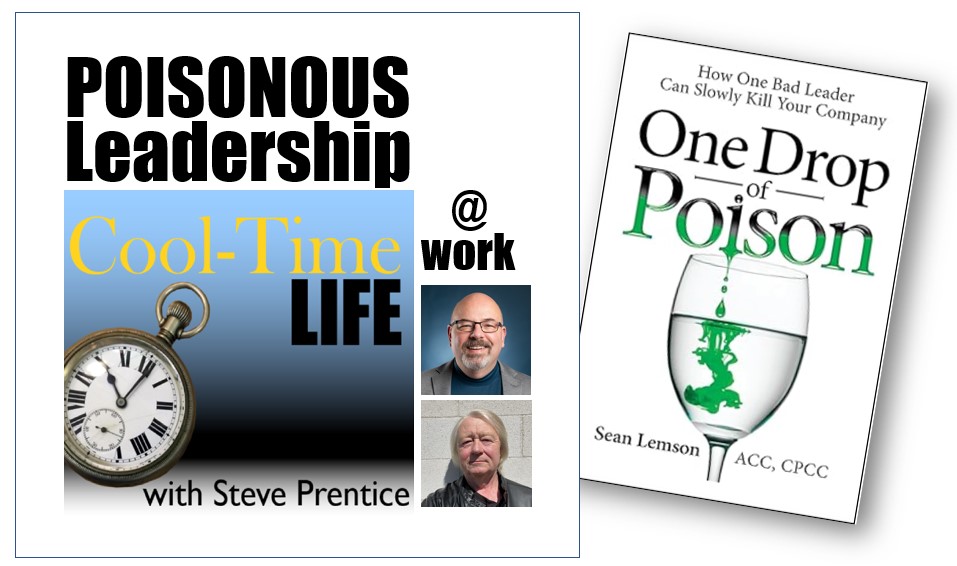
Much has been written about great leaders, but what happens when a leader starts to poison the well? Some leaders simply do not have the right people skills, some are only in it for themselves and others actually see a merit in appearing as a saint while ruling through fear and oppression behind closed doors. It only takes one person with one drop of poison to cause enormous and lasting damage to an organization. My guest, Sean Lemson, is an expert in spotting and fixing the poisonous leader problem. Check out his wisdom in this conversation. You can also buy his book and learn more about his practice at his website, Motivated Outcomes.
Listen to the podcast at our podcast host, Blubrry.com, or find it on your platform of choice, including iTunes, Spotify, Amazon, Audible, iHeart, and YouTube.
Transcript
Steve
There are many different kinds of people in any given workplace, and we try to get along with each other, in the interest of getting things done and keeping the work flowing. But sometimes relationships don’t work out, and the resulting clash of personalities can lead to toxicity. Managers and leaders, whose job it is to help the rest of the team move the ball forward, are not immune to this problem, but the bigger problem with that is, poisonous leaders take a toll on the workforce, and consequently on the bottom line. The gradual deterioration of a company is a sure sign of toxic leadership, as are disengaged employees. The key is to identify and fix the problem before it’s too late.
Hello and welcome to CoolTimeLife. I’m Steve Prentice. Each of our CoolTimeLife podcasts focuses on a topic dealing with people, productivity, technology, and worklife, and each offers ideas and facts you need to know about to thrive in today’s busy world. An index of our podcasts is available at cooltimelife.com.
Today I get to sit down with Sean Lemson, author of the book, One Drop of Poison: How One Bad Leader Can Slowly Kill Your Company. An intriguing title from someone who has walked a long and detailed path to get to the point where he can advise people on this troubling topic. So let’s get right into it: Sean, welcome to the CoolTimeLife podcast.
Sean
Yeah, thanks for having me. I appreciate it.
Steve 0:40
You’re dealing with a really interesting topic, here, one that can be a big elephant in the room. Most people don’t like to talk about the bad stuff that’s going on. But before we get into some of key issues surrounding poisonous leaders, how did you come to this place in space and time? What brought you here?
Sean
Yeah, well, you know, I’m in my early 50s. So I’ve probably changed my career four times in my life, and evolved from it work in the beginning, when I started my career, and then I became a database developer for a while. And I was really attracted to the Agile principles, I started looking at not just the Agile Manifesto, because that’s just four things. But the principles actually spoke to me in a deeper way, because I kind of always had a hobby of human psychology. And when I read the Agile principles, I can almost feel the pain, you know, of the people who wrote them, they’re just like, please don’t treat us badly anymore. You know, I was really attracted to that. And so I started, I did a switch in my career and became a scrum master and then worked my way up through the world to become an Agile coach. And my I think my journey is a little bit different here, it’s kind of worth calling out that I was going to abandon the whole thing. And I was going to become an executive coach. And I had gone through all of the training, and I mean, several 1000 hours of training, certification, long retreats, you know, six months leadership programs. And, and during that process, I realized why I don’t have to trade this is actually an Agile coach with these skills would actually be very valuable. So I started to practice a new kind of agile coaching, where I would not go in and talk about the process. As much as I would talk about the, the psychology on the team, I just have a core belief that if I could get the team to like each other, as human beings, like the work they’re doing, that the Agile stuff would just kind of work itself out. And that’s pretty much my experience. So what led me to the book was, I’ve been doing that work for almost a decade. And I cannot tell you the number of times that I took some of the worst teams at companies that I work with, and turn them around, they used to call me the team whisperer, they could drop me on a team that that had, like, nope, people wanted to quit, nobody wanted to be there, the work was terrible, they had quality issues. And I could turn it around, if you gave me a couple of months, I could turn it around. And I did that over and over again, I’d even gone on to teams where I was the third coach to go, and the previous two coaches before me had not been able to do it, and then I did it. And so it really reaffirmed my belief that this psychology approach was the right approach. But what would happen inevitably, is that I would spend these months working on these teams and make them perfect. And then some senior leader from up above would just come in and blow it up, you know, just, oh, it’s time for a reorg. Or we’re going to move these people over here to this team, or, and it got so frustrating for me, I would say, you know, why am I spending all this time on these teams, when the leaders, if they don’t align with the same belief that I have about psychology, when they’re just gonna blow it up, they’re gonna do the wrong thing. And that happened over and over again, to the point that to me, and also as a coach to the teams I was working with. So I decided enough was enough. And I have read, I don’t know how many leadership books as I’m imagining you have as well. There are 1000s of them. And they’ve been saying a lot of the same things since the 50s. So I decided that what was missing was someone need to tell leaders what they needed to hear, not what they wanted to hear. And so my book is written a little bit differently. It’s written from the side of, hey, you might be a good person, but you’re doing the wrong thing at your company. And it’s costing your company a lot of money.
Steve 4:48
So you have as the team whisperer, this capacity now to get through to people very clearly, and you’re seeing something that the team members either cannot see, or do not want to admit they can see.At the risk of asking a questions with a potentially obvious answer, why does poisonous leadership matter in this day and age?
Sean 5:52
Well, I think it matters for people to understand it in these terms, because they’re not thinking about it in these terms today. The one of the reasons why this is so insidious, is that the some of the worst leaders that companies are actually look like they’re delivering results, right? Like their teams are delivering the outcomes, they are achieving the targets, whatever those targets are for their goal for their organizations. So from on high, it looks like these are great leaders. But that metric of measuring Leadership isn’t healthy here. It’s not useful. It doesn’t do any good if my teams are reaching their targets, if 30% of them want to quit afterwards, right? And 30% of the other 30, another 30% of them want to quit and stay, which is even worse, you know. So we have this disengagement problem we have we have the quiet quitting thing I know you’ve mentioned several times, which is, you know, quiet, quitting is just doing the job you were hired to do and nothing more. But employee, you know, companies continually ask me, Hey, help us get our teams to be higher performing, you know, and then I get in and find out well, you have all this subtle, toxic behavior going on at your leadership team, I’m not going to be able to get human beings to perform better if we don’t address that.
Steve
The only thing worse than someone who quits is someone who wants to quit but doesn’t. That’s a pretty weighty observation. But along with the illusion of teams reaching their targets despite the fact that 30% of them want to leave…behind that is also the concept of the rockstar CEO. There’s always a few of them around, and they appear to be bigger than their companies, to the point that a certain degree of investor confidence can be based on this particular person remaining at the helm. Their larger than life personality almost becomes the company. If they were to leave, you know, what might that do to the actual company itself? And this kind of person might not care so much about spreading a little poison around if it gets things done and impresses the shareholders. But I think its safe to say that most people who work at a job, would like to work at a place where they feel respected and where the work is fulfilling. So if let’s say you have a leader who is exhibiting these poisonous behaviors, maybe emulating the rockstars that they admire, and who may not be aware of the damage they are causing, what do you do?
Sean
I often ask a trick question when I’m working with leaders, and I’ll ask them, “what do you think? What is the one thing that all successful leaders have? And they’ll give me the typical answers, you know, courage, aspiration, you know, hard, hard work, whatever, they give me all the Hollywood answers. But the real answer is followers. Leaders have followers, okay. The followers are people who are willfully willingly following you not because they have to, not because they’re getting a check to do that, but because they want to, and when I see, that’s how I know that so I’m staring at a good leader. I’m staring at a good leader when I see people who would do anything for that leader, right? They don’t need to go in and move the cheese every five, five minutes to the next corner. They want all their team members to go. They just tell the teams what they want the outcome they Want and their teams go go go, you know, and they do that because they want to not because they’re being told to. So I mean, a toxic, I would just say that toxic leaders often are good people. These are not I just want to be clear here, we’re not talking about evil people. There are there’s a small subset, you could argue, I think, at the numbers around 8%, were of senior executives that are considered to be sociopathic, which they’re just incapable of empathy at all. It does certainly the current, you know, corporate incentives do seem to maximize the benefit of having no empathy. But that certainly isn’t going to get you followers. So I think most people who are toxic leaders are toxic leaders, without by accident, they don’t really what they’re doing the best they can with what they know, they they have incentives of their own, the company has a culture that’s driving them to behave a certain way they get rewarded for certain kinds of behavior. And then they learn that this toxic behavior is that well, first of all, they don’t think of it as toxic behavior in the first place. They think of it as I’m just doing my job. And I’m a great leader, because I always check the box. And my leader likes me. That’s not necessarily, you know, so that the point of my book is, hey, you could be a great person doing all the things you think are right, and still be toxic to your teams at a very psychological level and not realize that you’re doing that.
Steve
Good point. So its may be a situation of blind poisonous leadership. So how would we approach that? How could I go and tell this individual that they’re poisoning the well?
Sean 11:45
Well, so you know, first of all, there’s two ways, right? One one you need to be, hopefully, your company is gathering engagement information more often than annually. And that you have at least enough psychological safety or there’s enough anonymity in that process that you can talk about your engagement at the company. So as an employee, that’s how you can make yourself heard. But it’s really more for the leader to spot the toxic behaviors that that that they’re having. I mean, we probably should talk about the leadership mindset here. Because I know those things come up, that word comes up a lot, but I have a very specific definition of what makes up a leadership mindset. It is values, principles, and beliefs, right? All three of them. Values are I value this over that, you know, I value peace and quiet over loud environments, I value. Some people say I value loyalty, which is, you know, that’s already I start to perk up when I hear that. And then their beliefs and beliefs are things like, you know, there’s never a cop around when you need one or you know, whatever story you tell yourself. People work better under a deadline. You know, whatever these little catchphrases we have about how we define our belief structure. We can’t prove it, but we believe it. And then principles are kind of the commandment version of both of those together, like I never tell a lie, right? Or I always tell the truth is more of a principle, a way of thinking about your values and beliefs. Well, we’re all we’re operating with a mindset about leadership. We all have values, principles and beliefs that make up who we show up as, as a leader, we’ve either had a demonstrated by our parents, we’ve had leaders in our lives who have shown us the right way, and we’ve seen it work. And what I see these leaders doing is they have a kind of a messed up value system for leadership, that corporate America and many companies is driving into them. You know, the to not value to think of human beings as euphemisms, you know, human resources, human capital, my favorite one ever. Yeah. You know, that one, it just makes it sort of makes it easier for me to go well, 10, less of you will save me this much money without thinking yes, those are 10 people whose lives you’re now going to up end.
Steve
Yes, it seems to be a sort of a dual exercise then. Or is the onus more than just on the individual to do self analysis? I’ll just give you a modern case study. One of the components of being a leader in the age of AI – an augmented leader, as it is called – is where leaders can use tools like sentiment analysis of conversations that occur during meetings or one-on-ones. The AI tool will work through the audio or the text transcript of a conversation and derive a sense of the emotional state of individuals or of the team. So there seem to be some interesting opportunities to use AI to help leaders do what they don’t have the awareness to do on their own – to sit down and actively listen to their people. Would you say that in this AI driven era, that the onus is now even more on leaders, regardless of how they perceive themselves to be, to do a regular self-check, a regular feedback opportunity to ensure that they’re not drifting into poisonous territory?
Sean
Yeah, I would actually go one step further. So yes, I would say that it’s up to leaders to do this self check. And for me, that self check comes by, you know, I guess you could say that engagement scores are like the equivalent of looking over your shoulder to see if you actually have followers. Right. So you know, that’s, that’s one thing that I would do if I were a leader is I’d continually be checking. But I would go one step further and say that companies need to make sure they instill that all the way down, because I’ve had plenty of leaders who if they had had a leader who didn’t reward the behavior. So just an example, in my book, I talk about these 10 archetypes of toxic leadership. And one of them is the peacock. And these are people who, you know, when they’re with their leaders, they spread their wings, there’s they spread their feathers, and talk about how great they are, and how great their teams are. But when they get to their teams, all they do is peck at them. And, you know, they’re just, they’re all upward leading upward, pushing upward, trying to show good optics upward. That kind of leader would never succeed in a company where their leader didn’t let that work. In other words, if I have, you know, if my if I’m bringing you these great wins, but my engagement scores are terrible for my teams, then my leader should say to me, these wins are great, Shawn. But the problem is, you’re bringing us these wins with two thirds of your team’s not wanting to work here anymore, right. And it costs us a lot of money to recruit and train these people. So actually, all the money to replace the people who are leaving, is costing us more than the winds you’re bringing us. Right? It’s so if I were a leader, it’s really important that these leaders continue to hold their leaders that are underneath them to those standards, and not get lulled into the fact that this leader is below you just brought you this wonderful PowerPoint presentation that seems to have all these wins on it. But oh, by the way, they have no followers. That should be a big problem for you, if you if you have leaders that work for you who don’t have followers.
Steve 17:38
From a historical perspective, are you seeing a shift? Overall, do you see any changes in this decade from the “before times,” before COVID. Are there more Satya Nadellas in the world following his lead in therms of wanting to know and love his followers? Well, actually before you answer that, do you like Nadella’s style? Does he represent the kind of thing that you would want to promote in a toxic organization?
Sean 18:34
I like his style. But he’s an example of the cautionary tale I’m giving, which is that, you know, that style has to be pushed all the way down. Right? Okay. I know, people who have worked at Microsoft for decades, who would tell me there is a lot of dysfunction as you move down the organization. So the farther you get away from him, the more you start to see some of these toxic leadership types. And it takes a vigilant look to make sure, I mean, it’s almost like think of it this way. When I bring on somebody on my below me who has the ability to promote and hire other leaders, right. So in other words, I have a leader, that leader has the right the ability, the maybe even the responsibility to promote and hire other leaders below me. If I’m toxic, if I’m behaving toxically, I’m going to look for people who think, like me, who who think of leadership like I do. And this is one of the reasons why I called the Book One drop of poison how one bad leader can slowly kill your company. Because what happens is that leader brings in other leaders who think just like that leader, and because they don’t think of their behavior as toxic, they don’t realize they’re adding more toxic leaders below them. And before you know, and this is very costly to companies, this is the real point that I want to make in the book is that we’re we’re not measuring this stuff. On our p&l, we’re not measuring, you know, how many innovative employees we have? We’re not measuring what some what I call shower time, right? Do people care about your company enough to think about the problems of your company while they’re in the shower? Right, right? Or are they in the shower thinking, forget this place, man, you know. So it’s just where their heads when you have followers, they want to help you, they want to solve your problems. And it’s a little bit of a leap of faith, when I’m talking to leaders to say, Hey, I know that your urge is to just tell everybody what to do. But just imagine how much more performance you would get from them if you just told them what you wanted. And let them gave them the autonomy to solve the problem. So that’s a bit to your question. I just want to just say that that trickled down I love the way that Microsoft is headed at the top, I just want to I really feel like it’s a vigilant act all the way down, you really have to be vigilant about watching for toxic leaders.
And it’s just that too, it can be tied to sorry, it just one more thing about that it can be a high two incentives at the company as well. So for example, something like the HR group could set up a way with which employees are reviewed. And then that review process could incentivize companies to or sorry, employees to push for behave certain ways to so that they can get a raise. And that can those kinds of little incentives are the things that push leaders to act the wrong way. And, and frankly, can even push employees to act the wrong way. It’s what’s It’s what defines a culture. So, you know, Satya can do all the right things at the top. But if we don’t also address these incentives that come through corporate policy, and how they cause our leaders to behave, which then cause our employees to behave a certain way, you know, we won’t make the change that I think needs to be made.
Steve
My final question is about generational differences, because we know we are always going to have a new generation of leaders coming in working their way through from their 20s into their 30s, and so on. So do you observe any particular changes in attitude, competence, behavior or socialization in the newest generation of young leaders, as compared to t heir predecessors? either better or worse?
Sean
I think, well, here’s the interesting thing, generally, generationally, right, the some of the stuff we’re working off of about what good leadership is, and what motivates human beings, has been known since 1950. Okay, I mean, it Theory X and Theory, y was 1960. Maslow’s Hierarchy of Needs was late 40s. I mean, we could just go on and on, we’ve been saying, we, those of us who, who coach leaders have been using the same material, it since the 70s. We’ve known that money doesn’t incentivize people, for example, in knowledge work anyway. And, you know, so we have all these answers. It’s really weird that we have people who are in Gen X, or boomers who are in leadership positions, who are still clinging to, to the other way, the old, you know, what I would call Theory X. Leadership, when, when we have so much data to say that the other way is better. So that tells me that we have incentives that are working against us and working against them. And I would say that the problem we’re having with the younger leaders that are coming in now, is they aren’t getting the training. I would even say this has happened to older leaders as well, that didn’t get the training, they got rewarded for being good widget makers. Right there. I’m the best widget maker so I get promoted to be in charge of widget makers. And then suddenly, I learned my job is totally different. Right? It’s leading widget makers is very different than making widgets. And I think what happens, we are making them like, here’s a trend I’m seeing right now in corporate America, where we’re trying to take younger leaders, and we’re trying to make them both individual contributors and leaders. So I worked with a company that that just switched the title around, they took in engineering managers, and made them managing engineers. And they did that. You know, they’re like, Oh, well, you’re a great engineer. You know, most of your job, we want to be hands on keyboard, we want you coding. But oh, by the way, you’re also the leader of this team of developer. It’s like, it sounds so fantastic on paper. But number one, you’re not preparing that young leader for actual leadership, right? You’re just you’re not taking it’s a completely different set of skills. So I think that we young leaders just need the training that older leaders didn’t get. We and we need to start. And that’s actually one of the goals of my company is to try to create leadership workshops, where people who are just starting, who kind of want to get the right mindset about leadership before they go into it, they can learn it.
Steve
So for those who want to learn more about toxic leadership, and maybe spot it in their organization or maybe eve in themselves, let’s just revisit the book and also where people can find you online.
Sean
Sure. So the title of the book is One Drop of Poison: How One Bad Leader can Slowly Kill your Company. And I think it’s a different kind of book than other leadership books you’ll read, because I like to say that I’m the coach that will tell you what you need to hear, and not maybe what you want to hear. And, and I like to think it’s a little bit humorous as well, or at least I tried to throw some humor into it. You can find me on LinkedIn primarily. Just look me up, Shawn Lemson and I spell Shawn like Sean Connery, S E A N. And let’s see, and on my company’s Motivated Outcomes.com. And I have a YouTube channel under motivated outcome. So if you go on YouTube, you can search for motivated outcomes. I’ve got some pretty good videos out there about leadership and team performance, and there’s a lot more coming.
Steve
Yeah, I can certainly attest to that. I’ve watched a few already. It’s a great example of modular, iterative learning – something I’m really passionate about. All that remains to be said, Sean is thank you so much for joining me here today on the CoolTimeLife podcast.
Sean
Thanks for having me. I really really had a good time. Thank you.
Close
If you have a comment about this podcast, feel free to drop me a line through the contact form at cooltimelife.com. A full listing of our past CoolTimeLife episodes is available there too. I update the episodes regularly so that the concepts do not get dated. So, check them out and download whatever feels good. If you feel you are getting value from this series, please leave a review, and tell just one person about us, or mention us on social media. And if you want, you can support us on Patreon. Contributions from our listeners allow me and my team to spend more time researching and preparing our podcast series. If that feels fair to you, please visit patreon.com/cooltimelife. Until next time, stay safe, and thanks for listening.
Thank you for visiting. Do you have comments or thoughts about this episode? Feel free to get in touch through our Contact page.
Keywords: leadership, culture, toxic, poisonous
 CoolTimeLife