Is there a problem?
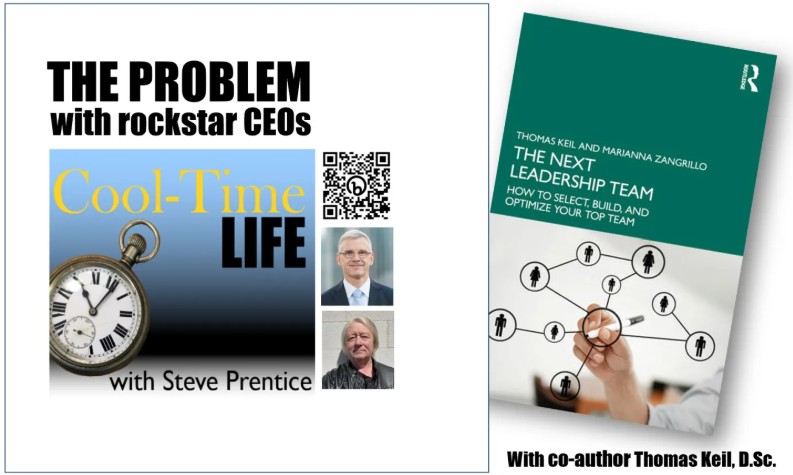
Listen to the podcast at our podcast host, Blubrry.com, or find it on your platform of choice, including iTunes, Spotify, Amazon, Audible, iHeart, and YouTube.
Visit Thomas Keil and his organization here.
Transcript
Steve
Thomas welcome to the cool time life podcast.
Thomas
Thank you Steve it’s a true pleasure to be here.
Steve
We’re here to talk about the fact that you you know you and Mariana have created this book which is focusing on the idea that our obsession with CEO superstars is a big mistake and we’re seeing so many of these kinds of high-profile images. Elon Musk of course takes the the lead at this point but we’ve seen many others with Apple and Microsoft and and all these major names having a superstar CEO as your book describes. You know we are in a social media and culture world where we are obsessed with superstars of all types those that have sort of obvious demonstrations of success and power and we sort of laud them as the heroes. The drivers of innovation and success. But you are here to tell us that this is a mistake; that the the most potent leaders cannot lead or change or run the organizations by themselves. So just to give some background as to your study that that helped create the book with Mariana. Why do you say this and what what did you find when you were doing the research?
Thomas
Well, we really started ten years ago to talk to CEOs in large companies in Europe and North America, and when you really talk also with some of these star CEOs, in private, not the press in the room, they very readily admit that they are maybe the poster child of whatever the company does, but they alone cannot really accomplish any change. In fact, those that I would call the most enlightened are ready to admit that they are putting together a team and if they if things really work well then they’ve done a good job in actually putting together a team that it’s really, team that needs to drive change. They alone cannot move, what is at times twenty or ten thousand people and get them to change what they’re doing. They need many change agents throughout the organization and they need to motivate them. They need to get them to actually implement a vision, to help them to create a vision in the first place and we were really surprised because this doesn’t vibe at all with what we have in the press.
We often see that you know it’s it’s the one person – it’s Elon Musk, it’s that Steve Jobs, it’s the Jamie Diamond that everybody hears about because it’s of course an easy story. This is one person to talk to. It’s a face that you can put on to a magazine, and it makes life as always so much easier if you can find a single course for success. But it’s too simple a story. It’s really not a story that meets with reality, and reality is much more complex than that.
And that’s that’s what we got excited about. That’s what we’ve been studying – leaders in organizations putting together these types of teams that actually can engender change that really can drive something new in an organization and make the organization over time, successful.
Steve
It’s an interesting observation that you make that they themselves admit the fact that they can’t do all of this themselves. So it appears that the bias towards a superstar CEO comes from outside, from the media. We can all learn, however from different types of leaders, good and bad. I mean anybody who’s aspiring to be a leader, who who already is a leader, is looking to see what can we learn from this so question one I guess is, you know when you’re looking at leaders who are currently running their own organizations and looking to these superstars as role models, what can they do to identify their company type and what the best leadership approach might be for their specific company?
Thomas
I think you can see a lot of how companies run when you look at what kind of appointments people make. Are they again putting people in on the first row of the management team that are themselves high profile or are they rather building a team that maybe on the surface, is not as shiny, but it’s really individuals that work together and I think it really has a lot to do with that. There is not a single solution that these people have. This is also something that we found really surprising because this is another obsession in media, that we want to have one single solution that fits all situations, and what we really found is that that’s not working. That’s not what happens in in the real world in the organizations that we are talking. Rather there are very different models that can work; some of them run counter to what we like to hear. Nowadays like to hear we want to have very cooperative leaders. We want to have leaders that engage everybody. We have some really good success stories where you have leaders that truly walk ahead. They call the shots, everybody else follows. Elon Musk in the position at Tesla is an example of that, where he’s been doing this fantastically, but it doesn’t work in every situation, as we can see now at Twitter where the very same approach completely backfires.
But what we really find is that this is very situational and the really good leaders are careful to understand, “what’s my organization about? what’s the situation I’m in? and what kind of a team do I need in this organization and this situation?” So they are actually more flexible in their approach than we often give them credit for. I mean even Elon Musk in the end realized that his approach doesn’t work at Twitter and he stepped back from the CEO position to bring in a different leader that will lead in a different style.
Steve
That is a very good point. He did notice that sort of a mea culpa and said, “okay I’m going to bring somebody else in,” and he’s obviously got huge interest in Wall Street and other places where the investors are. So, do you think that a lot of this is driven by the fear, for example, that a board of directors or a team of investors may have that if a superstar CEO steps down, it’s going to devalue the company, so they want to prop this person up just simply because of of immediate vested interest in in maintaining good good cash flow?
Thomas
Well, we we do see this. I mean just look at Jamie Diamond. I mean, you know it’s very clear that the board is really in fear of him stepping down and that there is nobody else with the same stature behind in the second row. And that’s of course something that also then puts these people even further on the pedestal. It makes it very hard for somebody like Jamie Diamond to step back and and take a back seat because he’s supposed to march in front. So this is very clearly something and boards and investors of course also love to have a single person that they can that they can tap on the shoulder or blame when things aren’t going right. That’s of course again, much easier than if you’re saying, “okay, there is this team. What’s your role in this. This is not working this is working to whom should we talk here?” So this is of course something that both investors and and boards do drive to some extent.
Steve
So as a leader of a company, what would be the three telltale signs that it’s time to rethink or replace executive team members? What can we look for to help us?
Thomas
I think the most obvious is when when the world around you changes, I mean just look at industries like the automotive industry that is fundamentally changing, and as a leader if you see fundamental change in your environment, you cannot run this with the same team. So this is definitely and a situation where it would be very obvious. Also when you’ve been successful for a very long period of time, it’s a bit counterintuitive. But if you want to stay successful over time as a leader in an organization, you need to reinvent the company. You need to reinvent yourself and that often also means that you need to change the team over time. Maybe not necessarily the approach, but you may need to bring in new blood, new ideas, etc. And then last but not least, these senior positions are very very energy consuming and people over time run out of steam. They are becoming too comfortable. So over time, it’s also a thing that you need to be very mindful as a leader. When your leadership team members are starting to slow down, when they are not at their very best anymore,you need to think about renewal and I think every leader has a due date.
When we talked with one CEO here from Europe but he said, “you know, I as a CEO have a best before date, and the board needs to realize and so I need to realize with my leadership team members.
Steve
So would this be part of what you what you put forward that our top management teams are different from other teams is it that notion of being on the spot and being future ready at this moment, but also being ready to change them out if need be. Is that what makes top management teams different from other teams?
Thomas
I think it’s one of the one of the key things. But I think it comes down to the degree of responsibility that you have to take as an individual as opposed to the team. The really difficult thing when you put together a top management team is that you have individuals that can lead large organizations themselves. So if you go to the top leadership team of a company like General Motors, every division leader is leading himself or herself. That means they have to be leaders in themselves. They have to be ambitious, very strong but at the same time they need to cooperate, and this tension between being competitive and being able to collaborate at the same time, you rarely find in other teams. You can create teams where it’s really all around collaboration, that you you don’t have that luxury on the top. You always have to have people that can do both of these things to varying degrees.
Steve
So in terms of the changes we’ve seen just in the last five years, I mean obviously we can’t have any conversation without the fact that Covid and the pandemic stood in the way of everything and changed work models very quickly and some companies pivoted very very quickly and easily to adapt this. But we’re now seeing this, let’s say that the tail end of this and at least in terms of the whole work from home thing, so hybrid workplaces and building companies and organizations based on less of a cohesive workforce than we had just three or four years ago.
Thomas
Yes.
Steve
So these are quantum changes. I mean they don’t seem to happen that often. But how would a leader look to this and say, “what happens next time we get one of these major quantum changes where our entire management model has to shift, in this case, to a work from home or hybrid offices. Can a leader look into themselves to say, “am I ready for this kind of fast pivoting?” As an attribute of my leadership should that be mentioned as a asset?
Thomas
We really think that if you look at the characteristics of leaders and organizations, we’re seeing a transformation in the past. To be good at one thing they had to be experts in an area. They had to be strong sales people, they have to be super analytical in finance or something like that, and I think today that is really not so much the case anymore. The leaders that we see more and more emerging are people that are best described as good learners, as change masters that can reinvent themselves, and I think this is exactly the skill that you’re talking about. You cannot get stuck in a single model. And we seen this in the aftermath of Covid when we heard people say, “Okay, now you have to immediately come back to the office or we have to go back to the old model because there still are leaders that are very much stuck in in a model and that are not adopting that.
Steve
So we looked at some rockstar CEOs that either hold some really good attributes or or questionable attributes and I mean Elon Musk kind of like as you said. I greatly admire what he achieved in getting you know Tesla to change the world’s perception of of electrically powered cars. What other leaders do you notice who aren’t necessarily in that superstar spotlight but people you may want to bring forward as saying here’s some great examples of leadership in this era?
Thomas
I think it’s really interesting in the tech space. You see very different models. Because you know we have Elon Musk we have Mark Zuckerberg where it’s really about I would say almost a personality cult. And then you have the counter model of that you have Satya Nadela who obviously also has a very public stature but is a lot less about a superstar CEO but really pushed the collaboration into Microsoft, where this was really an antithesis. Or if you go to Google and Alphabet you know Sundar Pichai was not really the superstar, even today he’s very toned down. He’s much more making the organization shine than necessarily being about shining himself. So so I think this is really in the tech space. Both of these models can work. It has something to do as well with ah with the individual and it’s very clear that you know has to do with the ego of people, etc.
Steve
Yeah, and the the Satya Nadela case is is fascinating given there’s only ever been 3 CEOs at Microsoft and they they are so different in their approaches in terms of the the engineer, the Wall Street maven, and now we’ve got the the love guru basically and I think that’s an amazing evolution.
I just want to circle back around again because when you see leaders like Nadela who are people focused, and I’m following somebody on Linkedin, Farah Robin Gilston, her company makes footwear basically and she always posts about how how she’s a servant leader. She focuses on people and when , where and how you work is up to you, as long as the work gets done. Very much what I consider to be the leading edge of this new approach. So once again I Just want to go back around to saying do these do these kind of people who are servant-based leaders who are focused on the success of their team first. Do you think that they will stand a chance again with the boards of directors and investors who are always concerned about having this this rock star and this immediate solution?. Do you think that they stand a chance to become the next generation of great leaders?.
Thomas
I I think that also boards are changing in this respect. Because also boards are getting more diverse. A lot of this has to do once you start to to explore um more diverse boards. Once you have different voices on the board, it starts as well that you need to have different voices in the management team and different leaders thereby. So I think it’s ah it’s a gradual progression I think we’re seeing some some good signs in that respect also in terms of boards. Obviously some move faster than others and. And I would not claim that all of them will be like that again, you know there are different models that work. It’s not like there’s a one approach only but I do believe that there are organizations that that take a broader perspective bring in broader leadership and. engage with leaders and with a different leadership style. They will not be the only model but I think it’s one of the models that definitely does succeed and will succeed also in the future.
Steve
So just before we get to talk about your book I’d I’d love to have it just a couple of minutes to describe how you put the book together the research that the companies that you drew from in your research. Just from an advice standpoint. What advice would you give to somebody who is on a leadership track who may be an aggressive individual who wants that that CEO position. Some people of course don’t mind who they step on on the way up. But what advice would you give to a someone who wants to become a a rock star CEO? “Don’t do it?” or “here’s how you should do it”?
Thomas
I think today I would advise anybody who really wants to be a leader to not build a narrow profile I think you need to make career progression. But I think leaders today need to be much more balanced so looking just at the next step up and the next job. Opportunity upwards may get people actually into a dead end going forward. So I would today actually advise people to build a broader career portfolio. But really engaging activities in the not for-profits sector in not only work related things to build a a broader personal reservoir to build on – to build a foundation that that is not only narrowly around business success because it makes a leader stronger in the long run.
Steve
Would you encourage them to be clear and demonstrative about their work-life balance, family connections? I mean leaders have always placed themselves that way as being great family people. But there’s still a certain kind of stigma around taking time off work for for health and for balance. Would you say that this should be something that should be now more visible and demonstrated by great leaders?
Thomas
I think we are seeing a shift because we are we’re having now a generation going into the workplace that so will not so really trust people that do not look like themselves. You know when you look at the generation of what is at the moment my children. They they are looking up to people that actually show this balance so you want to bring these people along with you. I mean there is a risk. Let’s let’s let’s be fair I mean in in today’s world we still see that you have to be delivering. You have to be business focused that will never go away but you need today more to bring the the younger generation on board.
Steve
I’m glad to hear that because I certainly subscribe to that just as a concept of just being a well-balanced individual. So tell us about the the book itself I mean you and Mariana put this together I. This was I believe a multi-year study. So tell us just a little bit about the the research you did and a few of the companies that you touched base with to to build your knowledge base for this book.
Thomas
Basically as I said it’s actually already the second book in in a series that we are engaging. So it’s a long-term endeavor where we are combining several sources of data. We’ve done quantitative studies of CEOs so and their success when they become CEOs and on the other hand we combine this now with well over a hundred interviews ah of CEOs, head hunters, executives reporting to them. I’m trying to understand actually what they’re doing because you cannot see this often from the external quantitative archival data that the most of the quantitative research does. And we’ve been interviewing in that context of CEOs in large organizations. From the UK, Continental Europe, the U.S., Australia, India – but we’ve we’ve really tried to give this a global coverage. There are of course differences, and the U.S. environment is of course different from Continental Europe and certainly different from India. But we see that many of these fundamental principles of leadership are the same because we’re talking about “how do we bring humans on board? How do we get people to actually do their best and in that respect we are all surprisingly similar independent of where we live.” Then what we did over over years we interviewed these people. As I said one over a hundred interviews several of them. We have interviewed multiple times different stages of their career. Then we have systematically compared that tried to understand how this works in different companies, different industries different size organizations. So most of them are a relatively large organization. So and we’ve combined it as well. Of course withw hat we could accomplish through secondary interviews so we have high-flying organizations like Amazon, like Microsoft, like HSBC in the UK, Nestlé, so we have we have everything. Some of them of course also with secondary data but with many of these we had. We had the opportunity to speak ah directly with the CEO.
25:30.25
Steve
Those certainly are high pedigree organizations So there’s a lot of great learning that can be taken just just from their the differences as well as their similarities and being so so large and successful and and broad reaching around the world. This has been a fantastic conversation and there’s a lot of great learning that people can take away from what you’ve described here so where can people find out more about you.
Thomas
The easiest way is to to find both me and Mariana on Linkedin. Thomas Kyle that’s Keil, and maybe Zurich in connection, and then I should be popping up, Mariana the same thing, Mariana Zangrilo with a za. And again, maybe Zurich, and she definitely will pop up. The book, you can find on Amazon like everything that we nowadays buy and we we really would like to engage with people. We love this to talk about this topic and we really have enjoyed as well. I’ve really enjoyed the conversation with you as well.
Steve
Well thank you very much. The book again is called The Next Leadership Team: How to Select, Build and Optimize your Top Team, published by Routledge this year. Congratulations by the way in the publication. I invite everyone to check that out and and learn from us. This has been a wonderful opportunity to speak and learn with you Thomas thank you so much for joining us here on the cool time life podcast.
Thomas
Thank you Steve is a true pleasure.
Thank you for visiting. Do you have comments or thoughts about this episode? Feel free to get in touch through our Contact page.
Keywords: eadership, CEOs, Elon Musk, Jamie Dimon, Thomas Keil, leadership, rock star, rockstar
 CoolTimeLife