Our Most Underrated Productivity Tool
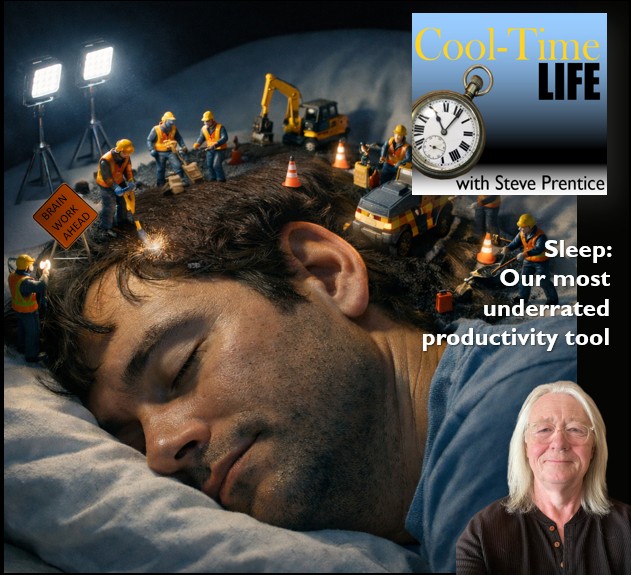
Listen to the podcast at our podcast host, Blubrry.com, or find it on your platform of choice, including iTunes, Spotify, Amazon, Audible, and YouTube.
Sleep is often treated like a luxury—something we sacrifice in the name of productivity, responsiveness, and “being available.” But what if that thinking is exactly backward? In this episode of CoolTimeLife, I explore why sleep is the hidden engine behind clear thinking, emotional regulation, creativity, and effective leadership. From the myth of catching up on lost sleep to the real impact of late-night emails, stress, and screen time, we look at what healthy sleep actually does for the brain—and what happens when we don’t protect it. If you care about performance, decision-making, and sustainable success at work, this conversation starts at bedtime.
Transcript
Our Strange Relationship with Sleep
It’s midnight. You are comfortable in your bed, enjoying the perfect balance of warmth and cool that your sheets provide, and enjoying the first of many dreams that will unfold while the streets outside become quieter and the stars wheel across the dark sky. Then your phone buzzes. It’s a text message from a client, or your boss. “Are you still up?” You struggle to clear your mind, to pull it back from its comfortable refuge and to focus on the request shining up from your phone screen. Whether this message takes thirty seconds or two hours to resolve, the result is the same. This night’s sleep pattern, and the health benefits it was to provide is now gone. Is there a better way?
What a bizarre relationship we have with sleep. Many of us feel we don’t get enough, but we also feel we really don’t have time for it. We should be spending a third of our lives in healthy sleep, but our busy lives don’t always allow for this, and modern culture certainly does not encourage it. Many of us see sleep as a thief; like something that steals time from the activities we could or should be doing. Our willingness to answer text messages long into the night is a classic indication of this. We are willing to prioritize a call from the boss over comfortable sleep because it’s more important.
But what if that’s exactly backward? Sleep is the secret engine behind every success, every clear decision, every good idea you’ve ever had. It is as vital as air, food and water as an element of survival, and should be interrupted for nothing except true emergencies.
The myth that availability equals performance
When I was growing up, I always heard the same thing from the adults around me: Thank God it’s Friday – TGIF. They had become grudgingly accustomed to the norm of slaving away in a job for five full days, getting less than the optimum number of hours of sleep in the hopes they could try to recuperate over the weekend, and catch up then. Maybe they didn’t understand. Sleep is not something you can borrow against and pay back later. It’s more like our relationship with water. You need it now. You cannot go thirsty for days and then drink a whole lot at once. It will be too late by then.
Most of us have to work for a living, and with every job comes the fear of losing it. Consequently we allow those daylight priorities – meetings, Zoom calls, emails and deadlines – to occupy the entire 24-hour day. If your boss or client wants to talk to you at midnight, well, what choice do you have? Somewhere along the path to adulthood as we entered the vast hangar of the job market, many of us absorbed a dangerous belief: if I’m reachable at all hours, I will become indispensable.
But constant availability doesn’t make you indispensable. It makes you depleted. Elite performers, like athletes, surgeons, and pilots, protect their sleep like the priceless asset that it is. They know that fatigue leads to errors, misjudgments, emotional volatility, and burnout. But in the corporate world, we often reward the opposite: the person who answers emails at 11:45 p.m. is seen as committed, reliable, a team player. But really they’re simply tired, and tired people make more mistakes.
The choice is yours, of course, but the stakes are high. Higher than most people are willing to admit. And the math doesn’t work either. You can’t borrow time from tonight and pay it back on Saturday. An interrupted sleep cycle leaves its mark on the day that follows. You will be groggy, maybe even in pain. You will be working at a far lower level of quality than you would want. Higher level mental activities such as prioritizing tasks, focusing on work or influencing people – all of which are topics I have discussed in other episodes of this series by the way – these abilities get lost in the fog. Forget that extra cup of coffee. If you are a regular coffee drinker, that hit will not overcome your sleep deficit. It simply balances out the chemical dependency we have on caffeine. It does not lift you any higher than that. Supercharged energy drinks may make you feel like you have restored your energy, but this too, is a temporary hit that exacts a huge toll on your body’s functioning.
The pressures we have accepted as the conditions of our employment make the act of sleep seem like a waste of time. The forms of entertainment that so many of us choose, specifically doomscrolling through a social media feed, keep us staring at a phone screen – a light source – which starts to erode the sleep cycle before you even close your eyes.
Why do we need sleep at all?
The fascinating thing about sleep is what it does for us, especially when it is healthy and well-supported. It forms part of our 24-hour cycle of being – part of the circadian rhythm, meaning “around the day,” and that’s what it is: it is part of a complete package of existence that orients itself to the regular and reliable rising of the sun.
Why can’t we function on caloric energy all day and all night? Burn the midnight oil every night, as it were. In fact, from a purely evolutionary standpoint, sleep seems to make no sense. When you’re asleep, you’re not hunting, gathering, working or reproducing. You’re also vulnerable. Predators and other dangers can creep up on you. Yet every animal that has a brain sleeps, from whales to fruit flies. So, clearly, sleep isn’t optional. It’s natural and serves some evolutionary survival process. So what could that process be?
It’s all about restoring and rebuilding. And it is essential.
First of all, sleep is not unconsciousness. Your body does not turn itself off during this time, it simply switches to other priorities. It is an altered state of consciousness. Your mind does not rest during sleep; it gets busy with other things. Like a road crew on the overnight shift, it takes care of things that aren’t practical to do during the day, which I will describe in just a moment. The body also gets to work during the sleep period. Cells work on repairing and replacing tissue, fixing wounds and bruises, building muscle, and releasing growth hormone, especially for kids. Our immune system runs diagnostics, scans for infections and works on fighting invaders.
Most people can be roused from sleep by an infant’s cry, an unusual sound, or your phone buzzing with a late night text message. Your ears and other senses are still alert to dangers or to the unusual. True unconsciousness, by contrast, is usually caused by physical trauma, such as getting hit on the head, a serious event that causes the body to shut down almost everything in order to recover from the damage. In most cases we can’t survive unconsciousness alone – we need medical help.
Back to the idea of sleep. As the “night shift of the conscious mind,” sleep rotates through five cycles, each between 45 and 90 minutes long. This starts with a light sleep period where you just drop off and maybe even start with your first dream of the night. You might even experience an odd leg kick – an involuntary spasm that happens as our nervous system switches over and turns our arms and legs into dormant mode. This is a good thing, otherwise if you dream you are running you might actually get up and run. This dormant mode helps protect you from self-inflicted injuries during sleep. As the sleeping process continues you pass through three other phases, each of which displays differently shaped brain waves, which would be visible if you were connected to an electroencephalogram (EEG). Each represents differing levels of output and electrical energy within your busy nighttime brain. Finally you reach the deepest phase of sleep, called REM sleep, which stands for “rapid eye movement,” which is where most of our dreams happen, and is signified by increased motion of the eyes, even though they are closed. They move as if they are looking at the things you are dreaming about.
During the first four phases of non-REM sleep, the brain waves slow down dramatically, and the physical brain actually washes itself. The glymphatic system, the brain’s own plumbing network, flushes out toxins and metabolic waste that build up during the day. One of those toxins, beta-amyloid, is a protein linked to Alzheimer’s disease. So in a sense, good sleep literally cleans the mind. Another key survival activity taken care of by the night shift crew.
During REM sleep, the brain is highly active. This is the place for those crazy involved dreams which themselves are a by-product of the mind’s nocturnal activities of emotional regulation and memory integration. During REM, your brain sorts through the day’s experiences, deciding what to keep and what to delete. It cross-references memories, linking new knowledge to old frameworks, which is why dreams can be so weird. As the late, great comedian Mitch Hedberg once said, “I hate dreaming because I just wanna sleep. I’m fast asleep, and next thing you know, I have to build a go-cart with my ex–landlord.”
Interestingly, this process is also responsible for those creative breakthroughs that often appear after a good night’s sleep. Whether you are wrestling with a decision or working on something that needs a creative solution, one of the best pieces of advice you could heed would be to “Sleep on it.” Let your “night shift brain team” run over the details while the rest of you is off the clock.
The impact of sleep on your non-sleep hours
Most people take sleep as a necessary blank period in their lives. They focus more on what they can achieve during their waking hours, completely unaware that their night shift crew has been doing that too. For most of us, the daylight hours are when we perform the modern-day equivalent of hunting and gathering, specifically, going to work, socializing, buying groceries, eating those groceries, and hopefully enjoying some hobbies and pastimes in between. For people who are parents or caregivers to kids, some time is given over to attending to kids’ needs and activities, yet another key element of preparing them for the challenges and demands of life, thus furthering nature’s mission of furthering the species.
Someone who is sleep deprived – who has not had enough sleep of for whom sleep was interrupted – this person is basically impaired. Everything they do suffers: attention, memory, creativity, decision-making. The prefrontal cortex – the part of the brain responsible for logic and decision-making – had no chance to fully rest and reset. The amygdala, the emotional center, cannot regulate itself properly, manifesting itself in excesses of mood such as anger, frustration or excessive fear. Without enough sleep, the crucial mental and emotional balance falls apart. People become more impulsive, more reactive, and less able to read social cues.
Studies have revealed that sleep deprived leaders – people who lead teams in an organization – are rated by their teams as less charismatic, less inspiring, and less fair, even when the leaders themselves thought they were doing fine. That disconnect can be dangerous. You might think you’re sharp and decisive, but your team sees you as short-tempered and inconsistent. Well-rested leaders are better at empathy, patience, and creative problem-solving – qualities that define great leadership.
So why can’t I get to sleep?
It’s not so much that people are in some way opposed to sleep. Many people look forward to a good night’s sleep and then unwittingly do things to sabotage it. Sometimes this is due to the need to stay connected to social media until the very last minute. As I mentioned earlier, doomscrolling through social media such as Facebook, Instagram and Tik Tok, may seem interesting but don’t forget, there’s a reason for that – they’re driven by algorithms that constantly check what you’re interested in and send you more of the same. The problem is that a phone is a light source. Your eyes are staring at a light when they should be relaxing into sleep. You may consciously be aware that it is nighttime and that you are looking at a phone screen, but your ancient nervous system still responds as if the sun is up and immediately seeks to reverse the flow of the sleep hormone melatonin, replacing it with positive stress hormones such as serotonin and cortisol. If you really need phone based material as your pre-sleep ritual, then make sure to activate the phone’s nightlight filter to lower its light and contrast.
Remember, by the way, I am not saying here that scrolling your phone or watching TV prevents sleep. Most of us will still fall asleep, including in front of the TV, but it’s the quality of that sleep that gets negatively affected.
We also have complicated relationship between sleep and another metabolic condition: stress. We all deal with a great many stressors during the day. During times of stress, the body releases two chemicals designed to keep us alert and ready to act: cortisol and adrenaline. These come in very handy during fight-or-flight situations like running away from danger but not are not terribly conducive to quality sleep. High cortisol levels make it harder to relax, which leads to poor sleep. Poor sleep then raises cortisol further, and the cycle continues.
It’s easy to experience this after a particularly rough day. You’re exhausted but can’t shut off your mind. You replay conversations, you revisit worries, you think about unfinished tasks. That’s your fight-or-flight system stuck in the “on” position. To break this loop, your body needs actual permission to power down. This requires more than darkness and quiet; you also need to experience psychological safety. You can’t sleep if your body thinks there’s danger about. One of the ways to do this is to satisfy yourself that you have done enough for the day. And this goes back to your daylight hours. Finishing off your emails by the end of day, for example, managing the expectations of the people who need to talk to you that you will be back in business tomorrow, and recognizing that not everything can get done, and that it doesn’t really matter overall. As the expression goes, no one on their deathbed has ever said “I wish I had spent more time at the office.” There has to be a moment where you say, “enough for today” and that should happen around sunset, not midnight.
Why sunset? Because that’s the time that your ancient brain sees the fading light and the approach of evening. And as it has done for our ancestors for hundreds of thousands of years, it now starts the process of releasing the sleep hormone melatonin into the bloodstream, a small amount at a time, letting it build to a point that we fall effortlessly to sleep.
When we don’t allow this to happen, when we try to get more done by bringing work into our personal hours, we sabotage this careful system, forcing a change to our chemistry and dissolving the melatonin buildup. This is why it is so important to create a bedtime ritual, something that is predictable, consistent and calming. This sends a signal to your nervous system that it’s safe to let go.
Modern Sleep Challenges
Let’s go back to some of the modern world’s assault on our sleep. First, as I said before there’s light, especially the blue light that comes from computer and phone screens. Our human bodies have evolved over the millennia to wake with the sun and sleep in darkness. Despite you logically knowing it’s only a screen and that it’s nighttime, the blueishness of the light tells our brains it’s daytime. This suppresses the release and distribution of melatonin, which is the primary hormone responsible for sleep hormone.
Adding to this always-on culture of emails, social media and multitasking, there’s a belief that we can catch up on lost sleep over the weekend. Unfortunately, it doesn’t work that way. While you can recover some alertness, your body clock doesn’t reset that easily. Inconsistent sleep schedules confuse the system, a bit like flying through time zones without leaving home. Inconsistent sleep is like jet lag that you can get without traveling anywhere.
The real solution is consistency. Seeking to go to bed and wake up at roughly the same time every day — even weekends. This is because your brain loves rhythm. It’s also a good idea to avoid caffeinated drinks and high-sugar foods before bed. If you want a natural sedative in place of pills, try Corn Flake-type cereal with milk and a little honey. Milk contains tryptophan, which makes people sleepy (think about large turkey dinners), and honey allows it to pass into the brain more efficiently.
How Sleep Changes Across the Lifespan
How much sleep do you need? That depends a great deal on your age and your individual metabolism. As much as we all need sleep, we don’t all need the same amount, and this changes as we age.
Children and teenagers need a lot – in general between 9 and 11 hours. Teenagers are often looked down upon by their elders for their sleepy countenance and longer hours sleeping, but hey – they are in construction mode. The brains of children and teenagers are growing and wiring themselves, constantly and large amounts of energy are being diverted into that act of actual growth – making bones, muscles and organs larger. Not to mention all the mental processing they need to do to try to make sense of all the new discoveries they are making daily. Teenagers also experience a natural shift in circadian rhythm. They are actually wired to stay up later and sleep in. That’s biology, not laziness, and it’s why early school start times are such a problem.
Adults typically need about seven to nine hours, but the challenge isn’t knowing that – it’s making it happen. Work, parenting, technology, and the pressure to be available 24/7 chip away at our rest. Many adults live in a state of chronic partial sleep deprivation, getting maybe six hours a night and thinking it’s fine, when really it’s eroding focus and health over the short term and the long term.
Then, as we get older, sleep often becomes lighter and more fragmented. We wake up more often, sometimes because of physical discomfort or medical issues, sometimes because our circadian rhythms shift earlier. The trick here isn’t to fight it, but to adapt, maybe with short naps or more consistent wake times.
Sleep as a Leadership Tool
Let’s connect this back to the workplace. I’ve already talked about how sleep affects mood, empathy, and decision-making. But let’s go further: sleep also influences culture. A leader who values rest sets the tone for the team. When you as a leader send out emails at midnight or brag about working through the night, the message that sleep is a sign of weakness spreads across the community, leading to a sleep deprived team. On the other hand, leaders who model healthy boundaries, who allow themselves to disconnect, who encourage downtime, give their teams permission to do the same. That’s not softness; it generates sustainability. Well-rested teams make fewer mistakes, innovate more, and they stay as employees longer. The most effective leaders understand this: rest is not the opposite of effort. It’s part of it.
Until next time, stay safe, stay confident and thanks for listening.
Thank you for visiting. Do you have comments or thoughts about this episode? Feel free to get in touch through our Contact page.
 CoolTimeLife