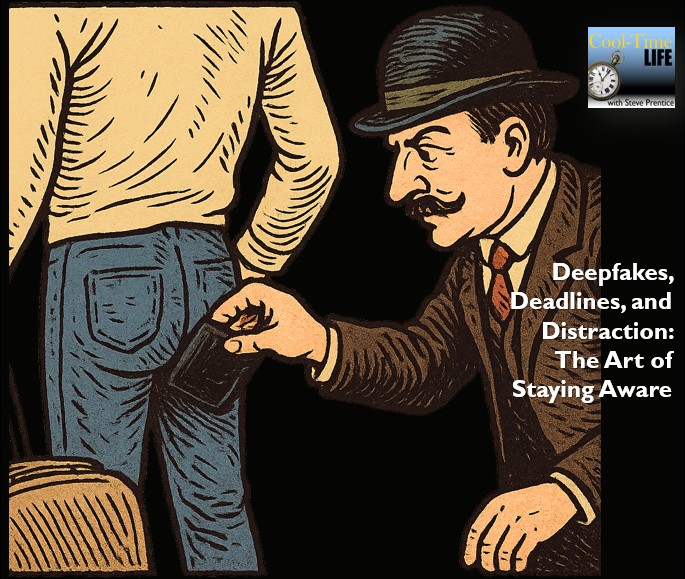
Most people live in reaction mode, constantly responding to emails, pings, and pop-ups. But every reaction costs attention and control. Just like a traveler who touches their wallet after seeing a “Beware of pickpockets” sign, we reveal too much when we react unconsciously. Awareness starts with a pause : that split second to assess before you act. It’s how you reclaim control over your time and your decisions. Discover how to stay conscious in a world built to distract.
Listen to the podcast at our podcast host, Blubrry.com, or find it on your platform of choice, including iTunes, Spotify, Amazon, Audible, and YouTube.
Transcript
Are you conscious? I don’t mean, “are you awake? I mean, are you really conscious? Are you in the moment? Do you know what is going on around you and judge what is real and what is not. In this era of AI and unprecedented geopolitical instability it is more important than ever to keep your wits sharp and think critically about everything you see – from the emails in your inbox to the videos on streaming media and even your calendar. Let’s have a look at reviving this most vital survival skill.
Welcome to CoolTimeLife. I’m Steve Prentice. I’m glad you’re here. Each of our CoolTimeLife episodes focuses on a topic dealing with people, productivity, technology, and work-life, and each offers ideas and facts you need to know about to thrive in today’s busy world. An index of our podcasts is available at cooltimelife.com.

Imagine yourself for a moment in the departure lounge of an airport. You are rushing to catch a connecting flight, half jogging to the gate and pulling your wheeled carry-on bag behind you. And you look up, and a sign on the wall catches your eye. It says “Beware! There may be pickpockets in this area!” If you are like 95% of the traveling public, you will now make a dangerous mistake. You will instinctively reach for your wallet or your purse wherever it is that you carry your money and valuable cards.
That’s a bad move. It’s precisely what a good pickpocket wants you to do. This is the reaction they are looking for.
Human beings are hard-wired by nature to react, especially to dangerous or threatening situations. The threat of a pickpocket in the area immediately forces the unconscious passerby to touch the location where the money is being stored. It’s an attempt to neutralize the threat by ensuring money is still there. Notice I use the word unconscious here. The traveler is fully awake, but they are not fully conscious of their surroundings.
But touching their purse or wallet in this act of self-reassurance, what the traveler is actually doing is telling the thief “Hey, my money is here, okay?” making the thief’s work so much easier. In this situation, the unsuspecting traveler reacts as all living creatures do. Alerted to danger, instinct takes over. We react. But the pickpocket on the other hand, is proacting. Anticipating the turn of events, knowing the likely outcomes and setting a trap. So the thief is writing the script for the next few minutes.
You might think, “Great! I’ll remember this next time I am in an airport, but what relevance does that have to the rest of life?” It has every relevance. We spend most of our time in reaction mode.
Just like pickpockets, messages are thieves
Look at the messages we get every day: emails, text messages, and chat windows. When a new message arrives, we feel compelled to read it. It’s a reaction based on an instinctive drive to resolve an unknown element in our world, in order to make sure it is not a danger. This sounds very dramatic but it’s a purely physiological fact. Regardless of what the message says, we feel we must look at it in order to turn it from a known to an unknown.
Phishing emails are a modern version of pickpocketing. A crime of distraction. These messages that say, “your bank account has been frozen,” or “there’s a missed delivery from Federal Express,” or worse, “Mom help me! I’ve been arrested and I’m using someone else’s phone because they took mine away! Please help!” These and many other messages are all designed to take advantage of your reactive nature. I have, by the way, an episode dedicated to this idea and how to put a gap between what you experience and what you do next. Go to cooltimelife.com and go to GAP IT. For all of these messages and many more, people click on the link without fully thinking about what they are doing, giving away their information to scammers and possibly also allowing malware to be delivered.
We now live in a world where anything can be faked. Deepfakes – AI generated replicants of a person’s face or voice mean any message you receive can be just as distracting, misleading and dangerous as phishing emails always have been – maybe even more so.
Question everything and trust nothing
This means it is vital to question every message that arrives on your devices, to ask yourself “is this real?” and how can I tell? Sometimes this means looking at the URL or email address of the sender. Most lazy criminals don’t bother to hide this. They might copy the logo and text from a legitimate company, to create their message, and they likely will use Generative AI to make the copy read better, but they don’t bother getting hold of a faked email address. So making a habit of always looking at the sender’s email address and carefully hovering hour mouse over the link or “Click Here” button that they include – WITHOUT CLICKING IT” will reveal where this message is really going to.
Attachments in emails are a prime delivery vector for malware, and they might have filenames that sound legit. Many organizations have malware scanners attached to their email systems. Individuals including yourself might use an application such as Microsoft Defender to watch out for these types of packages. But not everyone does, and sometimes people turn them off, or forget to renew their subscriptions.
Now you would think everyone already knows this stuff already, but they don’t. I do a lot of writing consulting, speaking and teaching in cybersecurity field, and the sad fact is, the leading cause of cyberattacks from simple data theft to stealing money through to paralyzing ransomware, it is often a human who makes a mistake and allows the bad actors in. The mistake might be as quick and simple as an employee clicking on a link in a phishing email as I have already described, or it might involve a simple con job where an individual calls a company’s help desk pretending to be an employee and asks for a password reset. This happens and succeeds more often than you think.
Or it might be a more sophisticated con job, where a threat actor reaches out, pretending to be, for example, a vendor, with an innocuous letter of introduction: “Hi, I’m Steve, I’m the new sales rep for the company that does your HVAC – just touching base to say hello.” Just a nice email that does nothing other than start to build trust. This might be followed up a week later by a second email to the effect of “can you tell me who I should talk to at Accounts Receivable? The person I replaced left without showing me who it is,” which will lead to additional communication, intended always to obtain something vital out of you such as a password,
By the way, if this interests you, I do some work as a journalist for Cyber Security Headlines, as well as being researcher, host and producer for the Thales Security Sessions podcast, both of which focus on different areas of cyber technology and cybercrime, and always with an eye to security.
Proactivity is not natural, but it is vital
Pro-activity is what can put you back in the driver’s seat back in control. Being proactive allows you to think critically about a situation, questioning its validity or relevance. Being proactive allows you to anticipate events and reactions, and to conduct yourself in ways that will anticipate and even influence outcomes. And this is such a crucial part of life, of work, of productivity and in living in cool time.
There is also a positive physiological response that happens when you and your body become conscious and establish a greater sense of control over your surroundings. There is a sense that danger has been averted, and that you are on top of things. When this happens, nutrients, oxygen, and blood move back where they need to go. Not simply to the brain but also to the digestive system.
When you feel good, your body feels good and when your body feels good, it works best. This may sound like common sense, but like so much common sense, it isn’t all that common. We tend to lose full conscious awareness far too often.
Think about what happens when you receive an email or text message. As overly dramatic as this may sound, unknown stimuli like a new message waiting in your inbox activates the age-old fight or flight reflex that has kept humanity alive for thousands of years. During a fight-or-flight response, you stop thinking clearly and instead focus on resolving the urgency. At the same time much of the nutrients, oxygen and other vital elements get shifted over to the anger center of the brain to handle this unexpected urgency. Digestion tends to stop or slow to a crawl, your vision goes into tunnel vision, your sense of an ability to prioritize tasks or prioritize items freezes up. All of these things happen as soon as you feel you are not in control. But pro-activity can flip all this around once again and become a positive asset to your productivity and ability.
Not being conscious means being subject to the whims of others. Think about, for example, the act of saying no to somebody who is requesting a meeting with you. Nobody wants to say no, since the word sounds like an insult, or at least a challenge to another person’s dignity. It may even be an invitation to confrontation and bad feeling. But “no” can also be conceivably interpreted as the short form of the word negotiate. Most things in life can be negotiated. There are alternative approaches to taking care of a task. I am not available today, how about tomorrow at 2:00? A “suitable alternative to now” can, in many cases be sufficient. It might not work all the time, but there is great opportunity to alter your day more in line with your priorities when you are in the moment and able to think critically and proactively. If you are not in that mental place to negotiate, if you are stuck in fight or flight, you will find no creative capacity for coming up with alternative solutions, you are condemned to simply react.
Take time for yourself
The last point I want to make about this is that the ability to think clearly, proactively and to stay conscious and in the moment comes from a balanced mind and body, one that is not overcome by stress. This means, in order to stay conscious to the point that you are less likely to fall for a scam phishing message, to be able to balance your time and commitments, and frankly to be able to communicate better and influence people, you need to not be permanently in the grip of reaction and adrenaline. Your best mental self will come from the feeling of balance, and this is best done by taking at least some time in the day for yourself. Take a walk. Whether you work at home or in a business. Go outside, take a walk and let your mind wander. Avoid checking for and responding to emails on your phone and instead let your mind actually breathe and take in your surroundings.
The creativity and dynamics of this are enormous, and you can learn about them in another episode of CoolTimeLife entitled Your Brain is Like a Bath Sponge.
It is more important than ever to remember to remain conscious. In earlier decades, things took longer. It took longer to get things delivered, such as mail or products you ordered, it took longer to travel to meetings, and it took longer to prepare information. The speed by which things happen now may seem convenient, but it comes at a price, and that price is no time available to mull things over. Social media takes advantage of this by bombarding people with endless amounts of information, much of which is untrue and unfounded. But we have no time to think critically about it, because more messages are waiting. The workplace is typically a zone of endless time demands: meetings, messages and tasks, and every time we become able to do these things faster, it just ends up creating more tasks – that’s what I call ergonomic inflation.
So, ask yourself, are you really conscious? You owe it to yourself to be able to honestly say yes. Please take a while and think about that.
Thank you for visiting. Do you have comments or thoughts about this episode> Feel free to get in touch through our Contact page.
 CoolTimeLife