How Human Reflex Stands In The Way Of Digital Transformation
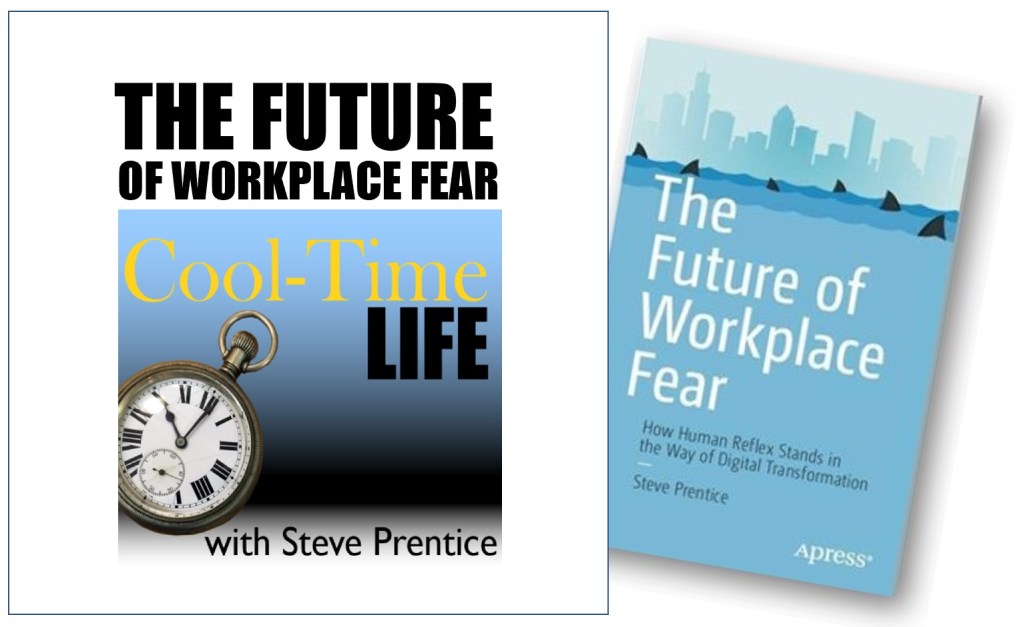
Hidden behind the term “digital transformation” is the word “change,” but this doesn’t sit well with most people, because change represents a threat that strikes at the heart of our greatest fear – losing our job. This is even more prescient in this era of AI.
Listen to the podcast at our podcast host, Blubrry.com, or find it on your platform of choice, including iTunes, Spotify, Amazon, Audible, iHeart, and YouTube.
This podcast is about my book, published in 2022. More details about the book are available on the Books page here.
Transcript
I will confess that career self-determination is a very personal topic for me. Back in 1992, just at the time I was starting up my own company, I watched my father, an aerospace engineer, lose his job and consequently his 30-year career, as part of a round of corporate downsizing that eliminated 2,000 people from his employer’s payroll in a single week. His job was the one thing that defined him, and to make matters worse, he was a year away from retirement – a retirement that would no longer be supported by the pension he had been contributing to. He never recovered from that trauma.
It affected me too, not just because it was my father, but because this event – this activity of getting fired from a place to which he – like so many millions of others – had dedicated his time, his education, and his experience for so long – had manifested the greatest fear that almost all working people harbor. The trauma of this event made me want to identify ways in which people can protect themselves against such a crushing event, not only on that day that termination happens, but during all those years of work that precede it – those years in which people mutter under their breath, “if I screw this up, I’ll be fired.”
This fear of job loss is at the heart of my new book, which has just been released from Apress, entitled The Future of Workplace Fear: How Human Reflex Stands in the Way of Digital Transformation. It takes a look at digital transformation from the perspective of the people that it will affect, in ways that the designers and purchasers of new digital technology might not always contemplate. Any new technology brings with it a degree of change, and whenever change happens, it rocks the foundations of the lives of the people upon whom the change has been foisted.
Change is not generally welcome for human beings. Every change that happens in our lives – every new thing – must be filtered through a series of internal priorities that essentially come down to answering the question, “how will this hurt me?” It has to be that way. Every unknown that confronts you must be addressed by your internal operating system whose job is to keep you alive. Therefore the response to all change is to assess its danger to your status quo.
For most working people, that status quo includes one’s current job, which is helping pay for the things that are needed to stay alive and employable: food, shelter, transport, and a way to protect those close to us. To lose the source of funding for these vital life activities would be the worst thing of all. Therefore any novelty – a new technology, a new manager, a new approach to working, or a seismic shift within the company itself (anything from a merger through to a ransomware attack), will disturb the delicate and often tenuous balance of daily life.
So when new technologies or techniques enter this fray, the first response is seldom “Great!” It’s going to be “Oh no. What now?”
In the book I use password management software as a recurring example. Cyberhygiene, as it is often called, is an absolutely vital component of workplace life. Crimes such as hacking and phishing grow more sophisticated by the day, and much of it leverages human beings as the weak point. It is a human who will click on a phishing link in an email. It is a human who will use and reuse easy-to-remember passwords. It is a human who will use coffee shop WiFi or a home-based router to get some of their work done.
The fundamental imperative for the human is to get the work done and to not get the manager upset. The fundamental fear is that to make a mistake or to be late with a work assignment will quickly eat away at one’s sense of job security. The fundamental constant knowledge is that there’s always someone else out there, often someone younger and cheaper, who can replace you.
Therefore, the tendency to willingly click on what looks like an important message from management or from a customer, but which actually is a phishing email, is driven by the primary fear of the pressure of time – to fill every moment with work, to not say no to anything, and therefore to get through the backlogs of email and tasks as quickly as humanly possible, with no time allowed for critical thinking. Learning a new software, such as a password manager, comes with the threat of looking incompetent during the learning phase, paired with a fear of losing control over the passwords themselves. This fear looms larger in the mind than does the greater danger that phishing and password breaches actually present.
Managers are not immune to this fear, either. Managers define themselves – and their value to their company – by their ability to manage their department and the people within, so that their manager above them remains pleased. When a manager is confronted by the prospect of the team working from their homes, out of sight and physically in a different space, it is a natural reflex for that manager to say “No! I do not like this! This changes how I manage people, and I don’t like it. If I screw this up, I’ll get fired!” or at the very least, “I won’t be able to manage.” This is why so much of the resistance to the work-from-home or hybrid work scenarios of the new normal find greatest pushback from those who do the managing. The threat to their stasis eclipses any benefits that such a working arrangement could bring.
Fear is natural. But people should not have to exist under a dark storm cloud, living with the constant fear of losing their job. This fear should not be the primary motivator for getting out of bed in the morning, nor should this particular fact remain unaddressed and unknown. A vital thing to remember about the inner workings of our selves is that we too are a hybrid – an uneven balance of emotion and logic. We have evolved enough of a brain to be able to think about things, yet we remain dominated by emotion.
A simple example of this is decision-making: you can set out all the facts (logic), but your decision will come down to a feeling (emotion). Emotion rules because it is the oldest. It existed before the cerebral cortex grew into a thinking machine, and consequently owns more real estate in the brain.
But fear can ultimately be managed by facts. If we fear something, then it is our job to know what the solution would be. Any work-related issue that you fear or procrastinate on can be solved, or at least managed, by taking the time to assess the facts.
In the case of the password manager example, people fear using it because it might make them look incompetent if they make a mistake, and that might lead eventually to losing the job. They also fear losing control over their passwords. The best way to get people to overcome these particular fears would be with the tangible facts of experience – give them a chance to try the software out in a safe situation, play with it repeatedly – make the mistakes that come with learning. Sadly, most organizations place very little stock in thorough training, largely due to its perceived cost. Training cannot be done in a day or an hour. It needs to be done iteratively, over time, so that the skills and awareness get absorbed into the body at the pace the body is capable of.
In the case of the ultimate fear of job loss, my approach to this is to have that “so what” solution in place. I have found that the fear of losing one’s job is a huge millstone around everyone’s neck. My father certainly had it, and he relied on hope alone that he would make it to retirement if he just kept his head down. That gambit did not work for him.
In my book, then, I suggest that career self-management is the best antidote to career fear. If you wake up every morning fearful of losing your job, then do something to resolve that fear. Get to know what else is out there, what other work opportunities exist. The good news – no, the great news – is that there has never been a better time for this. Career mobility has leapt forward enormously in recent years, and especially in recent months, as can be seen in events such as the Great Resignation, in which people have been resigning from their current jobs in much greater numbers as they realize that a.) their current job, with its costs in time, money and stress, just isn’t worth it, and b.) there are other jobs out there, with better working conditions, including work-from-home, for those who want that.
The secret is to maintain that degree of connectedness. I have long been a fan of LinkedIn – ever since it first came out, actually as a place for proactive career management. It’s not about looking for a “help wanted” ad the day after you get fired; LinkedIn, and other forms of networking should be a daily, proactive activity – nurturing a collection of professional peers who you respect and whose work you would recommend. These are the people that can make things happen for you and vice versa.
Similarly, daily microlearning opportunities, using carefully curated channels on Twitter, will help keep your knowledge about industry developments – anything you need to know about your chosen profession – up-to-date and valuable, by receiving instruction and information in manageable daily amounts.
The problem is, we are all kept too busy to do that. Or we have allowed our lives to become too busy to generate this type of proactive career safety net. We have been conditioned, collectively, from grade school to believe that any time that is not spent doing something is time wasted. This has led us into time management nightmares – back-to-back meetings, ever-increasing amounts of email and messages, and the fear that taking a break or even a personal day will quickly come around as a ding on the old career credit rating.
In my Future of Fear book, as well as in my time management book, Cool-Time, I seek to reinforce the benefits of the 80/20 Rule, in which 20 percent of anyone’s time should be spent on proactive activities including forging relationships with people, (that includes a bespoke one with one with your manager), as well as taking time for microlearning and for personal health. These are the things that in the end will yield greater productivity for your job and your life and will actually make things safer for you.
But just like the fear of the password manager, we hold back, in case the optics are bad. We give the control back to people and circumstances that should never be allowed to have it, at least to that degree.
But these are new times, post-2021 that is, and people are finally discovering they can shake off the grey flannel suit mentality that dominated the decades of the twentieth century. Work is beginning to be redefined by something more than years or decades at a single company, and education – the knowledge that helps you land that job – is now available as a daily newsfeed rather than just a five-year stint at a university or college. The only career that is worth wholly caring about is you. Your career as a living human. And it is allowed to take the turns and paths of your choosing as you now have access to the maps.
If my father had felt this spirit during his working time, perhaps he would have enjoyed the adventure that aerospace engineering should have been. And I know there are billions of people out there who are also missing out that same pleasure.
So that’s what The Future of Workplace Fear book is about. On the surface, it appears to be just about new technologies or workplace change, but circling below it all, like a shark in the water, are much more primordial fears that speak to our very physical existence. The good news is, we have the capacity to take control over these fears, by balancing them with facts.
If you are interested in picking up a copy of my book, it’s available at Amazon and Barnes and Noble, as well as in eBook format from the publisher, SpringerLink/Apress.
Thank you for visiting. Do you have comments or thoughts about this episode? Feel free to get in touch through our Contact page.
Tags/Keywords: digital transformation, future of workplace fear, office, culture, leadership, change management, technology
 CoolTimeLife