Discussing the future of work, with Bob Johansen
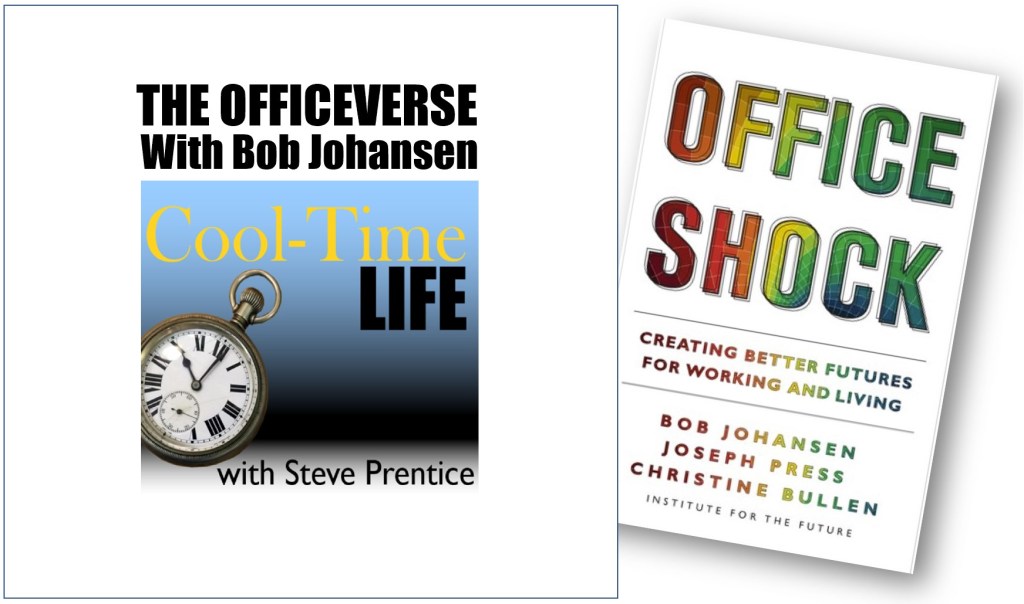
Have you ever thought of the word office as a verb? When you do, it changes everything, shining a light on the work we do rather than the place we do it. This is just one of many great ideas presented by futurist Bob Johansen in his new book, Office Shock. In this conversation, he shares his views on the future of work, the impact of AI on careers, the way we handle change, and much more, all through the lens of his special brand of future-back thinking.
Listen to the podcast at our podcast host, Blubrry.com, or find it on your platform of choice, including iTunes, Spotify, Amazon, Audible, iHeart, and YouTube.
Visit Bob’s organization, and sign up for their newsletter here: iftf.org.
Transcript
Steve
In a way, the new normal that we are experiencing in this second decade of the 21st Century is something like the Big Bang itself, in the same way that the universe is thought to have exploded instantaneously and then coagulated into clouds of gas and later, planets and stars. So we are all doing this, albeit on a much smaller scale, as we wrestle with the workplace of the future, one that exploded out of the forced lockdowns of the Covid 19 pandemic. We struggle as working professionals, as managers, as companies and as governments and regulators with technologies that are not only too new to fully understand, but which are also continuing to reform and evolve before our eyes. This is the CoolTimeLife podcast.
My guest on this episode is sociologist Bob Johansson, whose research and wisdom concerning the future of work has led him to coin the term the office verse, I do love that and anytime, anyplace world that promises to disrupt many of today’s organizational models to prepare for the potential opportunities of this wider office verse, every office worker, organization and policy maker should imagine how the world of work will look 10 years into the future. And this is a concept that he calls future back thinking. So it is with great pleasure that I introduce Bob Johansen. Thank you so much for joining me here today on the Cool Time Life podcast.
Bob
Thanks. Great to be with you.
Steve
Let’s talk about yourself and the book Office Shock. Where does this all come from, and what is the Book about in a short form description?
Bob
So Office shock is abrupt, unsettling change in how, where, when, and even why we work. So I’m a futurist, and I became intrigued with this idea that kind of took shape during the Covid lockdowns. I got a call during that from the CEO of a very large furniture company in Switzerland, USM, and he was asking, you know, kind of what’s life going to be like beyond the Covid shutdown, and could we begin an exploration, which led to the office shock book, begin an exploration, a future, back exploration, thinking 10 years ahead, kind of beyond the noise of the present, thinking future, back about all these basics of offices. And so we began the work, the research two year project, came up with ways of thinking about the choices that people are making. And you know, we’re humble futurists, so we’re looking about directions of change, but we’re not predicting the future. Nobody can do that. We’re provoking, provoking a conversation. And that’s what the office shock book does, and basically that’s what I do. I’m a futurist. I’ve been doing this a long time. I’m at Institute for the Future and Silicon Valley, we’re the longest running futures think tank in the world. You know, we’ve been doing distributed work since the 70s. So we were a spin off of Rand in 1968.
Steve
So this book does come out at just the right time. The changes in the workplace are coming at us now in an exponentially increasing rate. And as you said, meaning the covid pandemic situation created a bit of a spike in so many different areas and forced some change to happen much more, much more quickly than we expected. So we’re seeing these massive changes, and along with it, of course, is a great deal of confusion. And your book appears to me at first glance. It appears to me a manual for surviving, followed by being a manual for thriving, but at least to begin with, to let people know what’s going on. So this was written by yourself, and was Christine and Joseph also involved in the writing of the book?
Bob
Oh, yeah. So it’s I’ve got two co authors on this book. Joseph press is an architect by training a PhD from MIT, and he’s a workplace architect that has transformed in his career to being a digital transformation expert. So he was vital to the the framing of the book. Christine Bullen is an Information Systems professor who I worked with when I was affiliated with MIT, and she is bringing in more the digital perspective. She and I studied teleconferencing together many years ago, and this kind of three points of view, I think, were so important in creating this book Absolutely
Steve
and it reflects so well in the structure of the prose and the way it reads. It’s such a comfortable read. So just looking at the philosophies that you touch on as well, many actually means Satya Nadella and his new approach to running Microsoft is, I think, symbolic of where things are going in some regards. But before we get to him, Future Shock by Alvin Toffler has been a classic for the same kind of thing, and I can see, obviously, the connection to Office shock. As a reverberation of that. And then you’ve got the foundation series by Isaac Asimov, which, for those who have not read it, there’s a lot in there, of course, but one of the key areas is the planning of the future in sort of mathematical perfection, which is then sabotaged somewhat by the arrival of an unpredictable a mutant known as the mule. So in translating that into what you see in the workplace. What are the mules that are pushing themselves into our change right now? What do you identify as mules?
Bob
So the mules are unprecedented change that doesn’t fit your previous models, doesn’t fit your previous categories, you know, doesn’t fit the kind of expectations that you have about the future. So we begin with the framing of VUCA, volatile, uncertain, complex and ambiguous. And you know, I’m not a military guy by background, but I happen to be at the Army War College for the place where generals go, and I happened to be there the week before 911 I learned about this concept of the VUCA world, and since then, I’ve been asked to teach there. And I now teach the new three star generals on their first week in Washington, they read this book and my other books, and I’ve flipped that VUCA into something positive. And that’s the challenge with mules. How? How can you take the unprecedented and flip it into an opportunity? So what I argue is that volatility yields to vision. So if you think future back over the next decade, vision will be disproportionately rewarded. Uncertainty will yield to understanding. So this is a time to be listening to each other, you know, not shouting at each other, then complexity will yield to clarity. And what you want to be, you can’t be command and control. The military has learned this now. You can’t be command and control, but you can have what they call Commander’s Intent, or what I call clarity. Be very clear where you’re going, very flexible about how you get there. And in the office shock book, we use the introduce the phrase flexible intent to continuously evaluate that clarity as you go. And finally, ambiguity yields to agility. We have to be agile. Whatever we do. We have to be essentially corporate athletes, physically, mentally and even spiritually healthy, not necessarily religiously, but spiritually grounded in the face of the VUCA world. So within that VUCA frame in the book, we also talk a lot about climate. Climate disruption has taken a long time to get as bad as it is, but over the next decade is going to be a key set of decisions, which, if we make the right ones, we’re going to play through this. If we make the wrong ones, we’re going to be in serious, serious trouble. So it’s a kind of a mule in the sense that some of those climate disruptions we should have been paying attention to long ago, but we didn’t, so that’s creating these Now surprisingly bad impacts and and we talk, of course, about covid, and covid was a kind of a mule, although, again, quite predictable. At some level, we’ve had, we’ve had the kind of virus forecasts in our pandemic virus forecasts in our in our for base forecast since 2009 so not really new, but the way it played out was quite like a mule in the sense that it kicked over our established ways of working.
Steve
It certainly did. And you know, as you’re describing, that it seems like very high level concepts that people of a certain level of power and authority may be able to embrace this and say, Yes, we have the capacity to make these changes based on what you’re observing and saying. But I guess there is two other sort of confusing elements here, which would be number one, when it came to things like the pandemic or climate change. For that matter, you’ve got a substantial amount of human resistance, people who just are either in denial, just don’t want to be bothered with it, or just too busy or too uninformed to be bothered with it. And I think we saw a lot of that in the pandemic itself, with people’s various reactions to vaccines and masking and so on. So when we’re looking at change from a workplace perspective, who would be the ideal audience to read and then learn from your wisdom. Is this applied in a senior management level, or are you aiming to have this listened to and heard on all levels as more of a communal type education process?
Bob
Yeah, so we divide the book between individuals and kind of the individual frame. How do each of us decide about how and where and when and why we’re working organizations, and a lot of that is senior organizations, senior level organizations, making decisions about whether to go back to the office and if so, how and why. And then finally, policymakers, like elected officials. Or city managers or planners, planning cities, and this whole you know idea of doom loop cities that came up since we finished the book where you’ve got kind of empty office towers and figuring out what to do at the community level. So it applies to all of them. But let me say, as your question implied, the covid shutdown was very unfair to individuals. So if you had a good place to work at home, if you had bandwidth and good equipment and you were free of kids running around, or elders you had to care for, if you had a good setup to work for Home, then the way of working remotely was possible for you, and for some it was very good as an alternative, but for some it was really awful. It was traumatic. So this is very unfair, the way this is playing out. And the challenge, if you think future back, is, how do you make it more fair? So one of our seven spectrums of choice is all about belonging, and we talk a lot in there about the wealth gap and how to bridge that through alternative ways of working.
Steve
So this is a book and a philosophy that can be embraced by people from not only different levels of organization within, let’s say, a so called knowledge work environment, but also in those other workplace cultures that aren’t so computer based. I think one of the things I really enjoyed was the fact you used the word office as a verb to office. Is that an original concept, because it changes the lighting, it changes the entire perspective on work. And it’s really marvelous.
Bob
You know, I’m not actually sure where it came from. We did a lot of research on that and couldn’t find who actually coined it. I don’t think it was us, but what we do is talk about Office as a noun, being the buildings and the places. Officeing As a verb, being the ways we work, and the office verse as being that kind of archipelago of possibility that includes in person, but also includes the mix, the wild mix, the blended reality, mix of alternatives that will come available over the next decade. So we talk about offices, officeing and the office verse. I’m not
Steve
sure if Isaac Asimov was attributed to this particular quote, but there was somebody who once said that the perfect machine is one that perfect machine is one that has no moving parts. And I’ve always thought, you know, the smart the smartphone, is a good example of that. But this word office, it sort of digests everything down to a singularity. The word as a verb changes everything about the perspective of the workplace. So I was really amazed at that. This we can sort of translate across to another pandemic related incident, which was the great resignation, which you mentioned in the book, which, to my knowledge, anyways, was sort of noted as a spike at the height of the pandemic in 2020 maybe 2021, but certainly at the middle of all these bad times that people were leaving to find a new way of working. The way I describe it is that it was no longer worth it. I mean, the commute and everything else about it just wasn’t it just wasn’t worth it. And so you describe and you use the quote, imagine a world in which more office workers are motivated by a sense of purpose and meaning which is very liberating and very welcome as a concept, perhaps, of more self driven work and life pathways compared to the gray flannel suit mindset of decades past. So this is a liberating idea. And I think there’s a lot of people who would grab that and say yes, the self motivated class, who would say, Yes, I can do that. I can change my career, even to do something where, when and how I wish to be. But also going back to the unfairness principle of before, what about the average person who’s got a mortgage, got bills to pay, got kids to feed, and sees all of these changes as more of a great threat to their stability into their career, they see the fear, or they feel the fear, and they see the threat rather than the opportunity. How would you speak to them to say things like chat GPT aren’t as bad as they appear. Or would you say yes, they are so
Bob
chat GPT is kind of another story. I hope we can come back to talk about that under the what we call the spectrum of augmentation. But to get to the basic question that you’re asking, yes, it is very confusing. Yes, it can be very unfair. And yes, there are real challenges to sort these things out, if you’ve got a very difficult financial situation, and you know, kids to support and mortgages to pay and the like, those things are real challenges. The good news of this is that there’s more flexibility now. So the bad news is there’s going to be fewer traditional jobs in the future. The good news is there’s going to be more ways to make a living. I love more ways to make a living, even if you don’t have a formal job. So the challenge is, how do you sort out all these very. Ways to make a living and and it is, it is a real big challenge, but there’s, there’s way more to this than the great resignation that was an early term, and it was really far too simplistic. What was happening was a number of people, as you say, the more, the more well to do of the world, were saying, Yeah, I don’t have to do this anymore. I’m going to resign. Well, they actually went to work somewhere else, or in some other way. It wasn’t like they quit working. It was really that they resigned but found a better offer. And it was a very competitive environment in that time. And you know, we can see now that the tech companies were over hiring during that period, and we’re paying the price of that, of that now. So we then it was called The Great reset, and that was a better term. We’ve called it often, the great opportunity. And it’s a great opportunity for companies to rethink, for individuals to rethink, for cities to rethink. But you do have to flip those dangers, those threats, into opportunities. And we introduced the seven spectrums of choice in the in the book. And this is two years of research all around. How do you start the right conversation? And during this period, the dominant conversation that you read in the popular business press or from many CEOs is, when do we go back to the office? And there has been a push in some industries and with some people to force people back to the office. We know now that those kind of mandates don’t work. They don’t work. You can’t just mandate people go back to the office. It’s very difficult to do that. What does work is to think this through in terms of the seven spectrums of choice, beginning with purpose. You know why in office at all? So the first question isn’t, when do we go back to the office? The first question is, why in office at all? You know what’s the purpose of your office? And there’s good answers to that question, but it should not be an assumption. It should be a question asked, and the answer is, in person, offices are better for orientation, trust, building, renewal, early stage, creativity and culture building, particularly for young people. But if you think about the old fashioned office, old fashioned offices weren’t very good for any of those things. So if you’re if that’s the purpose, then you’ve got to rethink the design of your in person, in person offices. And to me, that’s the beginning point. What’s the purpose? Then the other six spectrums of choice are, what are the outcomes you’re seeking? And we’re futurists, so we looking future back. We think climate is the big kind of outcome you have to play for over the next decade. Then we ask, how do you create a climate of belonging? Then we ask, how can you position yourself? How can you position yourself on the spectrum of augmentation? We’re all going to be augmented in some way 10 years from now. But the question is, how, then you get to the question of, where should work occur, and when do we go back to the office, and how and what kind of office is. So notice that question of when to go back to the office. We’re facing up to it, but it’s number six out of seven for us. Six out of seven. And then the seventh question, which these are all in order, the 7/7 question is, how do you create agility to be able to respond to the VUCA world, to be able to respond to all the pressures of individuals, of organizations and of communities.
Steve
You said a moment ago, it’s not so much about losing jobs as it is about creating new opportunities. And when I explain these kind of concepts to the people that I teach at my university, I will say to them, you think about matte painters, who, for many decades in the film industry created these absolutely beautiful works of art on glass that were the scenery that a camera would shoot through to create the illusion of people in a jungle or wherever. Of course, CGI and things like that completely put the matte painting business out of business, except the people with that clarity and creativity to create those scenes are now doing it as advisors or as programmers with CGI, so it sort of translates the creativity into a new medium. So when you were describing a moment ago about managers and others, you know, calling everyone back to the office, it certainly seems, from what I was hearing you say, that the problem may be that managers see things solely in a polar black and white type of concept. It’s either here or there, it’s in the office or at home. But as you said, more of a sliding scale, bringing people in in their early onboarding periods to learn and to build community and creativity and then sending them back out. That’s a much more sort of nuanced approach to a progressive career path, rather than here or there. So that’s a more of. US observation?
Bob
Yeah, exactly. And this is what we call full spectrum thinking. So it’s thinking across gradients of possibility, so on the seven spectrums of choice, it’s a sliding scale, and we use a music mixing board metaphor, like the sliders on a music mixing board. And full spectrum thinking is to resist the old fashioned categories of the past, resist those kind of labels that constrain us, and instead think future back. And the neat thing is, a lot of the new digital tools like big data visualization, big data analytics, game flow, engagement, a lot of these new digital tools help us think in a full spectrum way. And what office shock does is basically apply full spectrum thinking to this challenge of where, when, how and why do we work the idea then
Steve
of, let’s say, moving from the world of zoom to the world of the virtual the metaverse has received sort of lukewarm interest from the media. I think perhaps a lot of it has to do with Mark Zuckerberg approachto it. But again, what I do with the students that I teach, and these are people in mid level management, mid career, learning how their jobs are going to change, is I show them what I call video chat version 2.0 which are things where there’s much more interaction and a permanent presence. I’m not sure if you’re familiar with toucan, for example, toucan dot events, and also verbella, which is one of the the metaverse style, three dimensional worlds, which I personally love. I think it’s a I tell people five minutes in and you forget that you’re an avatar. You’re just simply interacting with people. But maybe I’m too much of an enthusiast. How do you feel about the virtual worlds? I’ve seen about a 5050, interest uptake from my students. Some of them say I like it. Others say too weird. So I’m just wondering what your approach is, or your opinions are about us jumping into the fully immersive 3d worlds to come.
Bob
Yeah, so I’m really optimistic about that world again, thinking future back, but the prototypes that we’re working with right now aren’t very good. And, you know, Mark, Mark Zuckerberg, I think, oversold the idea of the metaverse and kind of jumped the gun before the tech was really ready. That’s part of the reason for the setback in the office shock book, we when we think future back, we go 10 years ahead and think future back and from the present, we go at least 50 Years back, right? So if you think about the metaverse and how the concept is developed, it really began a long time ago. You know the term artificial intelligence, which is a core element that was that term was coined in 1956 1956 so people think, oh, things are changing really fast. And look at all this chat GPT stuff, and look at how fast that diffused. And yes, that is a very fast diffusion curve, but it actually started in 1956 so in that sense, it took that long to be an overnight success, and the metaverse is going to build on AI and build on the various tools of connectivity. So what we’re going to see 10 years from now is going to be dramatically better than zoom, dramatically better than today’s Metaverse kind of virtual reality and an augmented reality dramatically better. But what we’re going to see is we call it the office verse. We we decided not to use the term metaverse. We coined our new a new term, just to get out of that hype. But what we see the office verse as this blend of realities that includes in person and includes all the different variations of virtual and augmented realities to create immersive experiences, depending on what the task is and depending what the kind of medium and the need is and the kind of people that you’re involved with, but I’m very convinced that the tools for being in the virtual world, the tools are going to be dramatically better 10 years from now than we are now. We’re going to look back on that and and say, Whoa, those were functional, but not very good and and I’m really optimistic about those.
Unknown Speaker
Well, that’s great to hear, because
Steve
contemporary of Alvin Toffler was Marshall McLuhan, and he had a expression that said, you know, people drive into the future with their eyes firmly fixed on the rear view mirror. So it is again, retro perspective of comparing what they know to what they’re seeing. But I’m delighted to know that you know, you’re optimistic about it, because the other variable here is the newer generations of people coming to work who have grown up with virtual environments
Bob
and gaming. That is a really big variable, and we talk a lot about the true digital natives who we define in the book as 27 or less, or younger, 27 or younger in 2023 we’re even. More interested in what we call the XR natives, the cross reality natives, the blended reality natives that are 17 or less in 2023 and those are the young people that I believe are going to change the world, because they’re growing up with digital kind of savvy skills coming from gaming and coming from home schooling, a bunch of other experiences that have been both good and bad and and those young people are going to bring a perspective. They’re also very concerned about climate in particular and in the US. They’re very concerned about guns in particular. So they’re going to have points of view, and many of them are angry, and most of them are digitally savvy, so they’re going to be a force to be reckoned with, and the power of that ability to cooperate and collaborate. Now there are downside risks, and I’m a social scientist by training, and I study media impacts, it’s easier to measure the negative impacts on kids than it is to measure the positive impacts. And there’s plenty of my colleagues doing study after study about the risks to kids of smartphones and social media and the like. I’m not denying those. I think that’s a real issue, but I also think there’s a big opportunity for kids to change the world, and I think we ought to talk about that too.
Steve
Just today, I was listening to Alec Baldwin’s podcast. Here’s the thing. And he was interviewing Blake Lemoine, who was the Google engineer who basically got fired by Google for saying that AI is becoming sentient. Yeah, but again, just triggering from what you were saying there. What he was noticing was that above that age barrier, the XR barrier, the adults in the room were saying, should we use this stuff because of all the bad stuff it can do? And everyone under that barrier were saying, this stuff’s great. It’s fabulous. And had no worries about using it, which I think is very typical of any generation, but is pronounced in world changing technologies like
Unknown Speaker
AI and that kind of thing. Yeah. So I
Bob
would agree with both of those. I think it is world changing, and I’m really optimistic, and there’s reason for concern. I think Blake Lemoine got caught in the middle of a quite a weird conversation, which then got accelerated by chat GPT, and we talk about, we use the William Gibson quote, the future is already here. It’s just unevenly distributed. And if you think about chat GPT as a signal, it was introduced, it was kind of let loose with no advertising, but for free. It was let loose on November 30, a month later, it was what we call a future force. A month after that, when a stable version was released. It was a trend, so it’s gone extremely fast. Now we refer to that as augmentation, and the way we’re asking the question is, what do humans do best? What Can computers do best? And How do humans want to be augmented, right? And I think each of us needs to ask that question. So I’m a writer, you know? I write books, and if I’m going to be writing books 10 years from now, I’m going to have to be augmented by something like chat, GPT. It’s just a given. I like it for first drafts, you know? I love to do titles. I love to do outlines. I love to do editing and finalization. I don’t like the blank page to do the first draft. And chat GPT is actually quite good for that. So I used it to draft chapter eight on the chapter of augmentation. And then we have a chat GPT chat bot for the book so you can actually find it online. We’ll put the links in here for your listeners. So I think we were going to be augmented. That’s just inevitable. The question is, how are we going to augment it? And that’s not inevitable at all. The questions of sentience and of computers taking over from humans. That’s an important conversation, and I’m glad it’s happening, but we can proceed with the conversation about augmentation, separately from that conversation around sentience that and again, I think Blake Lemoine got caught in a kind of weird vortex conversation
Steve
for the time being, to call our audience to your book. Where can people find you? Find the book and take advantage, not only of the book itself, but yeah, that marvelous sound slider board tool, and, of course, the chat bot as well. So where can people find you learn more and buy the book?
Bob
Sure. Well, you can buy it anywhere. It’s on Amazon and all the usual bookstore sources, just called Office shock. Office shock, dot O, R G has all the resources, including the music mixing board, slider board. For people, you know, we’re an independent nonprofit Institute for the Future is we want to share these resources, and you can. Find them on that. We’ll we’ll put in a discount code for your listeners, and we’ll put in the link to the office shock chat bot. But the Institute for the Future website. We also train people to be futurists. We’ve got a foresight Essentials program. We’ve got a big program called the equitable enterprise on the wealth gap and kind of ways of designing organizations to be more equitable and fair. So we’ll put all those links in for for your listeners.
Steve
Bob Johansen, this has been an absolute pleasure. And again, the book is a great read and so timely, so great. I want to
Unknown Speaker
thank you very much for being here on the cool Time
Bob
Life podcast today. Thank you. It’s great to great to join you and have this conversation. I think it’s really important that we be thinking about how to do better than what we’ve done in the past, at that intersection of working and living,
Steve
office shock creating better futures for working and living. By Bob Johansson, Christine Bolin and Joseph press is published by Barrett Kohler, and it’s available wherever books are sold. You can also learn more about the coming future ready by visiting office, shock.org, there’s a lot there, including some amazing courses, cool, time, life podcast. Listeners can also get a 30% discount off the books list price by entering the code offshock. That’s O, F, F, S, H, O, C, K, after adding the book to your cart. So here is the book page. It’ll be in the show notes as well. It is triple W, b, k, connection.com/books/title/office-shock,
Steve
if you have a comment about this podcast, you can also drop me a line through the contact form at Steve Prentice calm, where you’ll also find my social media links. A full listing of past episodes is available at cooltimelife.com and if you feel you’re getting value from this series, please leave a review. Tell someone about us, and if you want, you can support us on Patreon. Contributions from our listeners allow me and my team to spend more time researching and preparing our podcast series. So if that feels fair to you, please visit patreon.com/cooltimelife. Until next time, I’m Steve Prentice. Thanks for listening.
Thank you for visiting. Do you have comments or thoughts about this episode? Feel free to get in touch through our Contact page.
Keywords: future of work, office, careers Bob Johansen, office shock
 CoolTimeLife