How Modern Work Is Quietly Wearing You Down
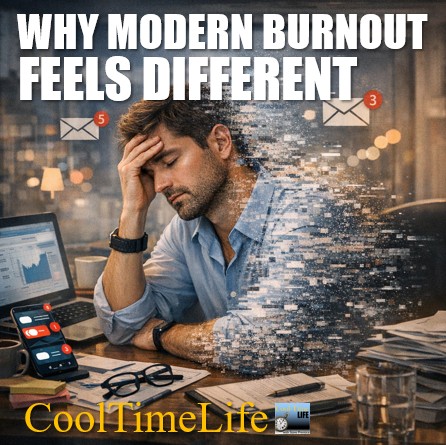
If you’ve ever wondered why modern work feels more exhausting even with better technology, this episode explains what “new burnout” really is and how to take back control.
Modern burnout is no longer the old “too much work for too long” syndrome. It has evolved, accelerated by digital overload, constant notifications, and the erosion of mental downtime. Today’s workers are surrounded by tools meant to make life easier, yet we seem to be working more hours, and even vacations don’t fully recharge people anymore. This episode explores why burnout now feels chronic, identity based, and invisible. From ergonomic inflation to ambient anxiety, the modern workplace keeps people in a perpetual fight or flight loop, leaving little chance to absorb and process the information. You’ll learn practical strategies to regain control, rebuild cognitive space, and shift from reactive survival to proactive influence. This is a real antidote to new era burnout.
Media links
Transcript
In offices and businesses all around the world, people are surrounded by supposedly efficient technologies that are intended to do much of our work for us. From email to AI, these tools offer to help us do everything from messages to meetings, even in making decisions. They save us commuting time and shorten the time required for every process. We surf on top of a tsunami of digital efficiency fueled by the perpetual promise that with these tools, we can get more done and improve productivity.
So why don’t people feel any better? We were supposed to be working fewer hours because of these technologies, yet somehow we seem to be working more hours. We feel more drained than ever, and even vacations don’t fully recharge people anymore. Why does a normal workday feel like running a marathon in sand? It’s because burnout itself has changed.
What Burnout Used to Be vs. What It Is Now
Welcome to CoolTimeLife. I’m Steve Prentice. I’m glad you’re here. Each of our CoolTimeLife episodes focuses on a topic dealing with people, productivity, technology, and work-life, and each offers ideas and facts you need to know about to thrive in today’s busy world. An index of our podcasts is available at cooltimelife.com.
Back in the old days, the pre-internet analog days of the 1970s people still had lots of work to do. They had deadlines, meetings and commutes. Some suffered burnout and other mental health issues. No matter the decade, people always take on more work than they could really handle. But the chief differentiator was that of presence and pace. Mail, for example, was an analog technology consisting of printed letters placed in envelopes and sent to recipients via the postal service or courier. Either way, there was a substantial delay between composing a message and receiving a reply. Yes, telephones existed back then, but if you weren’t there to answer a call, the best that could be done would be for someone to take a message, write it on a slip of paper and place it somewhere that the recipient would eventually access it.
There are two things to take from this. The first is the time difference between the sending and the reply. This delay allowed people’s minds to process the information further, kind of on autopilot. Stretches of time between sending and receiving a reply may be filled with other activities, but it still allowed the sender to mull over the issue – digest it, think on it some more.
The second is that the material was all on paper. Letters were printed on paper and people read them. The same thing with phone messages left with an answering service. They, too, were on paper, and this is important, because information presented on paper is processed differently from information that we now process by looking at a screen. This is why some people prefer to print out their emails and read them on paper. Not great for the environment, maybe, but more in line with how our eyes and minds process information. That’s also why writing things out by hand, using pen and paper or a dry erase board is also more productive. It’s not just about being nostalgic for older technologies, there is actually a stronger connection to the thinking parts of the brain that the timing of handwriting allows.
So, anyway, back to the mail thing, there were gaps in the information flow – gaps that allowed the mind to work things through, keep the in context, mull them over. The arrival of email and instant messaging took that processing time away and simultaneously increased the speed of expectation. The new normal was that of an immediate response. Another stressor for the recipient of the message.
Tangible media was something we could literally get hold of, but electronic media is not the same. It presents itself as an unknown and causes an immediate fight-or flight response. This literally drains the thinking brain of nutrients and oxygen immediately and takes many minutes to recover from. When this happens dozens of times a day, it condemns people to remain in a constant state of recovery and sub-level ability. All day. This is one of the many reasons why getting work done is such a challenge. It is not just the email message or even the time and effort required to respond to it; it is also the physiological hangover that follows each of these emails and compounds, one atop the upon each other.
Also, there was less buffer time back then. Less time for decompression. This is largely the fault of mobile phones, or more precisely, our compulsion to check them and be on them constantly. The time people used to spend decompressing during a walk or during the commute home – regardless of whether this was by car or public transit even on congested roads – this time was now taken up increasingly by spending more time responding to messages in email or talking on the phone while driving.
It may come as a surprise to some to learn that mental downtime in which you simply leave your mind free to wander while doing other things such as walking, commuting, or driving, is vital to mental health and therefore to physical health. It is also vital for creativity and problem solving. Activities such as walking or driving without engaging with your phone is not “nothing time.” It is not wasted time. It is a time when you do something of greater value for your mind and your life. It’s positive distraction. It’s processing time. Mental digestion. It has the same positive benefits to thought and achievement as do sleep and nutrition, both of which I have talked about in more detail in previous episodes. In fact, it’s great to have your phone with you so you can record the great ideas and thoughts that come your way.
The Hidden Drivers of Modern Burnout
So, what makes today’s burnout unique?
First, there is ergonomic inflation. Like regular inflation in the world economy, ergonomic inflation is when the number of actions we perform increases with the number of actions needed to complete the task. Take email and other forms of messaging, for example. People are forced to respond to an increasing number of these messages, but they seldom assist in reducing any task’s burden. In fact, they add to it.
Meetings that can be held online through video chat cut down on travel time, but if the meetings themselves go longer because of this, or worse, more meetings are scheduled simply because the time seems available, this too yields no advancement, and in fact often leads to reduced productivity. It takes more tasks to get work done and these, too, must be done between answering messages and meetings. Most people are already aware of this fact, of course, but they never get a chance to see from a bird’s eye-view just how many of these tasks are involved and just how complicated this is making things. I anticipate we will see even more of this as organizations rush to agentic AI tools in the name, once again, of increase productivity.
This leads to the “Ambient Anxiety” of uncertainty. Our news is filled with stories of companies laying off or not hiring because AI can do the jobs; or simply the willingness of organizations to move people or office around, carrying the threat of enormous upheaval for employees and their families. There is a constant fear of obsolescence as new technologies and techniques make their mark on the workplace, leading to a sense that “I should be doing more.” This emotional burden may be as large as contemplating the number of new skills you’ll need to work with AI, but even small anxiety burdens, such as company policies that insist that “cameras must be on” during a Teams or Zoom call is now mandatory, even though you would prefer to have yours off. It’s a small thing maybe, but these things all add up.
Think also about back-to-back meetings, something that should be easy to prevent, yet still happens all the time. Back-to-back meetings make for an impossible schedule one that makes it impossible for people to concentrate and learn. A day of back-to-back meetings becomes one of heightened stress that gives little chance to absorb and process the information from these meetings. This spills over to the following days as you try to catch up with everything you could do because of the meetings. This type of activity is the human equivalent of a flood situation during heavy rains, where water races over saturated ground because it has nowhere else to go. It is untenable and impractical.
Why This Burnout Feels Different
Burnout, by its very definition, describes a point at which people can no longer function well, or at all, as a result of an excess of activity, stress or both. We often think of it as occurring after a protracted period of intense work, or for some people, when they have simply had enough of a task, or even an employer or job role. It is usually seen as the sad end of a specific period of activity.
But modern burnout is different. It’s chronic, not acute. People aren’t so much hitting a wall as just slowly sinking. Because the overload isn’t ending. If anything, it’s increasing. To a significant degree, it is also highly identity based. People who work in computer-assisted jobs, also called knowledge workers by some, tie their self-worth to markers such as productivity, responsiveness, and expertise. These are the very things that are currently being threatened, and as such, burnout accelerates.
This form of burnout is also invisible. People can’t point to a single cause like a long intense project. They just feel depleted. For a species that thrives on being able to see a finish line and work towards it, such unmeasurable effort is draining and demoralizing.
It is important to recognize that our minds have limited working memory, and modern work exceeds and overburdens it daily. Every choice, every decision we have to make drains energy. Constant notifications create reward loops, anxiety spikes and attention fragmentation, all of which lead to a Dopamine Dysregulation; and imbalance in the way we process thought and emotions. Although we are used to and are somewhat capable of riding through stress cycles in our lives, the problem here is that this is not a complete stress cycle. It’s an incomplete stress cycle, which means full resolution cannot be attained.
How to resolve burnout: take back control
Stress and burnout can manifest themselves in many ways, from sluggishness and procrastination to panic to low level dread, even to symptoms that resemble seasonal allergies. The allergy one is due to the circulation of hormones like cortisol released into the bloodstream, and reactions to acids like adrenaline-part of the fight or flight response which itself is a key part of responding to a stressful situation.
There is an opposite state to the fight-or-flight response, by the way, one that is not talked about quite so much, and it is called “rest-and-digest.” This occurs when you are not feeling stressed, and when your body and mind feel it is safe to apply its energies to the more normal elements of life, like digesting the food you have eaten in order to extract the nutrients and calories in a healthier way. Digestion is one of the many functions of the body that are put aside during times of fight-or-flight crisis.
So how do you get to that state? The best way to attain a sense of control is to establish control from the get-go. This is something that I have talked about for years in my time management sessions, and it’s about being proactive and about developing the skill of influence.
Anyone can do this. It’s not about seniority, and it’s certainly not about criticizing those we work for. No matter how much they might deserve that, the reality is, if someone has control over your job, that’s some significant leverage. But that does not mean anyone who works for someone – which is pretty much all of us – anyone who works for someone can still be proactive and can establish control over a situation.
Let’s go back to the back-to-back meetings example. The back-to-back meeting situation happens because no guardrails were in place. A person scours your calendar for a time you’re available and then pounces on it. Let’s say 9:00 to 10:00 Friday morning. Another person who also wants you in their meeting scours your calendar and sees that 10:00 Friday is open, so they grab that. There is nothing in your calendar to defend against this attack, so it’s fair game.
The better route would have been to establish a skirt around that 9:00 meeting: 15 minutes before the meeting and 15 minutes after. The before skirt allows you to get ready, log in, or get to the meeting room, whatever, so that you are seated and ready before the scheduled start time of 9:00 a.m. The skirt after the meeting allows you time to enter in whatever action items the meeting presented, as well as allowing you time to get back to your workplace, take a breather, and then turn around to face the next meeting.
Gaps between events are a necessary part of the functioning of all types of jobs. They are the support system of true productivity. Yet many people feel obliged to say “yes” to every meeting request and every work item placed their way.
The skirt feature around that 9:00 meeting allows people to see that you’re not actually available until 10:15, and they can make their plans accordingly. Everything in life can be negotiated, and this includes when and where you are available.
Now this is just one small example, focusing on meetings, but regardless what your source of stress leading to burnout is, there is a strong change that you can be proactive – planning and adding controls like a time the skirt in advance to ensure that people can work around it. Its very presence influences them to adjust their expectations accordingly.
That’s it: just two small concepts: proactivity and influence. These go a long way towards re-establishing a genuine sense of control in your life, even in just a small part of your life, and consequently, reducing the potential for burnout. Less fight-or-flight, more rest-and-digest.
Burnout isn’t just about losing energy; it’s also about losing alignment and a sense of control. Most of us are blessed with enough energy to get through each day, but energy can easily be sapped by negative situations including that feeling of not being in control. There are of course many other sources of potential burnout in our lives, but we as humans generally have an enormous capacity for bearing the loads of hard work and challenging situations. What truly makes a difference, though, is how you feel about that work and these situations. The more you can exert control and influence over yourself and others, in an appropriate way, through clear communication and explanation, positive and not aggressive, the more you will be able to harvest that sense of control and push burnout out of the picture.
A couple of last thoughts: burnout does not mean you are weak. It means your energy has been misdirected towards a defensive position, rather than being active. Secondly, you can’t fix burnout with a vacation or even a weekend. ” Even if you were able to spend two days or a week completely not checking your work email, the moment you step back into your workplace on a Monday or after your vacay, the stress will reimpose itself upon you and all the therapeutic benefits of your time off will evaporate. Proactivity and influence need to be a permanent part of your workplace persona. Thirdly and finally, being busy doesn’t mean being productive. It’s a quality versus quantity thing. Productivity comes from having a clear calm mind, not an ability to cram every moment with work.
The best thing you can do is to give yourself time to plan – plan your week. Establish the tasks that are most productive and establish the times where you will be available. Manage the expectations of the people you work with and guide them towards those times when you are available. Insert skirting times around focused activities such as meetings, to give yourself time to prepare and later decompress. And overall keep in mind that the two words that point to success in managing your time – and therefore keeping burnout at bay, are the words “planning” and “communication.” Plan everything – your “on” times and your “off” times and make sure everyone knows. Do not allow their assumptions or expectations to take over your schedule. Because once they take over your schedule, your sense of control evaporates, paving the way toward burnout. You can do all of this in a positive and cooperative way. That is the art of proactive people management. And unsurprisingly perhaps, this task becomes easier the more you give yourself time to think it through.
If you have a comment about this podcast or a suggestion for a topic you would like me to discuss, join the conversation on LinkedIn, or visit the episode’s page at cooltimelife.com/burnout, and you will find a comment link at the bottom. If you feel you are getting value from this series, please leave a review, and tell just one person about us, or mention us on social media. And if you want, you can support us on Patreon. Contributions from our listeners allow me and my team to spend more time researching, preparing, and updating our podcast series, as well as delivering the episodes more frequently. Members get exclusive access to useful bonus materials. If that feels fair to you, please visit patreon.com/cooltimelife.
Until next time, stay safe, stay confident and thanks for listening.
Thank you for visiting. Do you have comments or thoughts about this episode? Feel free to get in touch through our Contact page.
Keywords: chronic burnout, digital overload, constant notifications, always‑on workplace culture, workplace stress, fear of obsolescence, fight‑or‑flight response, regain control of my workday, mental health
 CoolTimeLife