Is this the day I get fired by AI?
Let’s look at some of the realities.
The fear of artificial intelligence replacing human jobs is real—and growing. From Microsoft’s viral list of “most endangered jobs” to social media memes warning that “AI won’t take your job, but someone who knows AI will,” uncertainty is everywhere. In this episode of CoolTimeLife, Steve Prentice tackles the question head-on: should you be afraid of AI, or should you see it as the biggest career opportunity of your lifetime?
Listen to the podcast at our podcast host, Blubrry.com, or find it on your platform of choice, including iTunes, Spotify, Amazon, Audible, iHeart, and YouTube.
Transcript
There’s a good chance that you’ve asked yourself a few big questions lately about where your career is going, how – and why – new technologies like AI are changing everything, and whether the path you’re on is still the right one. You’re not alone. Millions of people are quietly asking the same things. Not just around the watercooler or over coffee with a friend, but in a much newer space, one of which being the very one that is causing all the concern in the first place: ChatGPT itself.
Interesting, isn’t it, that ChatGPT is becoming a sort of digital career coach. And the fact that people are using it while in the throes of worrying about their job speaks volumes. So, let’s look at that more closely, and see just how this can end up as victory for you.
Welcome to CoolTimeLife. I’m Steve Prentice. I’m glad you’re here. Each of our CoolTimeLife episodes focuses on a topic dealing with people, productivity, technology, and work-life, and each offers ideas and facts you need to know about to thrive in today’s busy world. An index of our podcasts is available at cooltimelife.com.
While I was writing the script for this episode, social media lit up with a report from Microsoft of the top 40 jobs most likely to be replaced or jeopardized by AI technology, and the top 40 safest. Pretty canny marketing on the part of Microsoft I might say. Maybe even bordering on clickbait. But if you have not already seen it, I have images of their lists on this episode’s page at CoolTimeLife.com. If you are a writer, author, editor, and teacher, as I am, those jobs are high on the list of being endangered. It’s better, it turns out, to be a phlebotomist. What is that, you ask? A phlebotomist is someone who can draw blood out of a patient for diagnostic purposes or for transfusions and blood donations. If you are a phlebotomist, or an embalmer, a ship engineer, or a roofer, congratulations. According to Microsoft, you’re safe.
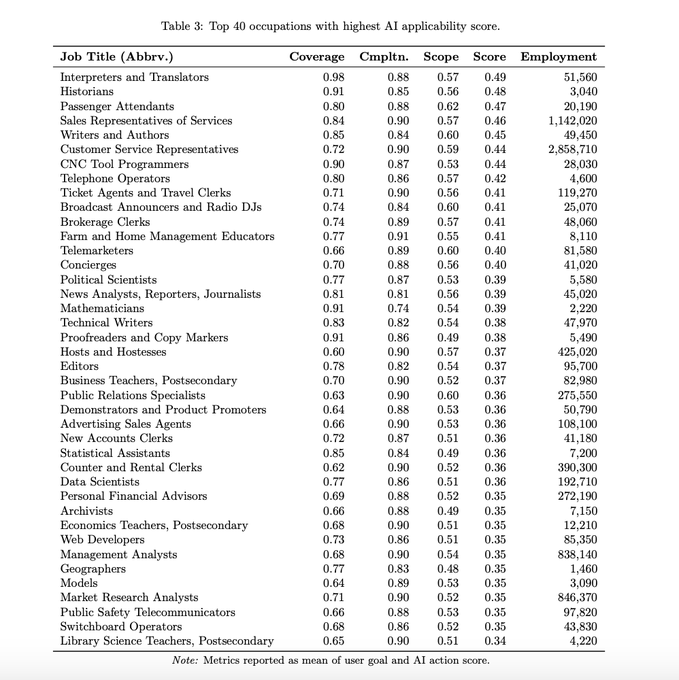
Above: the list from Microsoft of jobs in danger from AI. I will add the URL here once I find it.
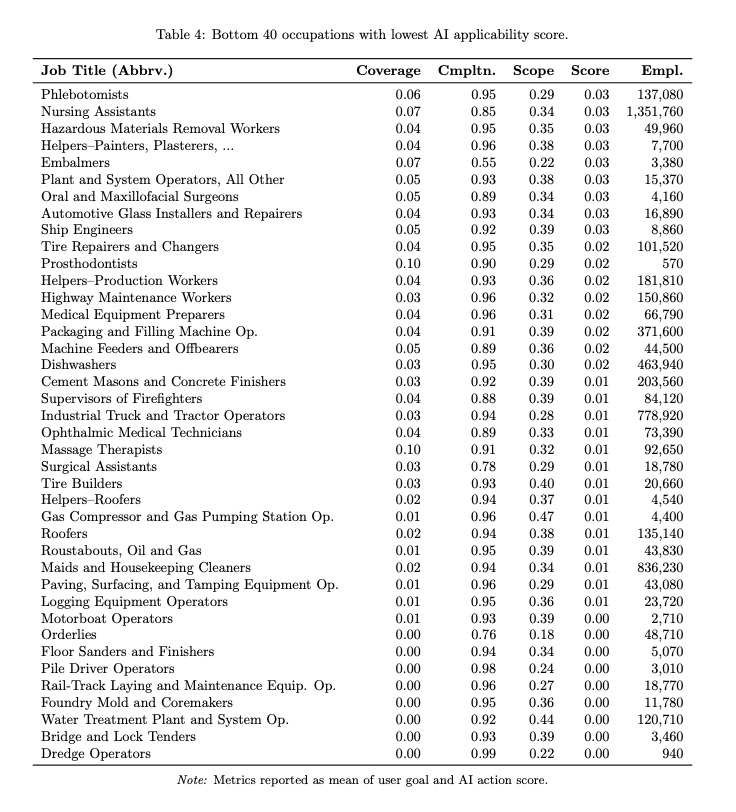
Above: a list from Microsoft of jobs less in danger from AI. I will add the URL here once I find it.
I find this list as darkly amusing as I did with the one I was given in high school in the 1970s, where after an aptitude test, you could find out what job you would be best suited for as a career. I was supposed to be a lumberjack. My wife, who went to the same school as me, discovered she was eminently qualified to be both a gunsmith and funeral director. I sensed she would face an immediate conflict of interest by pursuing both of those simultaneously. But she pursued neither.
Back in those days, the internet did not exist, mobile phones did not exist, and generative AI certainly did not exist. So as with most things, the determination of a person’s future worth was based solely on the past. No one could be a social media influencer or a cybersecurity specialist when those things weren’t even visible, even on the Death Star in Star Wars. Even though I do feel that I can hear C3PO’s voice in every cheery conversation I have with ChatGPT.
The problem with lists like the Microsoft jobs list one is its naivete. First in making you believe that certain jobs are in danger and second in making you feel that other jobs are not. Cement masons and concrete finishers may feel good to know they have made the “safe” list, but there are robots and apps being refined daily that can take care of cement work, both physically and chemically. Even if you need a pair of human hands to finish the job, the owner of those hands will still need to know about innovations and trends in their business. Better compounds, techniques or finishes available in cement masonry? Guess where you can hear about them first! Doing the paperwork, drafting agreements, getting paid? Calculating optimum purchase amounts or raw materials? Same guess. Same answer.
Generative AI tools like ChatGPT, Copilot, Perplexity and others, are knowledge bases with a nuanced interface. They are easy to talk to, and easy to work with. So, will they take your job? Will you get fired by AI?
Let’s look more closely at that.
First – two things you need to know about me that reflect directly back on you. For all of my career I have been a staunch advocate for career self-determination, which I define as the skill and attitude all people need to insure themselves against the risk of getting cut adrift during the next round of corporate layoffs or economic downturns. I saw my father, an aerospace engineer, go through this. His 30-year career was curtailed by senior management conveniently just one year before he was due to retire. And no, it wasn’t just him – two thousand other people were “let go” – don’t you just love that phrase – when the company decided the best way to save money was to get rid of the people that actually made its products and made sure those products were safe.
I wrote a book around that time called Is This the Day I Get Fired? It’s still around on Amazon if you’re interested. The point of the book is that knowing you can get fired at any time is the best way to ensure your defenses and contingencies are in place. To ask yourself this question daily – Is This the Day I Get Fired? – is not negative thinking. It’s the opposite: it’s a way of ensuring you own the keys to your future, not someone in HR. It’s about staying resilient – up to speed on what is necessary to ensure your continued employability, not just in terms of technology, but also in terms of your social network.
Job insecurity should never be far from anyone’s mind, because if it’s not there, complacency will fill that void. In these last two years since ChatGPT and its competitors truly hit public awareness, the stakes have risen somewhat. Regularly, news stories appear featuring companies who are already looking to replace all of their tedious, expensive employees with AI. They wanted to do the same thing when computers first came out and again when they all got connected to the internet. You only need to look at a modern car assembly line or Amazon fulfillment center to see just how many people have been replaced by robots. Similarly on a farm, a single farmer in a huge combine tractor thing can seed, fertilize, and later, harvest a decent-size field in a couple of hours, far quicker than a team of laborers with their endless demands for water and payment.
When everyone went virtual, working from home during the pandemic and then wanting to stay that way after the lockdowns ended, many of those same managers were the first to say “you can’t do your job from home! You will miss out on all those networking opportunities, those spontaneous and always helpful one-on-one meetings with me, your boss! How can you learn work skills from your kitchen table?” These same managers would also go on record as saying “I can’t trust my employees to work from home. What if they are all slackers? Maybe a keylogger would help.”
Companies have always looked for ways to save money in their production process and always identify human labor as the most expensive and expendable. Which means that every job is a target at any time, regardless of whether ChatGPT exists or not.
Then there is the soul-destroying meme currently circulating on social media, including LinkedIn, that says, “AI won’t take your job. But someone who knows AI will.” Fine. That should not be taken as a threat, but as a clue. A hint. Yes, you can say, “oh no, I wish this would all go away” or you can say “what can I do to make me that person with the AI skills?”
Will AI take your job, or will you take the reins?
Let’s start with the number one problem, which is fear, plain and simple. But not an irrational fear. There’s no question that AI tools are all very capable, when used correctly. They can write, they can code, they can analyze, and they can converse, and their abilities improve every day. So, it’s not surprising that people in all types of professions feel worried – or at least a little uncomfortable. But here’s the nuance that often gets missed in the fear: AI doesn’t replace whole jobs all at once, it replaces tasks, allowing people and the companies they work for to focus on higher-value services instead.
Think about paralegal. Even if you are not a paralegal, think about the many ways your job resembles that of a paralegal. For a paralegal AI might summarize documents faster, yes. But can it understand context, strategy, legal nuance? Not without help. Not yet. And maybe not ever in the way a human can. Or an accountant. If AI can take a shoebox full of receipts or a bunch of mismatched spreadsheets to create a ledger for a client, does that put the accountant out of work? No, because that accountant is still the one who does the analysis and provides advice and value to their clients. A pro photographer can take thousands of photos of a person or an event and use AI to locate the five percent of the photos that have the best composition, lighting and color. But it can only do this once it has been told by the expert photographer what is needed, and it is still up to the photographer to understand the client’s needs at the start and find the most fitting pictures from that five percent.
AI will do what every other technology before it has done: that is to change how we work. The photocopier replaced the typing pool. Waze replaced paper maps. CGI imagery replaced location shooting in the movies. But that doesn’t mean people whose professions include word processing, map making, or movie making went extinct or became homeless. They adapted. They learned how to use these new tools to make the best of their existing talents. The movie business might not need as many matte painters now that CGI can create the scenery. But they still need people who understand composition, dynamics, color and emotion in visual art. The matte painters who put away their brushes and learned how to work with CGI, or even with the younger operators of CGI, continue to thrive, thanks to their talents and their ability to adapt.
The real risk is not that AI walks in and takes your job tomorrow. It’s that the value of what you currently do starts to erode quietly, over time—unless you evolve with it. And you have every opportunity to do that. If you are a junior accountant, worried that AI will do the work that you currently do, it is certainly up to you to find out what AI can do for you – note I said for you, not against you – so that you can apply your talents in tandem with it, and frankly superior to it. If ChatGPT can detect anomalies in vast spreadsheets full of numbers, good for ChatGPT. It’s how you interpret those anomalies, how you explain them to your clients, and how you advise them what to do next that truly defines your value as an accounting professional.
The calculator conundrum
Again, going back to my time in high school in the 1970s, parents and teachers everywhere debated whether hand-held calculators should be allowed in classrooms. The question was “how could students prepare for jobs if they lose the ability to do math in their heads?” To this they added, “you never know when you might need a calculator and can’t find one.” But if you got caught with one during exams you could be expelled.
Well, we seem to have survived, at least to some degree. Very few people are now able to do math in their heads, as is evident when a group has dinner at a restaurant and then must split the bill – especially when some ordered alcohol and others did not, or when they disagree over tipping. Much easier to have and learn how to use a wireless app that creates separate checks, don’t you think?
People are really good at adapting. If a machine can do a certain thing, like calculate numbers, or plough a field, or show you the best route to travel from A to B, then we can adapt to the new normal and adopt new procedures. Where did all those people from the typing pool go when photocopiers and Microsoft Word became the new normal? They became something else, again leveraging their skills and talents and using the tools to their advantage rather than to their detriment. And in most cases discovering a more engaging and valuable career along the way.
The second thing about the calculator conundrum is that warning: “you never know when you might need a calculator and can’t find one.” This was said back in the day when a calculator was a separate device, not an app residing on your phone. It spoke from a natural but still misguided supposition that because something has not been invented yet, it never will be. This is evident today when people ask, “Will AI take my job” instead of asking “How will AI improve the way I do my job?’ or even “What new jobs will AI create?”
As an example, AI is only as good as the requests that are made of it. As computer programmers have said for years: “garbage in, garbage out.” Therefore, the use of generative AI gives rise to new positions or roles within the workforce. A prompt engineer, for example, is someone who now knows the language of prompting – how to write highly specific questions from a generative AI source like Copilot or ChatGPT in order to get truly useful output.
There are literally dozens of jobs available that focus specifically on generative AI tools. AI Content Curators, who review, fact-check, and refine AI-generated text, images, audio, or video to ensure accuracy, tone, and brand alignment. An AI Ethics and Policy Advisor assesses the ethical, legal, and societal implications of deploying GenAI systems in business or government. AI Training Data Specialists structure the datasets used to train and fine-tune GenAI models. And the Human-AI Interaction Designer
who is responsible for user experience – designing intuitive workflows and interfaces where humans and GenAI systems collaborate. All of these are jobs created directly out of the new technology itself. Some of the people in an organization who once did less fulfilling tasks that AI can now handle become prime candidates for taking on these new skills within the same organization. Or wherever else they choose to work.
OK, so those are new jobs. I present them here only to show that AI technologies don’t take jobs away as everyone suspects, but in fact creates others. Every car mechanic, gas station owner, insurance broker, and Uber driver owes their job to the existence of the automobile, a technology that just over a century ago did not exist. Many other people owe their current ability to get to and from their workplaces to this technology also. Life was very different and much more local in the days of the horse and cart. But the car came along and we adapted.
But suppose you are an accountant. You might not want to become an AI Content Curator. But if AI can now take care of some of the more tedious elements of your job – everything from data entry to crafting motivating emails to get clients ready for an audit, this allows you to focus on higher value tasks for those clients, using Generative AI to run hypothetical scenarios, analyze trends, spot anomalies, discuss strategies so that you can advise your clients on how to plan their future. Solutions that clients are truly looking for from their accountants – strategy over plain number crunching.
So that leads us directly to the next question:
What skills should I learn to stay relevant?
One of the reasons I wrote that book Is This the Day I Get Fired? is because an alert mindset is one that is more prone to observing what needs to be known. I have struggled with the title of that book. I had wanted to call it Work Like a Wolf, because wolves are skillful and intelligent hunters. They need to be, because they don’t know where their next meal is coming from. Domesticated animals tend to lose that skill when they start counting on food arriving from a human every day.
I have spent much of my career teaching people skills that they could have and should have learned by themselves, up to and including using generative AI. Why didn’t they? Because there were too many meetings, too many emails, too much day-to-day tasks on the hamster wheel. They had a job, they had a mortgage, and to keep things safe, they had to keep their head down and get the day’s work done. No time for looking around to learn new techniques or technologies, and certainly no desire to rock the boat.
So, what skills should you learn to stay relevant? Panic might take over at this point. Should I learn to become a prompt engineer? Should I learn to code? Will these skills even be relevant five years from now? This is the voice of someone who’s ready to adapt but completely overwhelmed by the options. Who can blame them. There’s a lot of noise out there. This podcast episode might be part of that noise for you. Although I hope not. Because I want to suggest something that might help cut through the confusion of new and alien options: Don’t just chase the hottest skill. Start with what you already do well—and ask how it’s changing.
For example, if you’re a project manager, learn how to run AI-assisted retrospectives. If you’re a writer, maybe prompt engineering is less about coding and more about mastering clarity, tone, and context. I have already described what accountants can do. Instead of looking for a skill, ask yourself, how could I do my job better? How could my company deliver its services better? How can we innovate and build on our existing skills and wisdom by using these technologies. Everything we do can be improved, if we give ourselves the time to think critically about what we do, how better it can become and what these technologies can do.
Even something as simple as asking ChatGPT to show you a formula in Excel, something like, “I need a formula that can calculate a date two weeks in the future but adapt to avoid weekends.” That’s not an earth-shaking improvement in your career, except it is for two reasons. It will take you far less time to get an actual usable formula, and simply knowing these easy, human-style conversations exist makes people feel better about the tasks they are facing. Dread gets replaced by optimism. And that’s healthy. Its ripples spread out much further out than simply the Excel spreadsheet.
The most future-proof skill might be this: the ability to learn fast, adapt thoughtfully, and apply new tools to old strengths. That’s the sweet spot people are looking for when they ask, “What skills should I learn?”
Is my industry dying?
If you look beyond yourself to your future employability within your industry, there might be a hard truth. Some industries die. Blockbuster Video died when Netflix took over. Kodak died when phones come with cameras. This may lead you to ask, “Have I been climbing the wrong ladder?” Or “Is it too late to change course?” “Can I still belong here?”
But industries seldom don’t die overnight. They morph. They fragment. They get disrupted. And yes, some do fade away. But within that disruption is often the seed of something new. So, the question to ask isn’t just, “Is my industry dying?” – instead ask, “Am I paying attention to where the energy is shifting?”
You don’t have to jump ship the minute the winds change. But it helps to know which way they’re blowing.
And that leads to the next question…
How do I change careers without starting over?
This is one of the most emotionally loaded questions out there. It’s often asked by people in their 40s, 50s or even 60s who feel restless, burned out, or ready for something new. They’re not beginners. They’ve built a career. An identity. A reputation. And now they’re wondering: Can I pivot without giving all that up? The good news is yes; you can. But not without doing some internal work.
The real trick is to look for non-transferable skills—not just tasks. Things that were once called soft skills – I always hated that term – but skills like problem-solving, relationship-building, critical thinking, storytelling, emotional intelligence, and intelligent time management. These are deeply human and deeply valuable. And they can be applied in any job and in any industry.
The other part of this solution is reframing your narrative. You might not have a degree in data analytics, but if you’ve spent 20 years making sense of business problems, you’re halfway there. People often define themselves by their job titles but not by the tasks they perform and the skills they use. When you consider moving from your current job to a new one, it may be more valuable to have some knowledge of what the future holds than what the past held. You’re not starting over. You’re evolving. And maybe more importantly, you’re listening to something inside yourself that too many people ignore for too long.
It’s not too late to reinvent yourself
I wouldn’t even use that term actually. It speaks too much of a complete and sudden change. It is better to see yourself as in a constant state of evolution. Accessing new skills as they arrive rather than wishing for everything to stay the same as it was.
But the longer you wait, the more courage it takes. That courage doesn’t have to be loud. It can be quiet. A decision to sign up for a course. To raise your hand in a meeting. To admit to yourself that something isn’t working anymore. Or simply sit down in front of ChatGPT or Copilot and try it out. Ask some questions and get comfortable in the knowledge that the answers and ideas you need are out there. You didn’t miss the boat by not taking a certain course or degree a decade or more ago.
If you’re asking these questions, you’re already ahead of the game. You’re not stuck. You’re paying attention. You’re actively shaping your own future instead of just reacting to it. You are working like a wolf.
Reinvention isn’t about abandoning who you are. It’s about aligning who you are now with what the world needs next.
Thank you for visiting. Do you have comments or thoughts about this episode? Feel free to get in touch through our Contact page.
 CoolTimeLife