A conversation with Chris Fontanella
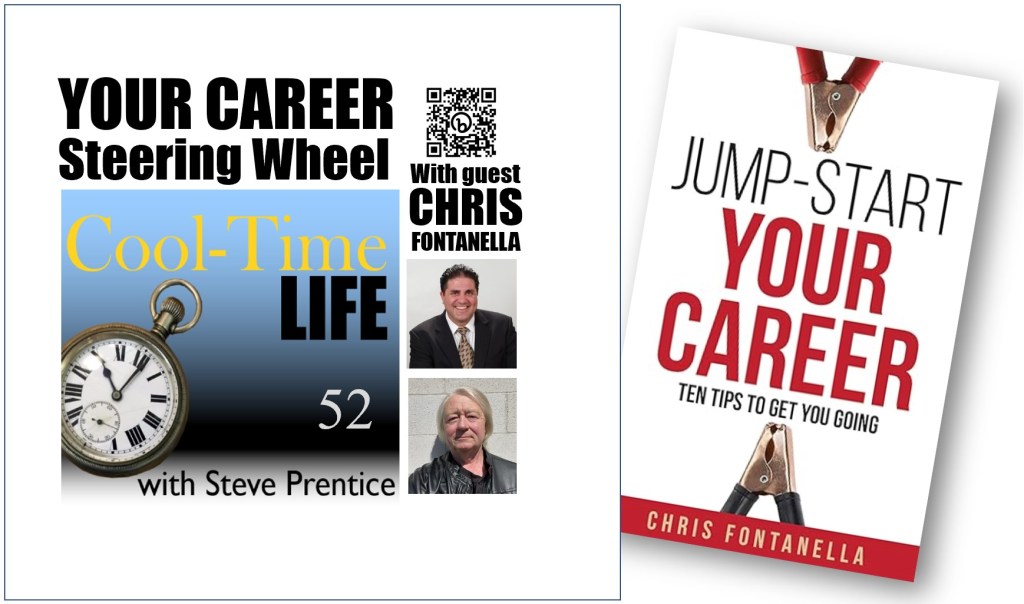
Listen to the podcast at our podcast host, Blubrry.com, or find it on your platform of choice, including iTunes, Spotify, Amazon, Audible, iHeart, and YouTube.
Visit Chris Fontanella’s website: chrisfontanella.com.
Transcript
Steve 0:06
A career never should be a clear, straight highway laid out by someone else for you to follow. This is increasingly true in this age where career mobility and self determination are more valuable and more appreciated than ever. But it does help to listen to trusted mentors and friends, people who have traveled this road themselves. There are so many additional items your passions, the people you meet, chance encounters and a commitment to your own self worth that are vital and easy items to pack for the journey. With that in mind, it is a pleasure to welcome Chris Fontanella, the founder of encore professionals group and author of jump start your career, 10 tips to get you going and tune up your career, tips and cautions for peak performance in the workplace. Because he is the person who says, Any job that doesn’t allow you to be you is not the job for you. I just love that idea, and I also agree with it. So it is my pleasure, my distinct pleasure, to welcome Chris to the CoolTimeLife podcast.
Chris 1:05
Thanks, Steve. It’s a pleasure to join you today.
Steve 1:08
So we are here to talk about, basically you your book and what you do, which is so useful and so valuable right now. So if I may just start by just asking you, if you want to just give us a just a summary of who you are, where you came from, what you do, and why you are doing it, we can start there. Then I’ll launch into the questions.
Chris 1:29
Thanks, Steve, yeah. My name is Chris Fontanella, and one of these guys that has an interesting background and career, actually spent nine years of my life studying for the ministry, felt a calling to be a pastor at one point in my life, and went to Oral Roberts University in Tulsa, Oklahoma, graduated from there, and then moved to California to go to fuller Theological Seminary, where I earned my Master’s of Arts in theological studies. Somewhere along the way, I decided that that was a path I no longer wanted to pursue, and I found myself wondering what I was going to do with myself. From a career standpoint, I spent a couple of years working in the banking industry. I worked for Bank of America in their corporate trust division, and lo and behold, one day, the chief operating officer had an all staff meeting and decided to let us know that the division we were in was being sold to a bank in Minnesota. So here I am, two years into wanting to be a banker, and now I’m being told I’ve got to move from Southern California to Minnesota. And no offense against Minnesota, but I just did not want to move to Minnesota when I was living in California, so I literally went back to my office after that meeting and looked in the want section the want ads of the newspaper, and saw a job description, or actually a job notification, saying, seeking managers call this phone number, call that phone number, and I end up speaking with the head guy of the Pacific Region for Robert Half International, which was is one of the largest staffing firms in the world. And he scheduled an appointment for me with a manager of their downtown Los Angeles branch, and I went, met with her, and ended up being this fantastic interview. I was fortunate enough that the person who interviewed me realized that there were transferable skills from not only the leadership skills I was learning at the bank, but all the years I spent studying for the ministry, because she just was convinced that an message was important to me, having a message and delivering a message was important to me, which obviously that’s why I wanted to be a pastor. And she said, Well, why don’t you make the service offerings of Robert Half your new message that you share with people I don’t know in my naivete, that made sense to me. So I accepted the job, and lo and behold, what ended up happening is I’ve been in the staffing industry for 30 years now because I fell in love with the business. I love the idea of helping a candidate find a job, and helping a client find a candidate, and bringing the two together. And so here I am. I’ve started two businesses, and now I’m writing books about how to help people in their career development.
Steve 4:15
That’s a wonderful story in itself. But again, there’s a learning moment there that people can take right from that. And that is what was seen there, is that you have a skill for delivering a message. You know, passion for a message. It’s a transferable skill, which I think we will get into that as we talk through here is people sort of deciding, you know, how do I define myself? What do I do? Or what am I set up for? So often, you can find that there are these things that have drawn you in one direction, that actually can take you in another direction, because it is, in your case, the passion for delivering a message and that is applicable to other areas. So that kind of self discovery that people can have, if they take a moment to look at not defining themselves in a particular career path, but saying, These are the things that I can do or I’m passionate about. It’s always delightful for that kind. Opportunity to arise, that light bulb to go on. So here you are now helping people in their lives, understanding more about their career paths, perhaps or even their sense of presence, their sense of purpose, one of your most significant messages today for people of any age or any specific age. You know, what do you now teach in terms of your message towards people and their careers and their lives?
Chris 5:25
Yeah, the main message I’ve been trying to tell people is that it’s super important to take ownership of your career. I mean, there’s, there’s a lot of stuff that happens along the way, right? We’re and if we look at it like we’re on a career journey, you have to imagine that there are different things that are going to happen throughout that span of time, and you can be like a person who just wants to blame others because you’re losing your job, or the corporation is relocating your job somewhere else, or outsourcing it to another country or another company. I mean, there’s just a zillion things that can happen, but what you can always do is be in control of your own destiny. So to speak, you can always take control of your own career and the next steps that you’re going to make. And so I’ve been really strongly encouraging people to grab the steering wheel of their career vehicle and hold on with both hands and take it where you want to go.
Steve 6:27
Do you find that the time we’re in today is more optimistic or more providing more opportunity for people than perhaps, let’s say, 10 years ago, or even the pre pandemic? What’s the status of the time in which we are now living, with regards to people’s opportunity to take that steering wheel and drive it where they want?
Chris 6:44
Yeah, I mean, I could imagine that a lot of people would not be very optimistic about today’s working world and the macroeconomic conditions that are sort of looming overhead with AI and tech layoffs and such. It’s hard. It would hard, be hard to be optimistic, but optimism is a point of view, right? And people can learn to see opportunities within challenging situations and challenging events. And personally, I believe there’s, there’s always going to be a need for talent and people who bring something to the table. And that’s, that’s what I would, I would emphasize with people, is that you’ve constantly got to be someone who’s bringing something to the table, or becoming someone who’s bringing something to the table. And if you’re one of those individuals, someone will always be willing to find a seat for you at the table because you’re bringing something to it.
Steve 7:42
Oh, beautifully put, absolutely, one of the examples that I’ve been using in speaking about the same kind of thing with people who are responding right now to saying, Oh, this is a terrible time. AI technologies and chat GPT are going to take away all the jobs. Is, again, just to redefine what jobs actually are. And we can go back 100 years to when the automobile came out and everyone was saying, Well, you know, there goes my career as a horse, you know person, but the capacity for what you do, whether you use horses or cars, can still translate. And so I totally agree with what you’re saying is that those transferable skills, again, even in these times, as you were saying before, that it’s hard to be optimistic. Crisis and opportunity are two sides of the same coin, and when you can see opportunity come from the scenarios right now, that’s something that’s inside people. So I love what you’re saying, and I totally agree.
Chris 8:30
I mean, I agree 100% with what you just said. And the thing is, like training yourself or teaching yourself to see those opportunities within those unexpected events that pop up in your life, whether on a personal level or at the job, right? Like I was, I was working at that Bank of America in their corporate trust division, and if I could expand upon the story I’ve already referenced, on a particular Friday, the chief operating officer came out and announced how happy the bank was with the with our division, because we were adding money to the bottom line. We were highly profitable, and the bank loved us. And then, literally, the next Friday, the chief operating officer had another staff meeting, and he said, we just sold the corporate trust division to a bank in Minnesota, and you have a year to figure out if you want to stay with the bank your job will be in Minnesota or, you know, start looking for a new job. But in that unexpected event, I started to peer through it and go, Okay, you know, what do I want to do here? Where do I want to take my career vehicle? Do I want to take it to Minnesota and continue to build upon the level of management and move up the food chain, you know, but I’m going to be living in Minnesota now, or is this an opportunity that’s pushing me outside of the company I’m already working for to find something new for myself? And I chose the latter, and that ended up being the best move for me, because it threw me in. To the staffing industry in the consulting world, and I fell in love with it, and here I am, 30 years later, still doing it.
Steve 10:07
That’s beautiful. So you’ve got the that internal drive. You ask that, you ask yourself that internal question, what do I want to do? And you’re totally right. I mean, people are sort of conditioned from early years in school to say, get a good job so that you can buy a house and all that kind of thing. But that good job is only as secure, as you said, as the next board meeting to say, well, basically, we’re all team. We’re all a team here, except you guys who are now going to be fired, and that that happens over and over again. You know, companies are designed to make money, and therefore they’re going to use and remove assets as needed, which sounds rather cynical, but it is, indeed that’s what we are when we join something like that, and it’s just the way we have been conditioned. Yes, I hear in your voice, as you’re describing this, that internal fire of self determination that you are responsible for your own destiny and you are going to take that and that’s the kind of message that I’ve always wanted to have people understand, is that it’s not a matter so much of finding a job, filling a seat somewhere, a vacant seat on a in a company as it is, creating your work and creating your destiny. So my next question to you is, how important, in addition to that internal fire, that internal self permission, people might have to do that, what about a network? How important do would you say is a network of professionals and other people to somebody’s steering wheel for their career vehicle.
Chris 11:25
Yeah, I mean networking is critical to your career development. I’m a big believer in not underestimating the value of encounters and people you meet. I could look back over my life and my career, and I have a small handful that directly impacted the trajectory of my career. And this goes way back to when I was a troubled youth getting in trouble in New Jersey, and mine was a misspent youth, and I was a little lost, just as a person, and I ended up meeting a youth pastor who believed in me and believed that God had something more important for my life, and I believe that as well, and that kind of set my path on a set my feet on a better path, right there, then, when I met this lady at Robert Half who saw something in me that I didn’t even see in myself, and that was that all the things I was learning to be a minister could be converted into being a sort of a mediator between a candidate looking for a job and a client looking for a job. That opened up a whole new world to me from a career standpoint, and then another person that I met working for a company ended up being a business partner with me when I started my first my first business. And I had always thought about doing that, but I was probably a little fearful to do it on my own. And she called me at just the right time when I was in between jobs, or I was at a job and I wasn’t happy with it, and I’m like, I know this. I’m not a good fit with this organization, and I need to leave. And as I’m thinking these thoughts, she called me and said, I’m thinking about starting my own business in the staffing industry. You were the top producer at the company we worked for and in Los Angeles, and I was the top producer in the office in Orange County. What do you think about joining our forces and starting a kick ass business? And I thought, Man, that’s great. And so you know, my encounter with her ended up leading into a whole world of entrepreneurship for myself. So you know your encounters and your networking and the people you meet, and where those relationships could potentially take you. unlimited. It’s such a mutually beneficial thing too.
Steve 13:45
I mean, it can help you or me in terms of exactly that, that chance encounter with the right person at the right time. If it wasn’t the right time, it could have just kept on going your different directions. But it was the right time, the synergy was there. But also on the other side, what you can do for other people as well. There’s this remarkable capacity for just simply helping others, just in terms of putting someone in touch with somebody else. When I started my career, I was a university student. I was studying law, actually at the time, and I knew that wasn’t my line of work. I didn’t like that at all. And I was working for Kelly Services, which was a staffing company doing computer based stuff. This is way back when computers were floppy disk driven type things. But, you know, I would basically say, give me a week’s work doing something. And the worry my traditional friends and my parents would say was, what happens after that week is over? Now, what are you going to do then? And you know, every one of these assignments grew into multi month things, and when, when they came to an end next Monday, there was something else. So I’ve always loved the freelance lifestyle, because it’s an extension of what you’re saying. You make your own luck as you not only do these kinds of jobs and continue to do them, but you’re in control of that. And I’ve just found that from that people that I met working on these gigs. Gig economy became clients and remain clients to this day, 30 years later, because of I met at that time, so it is a wonderful way to again find that road, as well as driving the vehicle. So shout out to Robert Half. I believe strongly in staffing organizations, because they do great work again, for people who have that vision for their own self determination.
Chris 15:20
Yeah, a lot of people don’t realize that being a consultant or a temporary employee can be an alternative career track for their life. There can be some scary moments if you’re in between assignments, right? And you’re like, oh, man, because you only get paid when you’re working, although there are some staffing agencies that will put you on salary, and you continue to get a paycheck while you’re on the bench, and the onus is on them to, you know, find your next home for the company to start making their their money. But it’s a beautiful thing, and it does allow you to sort of control your destiny and take control of your your career. So obviously, I’m in the industry for 30 years now. I love it, and I only have positive things to say about it.
Steve 16:06
Do you recommend people use LinkedIn? Is it an application that you favor, or do you have other alternatives for building a network?
Chris 16:13
Yeah, I love LinkedIn. I think it’s probably one of the more professional ones out there, out of all that’s available. But what I don’t like about all of that is, is how, to a certain extent, times have changed and and for what we do, things have become a lot more transactional and less relational. And I love the personal connection thing I love getting to, you know, have a relationship with a candidate that I can represent somewhere. And a lot of that sort of thing is going away because of technology. A lot more is just done online. Submit your resume online. A lot more what I’ve noticed, a lot more clients are going toward vendor management systems where even even staffing firms or consulting firms like mine, they’re just being asked to dump a resume into this vendor management system, and it’s it’s sort of scrubbed so that the hiring managers don’t really know where the resume is coming from or who it’s coming from, what company, what person, and so a lot of the relational side of the business is sort of being wiped away. And I just don’t think that that’s the best way to do the business, and I don’t think that’s the best way to find the right candidate for an open job.
Steve 17:35
So your preference, then, is to reinstate the relationship component, right? Have a much more human relationship. Is that what you’re saying?
Chris 17:43
Yeah, absolutely, because, and I’m just looking back over my 30 year career, some of the best placements I’ve made were when I had a conversation with a client or a hiring manager and I and I say to them, Look, this candidate I’m presenting has maybe six out of 10 things that you’ve got listed on your job description, but let me tell you why I think they’re the right person for the job. And I talk to the client about the candidate, and I incorporate a lot of what I’ve learned about that person, and talk about who they are as an individual, and that seems to have made the difference. And a lot of those people I’ve placed in jobs are still in those jobs because I took the time to make sure it was the right fit, not only for the candidate, but for the client as well. And when you subtract out that relational component, I think you’re doing your organization a total disservice the times we’re in right now.
Steve 18:43
One of the things that has come up in the working environment is called the Great resignation. What are your thoughts about that? Is it still an ongoing thing? And what do you think caused that, and what can we do about it? Yeah, so
Chris 18:55
I mean, that’s kind of when employees were resigning in mass, right? And a lot of it was based off of like wage stagnation, limited opportunities for career advancement. Maybe there’s hostile work environment, lack of benefits, inflexibility around remote work scenarios and such. But for me, when you really sort of slice through it, what it all boils down to is that employees have felt a lack of respect, a lack of recognition and or a lack of rewards, and companies have not figured out how to make sure that they’re meeting those three requirements of employees. So I think to a certain extent, you’re always going to have people who are leaving jobs because of the absence of those things. But it’s always important for the the the employee to exit an organization as professionally as they’ve entered. It, and how you exit is something it’s. A lot about you and how you do it. And so, you know, if you’re going to be one of those people that are that are leaving an organization, you should take the time to think about how you’re going to leave it.
Steve 20:08
That’s a very good point. People don’t tend to think about that part so much. I mean, the first part of what you’re saying there is that people are kind of driven away from the work. They may have that internal fire or might not, but when the conditions make it necessary, they are driven away. And I’d also add to all the symptoms or causes you mentioned, there’s also the notion of caring for people, not only in the covid period, but just simply caring for elder or aging parents as well as children. There’s so many things that make it not worth it to come there. But a very, very good point about, you know, how you leave, because it’s your legacy which will continue to carry with you. Let’s look at a couple of age groups here. Let’s look at people who are, let’s say, in their 50s or 60s, even they see themselves still needing to work, but they may consider themselves to be too old to do this kind of stuff. Attitudes do change as people age. So what advice would you have for people in their you know, a couple of generations ago, in your mid 50s, there’s time to retire, but that’s not always the case for everyone any longer. So is that too old? You know, what can people of that age and stage also do to consider themselves to still be needed in the workforce?
Chris 21:09
Well, again, if we look at a career as a journey, right? And and career development has the word development in it, it means like there’s an evolution to it over time. And to me, what’s important for a person to be thinking about in their career from step one to the last step is is being true to yourself in it and and looking at the steps that you’re taking, and you can always there’s always another step to take if you want to take a step, but it’s about knowing yourself and being aligned properly with your job, to figure out what’s right for you at a particular moment in the process of your career and the evolutionary process of your career. So even if you’re older and maybe you’re in a job and you’re comfortable there, you know you’re getting a paycheck, you’re getting out of the house, you’re interfacing with other peers and employees, and that might be enough for you, and you realize that where you’re at in your life that works. But if something inside of you is saying, I just don’t feel aligned with what I’m doing right now. It’s it’s draining your energies, or it’s just not making you feel fulfilled in any capacity, then maybe you should be thinking about taking a step into something else. And that sort of mentality, to me, applies no matter what age you are, at the beginning of your career or at the end of your career, it’s, I think Phil, Phil Knight in his book shoot dog says something about it’s not that it’s about like a finish line. It’s that, you know, you define the finish line, you know. So it’s all a matter of how you’re framing things for yourself. And to me, that’s sort of what you should be asking yourself, no matter what stage you’re at in your career.
Steve 23:02
And in the same vein, for young people who are, let’s say, in their mid to late teens, they’re in high school, they haven’t had a chance to really experience life at all, and they’re under this pressure to define themselves at that point, you know, where do you want to go to university? What you’re going to do? What advice would you give to someone on the other end of this career line who hasn’t seen enough to really know who they are yet?
Chris 23:22
Yeah, yeah. They’re just starting out, so to speak. You know, I, in my book, I talk about mapping out your territory of exploration and sort of drawing out a map, or sketching out this map for yourself. And so many things come into play for what the lines of that map might be. It could just be your interest. It could be your courses of study. It could be your education, your experiences, your interest, what you do with your spare time, stuff from your background, like challenges you’ve had and, and how that has shaped you as a person, like, sort of sketch all those things out and, that sort of becomes your general X marks the spot where you should start to dig right and sort of then sort of throw yourself into that and grab your shovel and start digging. Now, you know that might not be the end all and be all of what your career ultimately becomes, but it at least pushes you in the direction of things that allow you to be true to yourself, right? Because these are your interests, these are your dreams. These are your desires. These are the things that are calling for your attention and what you like spending your time on. So at least you’re in the general vicinity, and you know you can always take the time to redefine the map lines, right? Like your first sketches are not always your final sketches, and that’s the great thing, but at least get busy digging in that area and then see what you uncover as you’re digging through but at least you know you’re in the area you want to be in.
Steve 24:54
My last question for you is regarding fear. That’s something that I focus a lot on, is people who fear change. They. Your risk. It’s one thing to fear losing the job that you have that you thought you’d be in for 40 years, but there’s also the fear of taking that leap, you know, going off and doing it for yourself. So what advice would you give to somebody who says, I agree with this, I would love to be able to do this, but I’m too afraid.
Chris 25:15
Yeah, I would say I appreciate what you’re saying. You know, we all struggle with those things, and it can be fearful. It’s a seems to me, it’s a matter of whether you want to be on the this, have the security of the shoreline, so to speak, or, you know, go, be, be willing to go for it, right and and cross the treacherous waters of the Atlantic to get to Europe, to see what Europe has for you, so to speak. It is hard. But I think if you were to ask all the people who asked themselves that question, do I want to be there on the shoreline, or do I want to cross the treacherous, treacherous waters and have done it, all of them would tell you unequivocally, it is worth it. And so, I mean, I guess I would just leave people with that. I know there’s, there’s a fear factor involved. I know it can be challenging. And trust me, you’re going to face a lot of difficulties, dark nights on the sea, rainy nights on the sea. But you know, if you stick with it, and you just keep going for it, and then you get to where, you know, the place that you’re dreaming about, you’re going to be happy you did it. There was a
Steve 26:30
quote by supposedly John shed who said, you know, a ship in a harbor is safe, but that’s not what ships were built for. And I always love that expression for that same reason, and you have been amazing as a an expert today, not only delivering such fantastic wisdom, but also to use the analogies of the ship, and also of having your hand on the steering wheel driving your own vehicle, which I think really helped to give people a sense of their own place on this road. So this is a lot of wonderful advice for people to take in and just address their fears or concerns or doubts, to say they can indeed take this path, and perhaps it would be the healthier of the two. It’s a smaller fear than that worry of always losing your job that comes with every career. Let’s talk about you and your books. Where can people find out more about you?
Chris 27:18
Sure, yeah, my books can be found on Amazon, but also, if you go to my website, Chris Fontanella.com you can, you can find my books there, and then just tap on a link and it’ll, it’ll take you to Amazon, where you’ll find the books as well. So I would say, check me out there. It’s Chris Fontanella.com C, H, R, i, s, f, O, N, T, A, N, E, L, L, a.com, I’m also on LinkedIn. I’m working on being on Instagram, doing my best. I’m a non techie sort of guy, but I’ve been working on that a little bit. And I’m also on Facebook.
Steve 27:58
Good, no, that’s excellent. So thank you also for spelling it out, and those those links will be in the show notes as show notes as well. But I think you have, well, I know you have delivered a great amount of very comforting advice for people who are probably thinking about this right now, no matter what age or stage they are at, there’s more than just hope. There’s there’s a real path there for them to create for themselves. And I think having people like yourself there as authorities or as as mentors to help them move along is extremely important and valuable. Thank you so much for giving us your time today and sharing your wisdom with us.
Unknown Speaker 28:32
Thanks, Steve, I really appreciate being on the show today.
Steve 28:36 Chris Fontanella is founder of Encore Professionals group and author of two books, jumpstart your career, 10 tips to get you going and tune up your career, tips and cautions for peak performance in the workplace. You can find out more at Chris Fontanella.com that’s C, H, R, i, s, F O, N, T, A, N, E, L, L, a.com and if you have a comment about this podcast, you can drop me a line through the contact form at cooltimelife.com where you can find my social media links. A full listing of our past episodes is available at Steve Prentice comm slash podcast. I do try to keep them evergreen, so that they stay relevant as times change. If you feel you are getting value from this series, please do leave a review and tell someone about us, and if you want, you can support us on Patreon. Contributions from our listeners allow me and my team to spend more time researching and preparing our podcast series. So if that feels fair to you, please visit patreon.com/cooltimelife, until next time, thanks for listening.
Thank you for visiting. Do you have comments or thoughts about this episode? Feel free to get in touch through our Contact page.
Tags/Keywords: career, networking, mentorship, life, Chris Fontanella
 CoolTimeLife